

AI Predictions for the next 10 Years: What experts actually say
The nearer the prediction, the more the data agrees. The farther out you look, the more even top researchers are just guessing, and saying so.
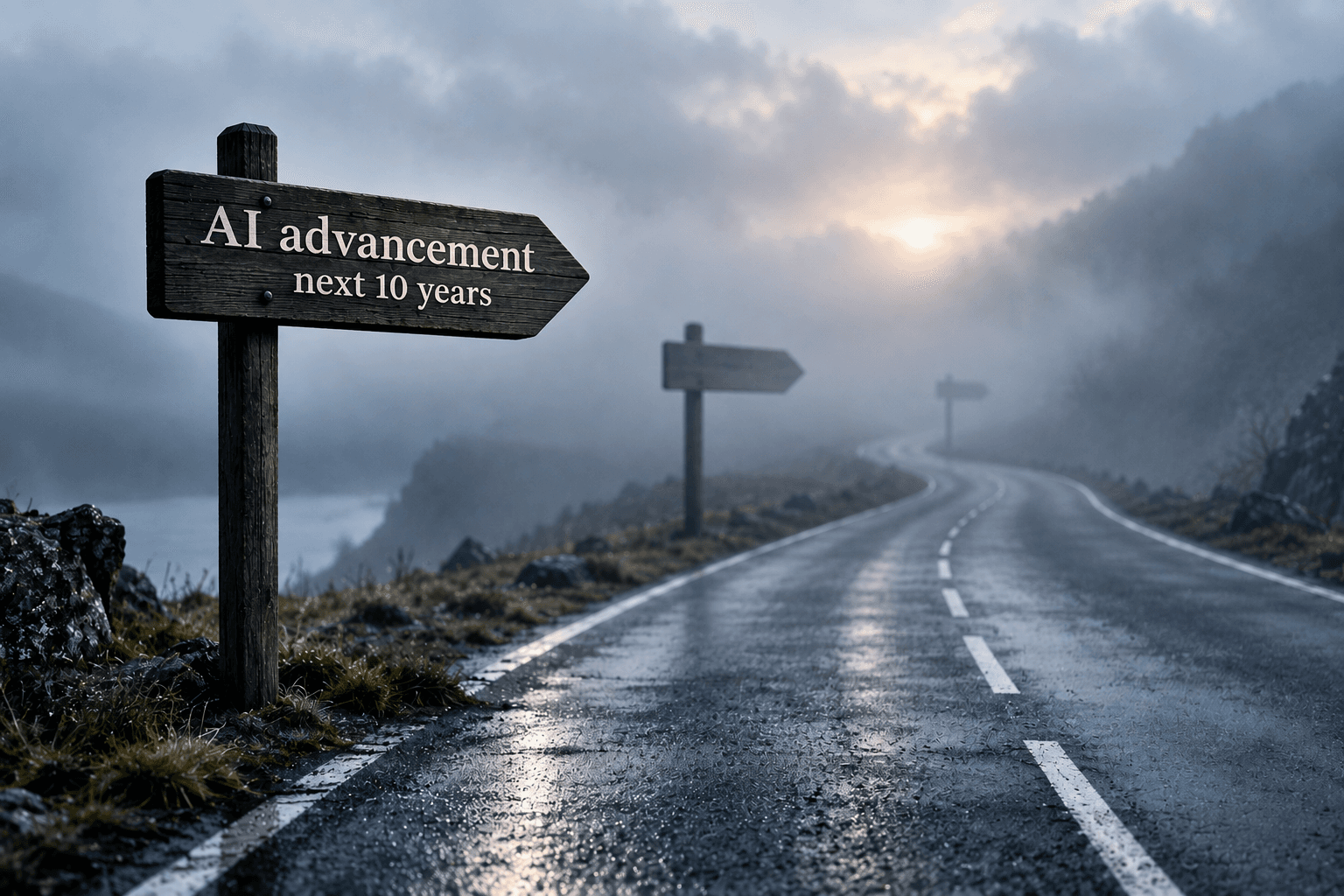
Ask an AI researcher what happens in the next 12 months and they'll show you a chart. Ask what happens in the next 10 years and the same researcher will often shrug, or worse, hand you a confident number that another equally credentialed researcher flatly contradicts.
That's not a communication problem. It's the actual shape of what's currently known.
Three time horizons, three completely different kinds of answer: near-term projections built on measured trends, mid-term forecasts pulled between two colliding forces, and long-term predictions that increasingly say more about who's making them than about AI itself. The nearer the prediction, the more the data agrees. The farther out you look, the more even the experts are just guessing, and the honest ones say so.
Stage One: What the Data Actually Shows (1 to 3 Years)
The closest-in predictions rest on the most solid ground, because they're extrapolations of a trend already happening rather than a guess about something new. The nonprofit research group METR tracks how long a task an AI system can complete on its own before failing, what it calls a "time horizon." In its January 2026 update, METR found that horizon has been doubling roughly every four months since 2023, faster than the seven-month doubling time measured over the years before that.
Separately, the research organization Epoch AI has tracked the computing power used to train the largest AI models, finding it has grown roughly fivefold every year since 2020. Epoch's own modeling projects the number of AI models trained above a specific massive-computation threshold to grow from around 10 in 2026 to over 200 by 2030, alongside a roughly tenfold increase in the electricity such training consumes.
Did You Know?
METR measures AI capability the way you'd measure a new hire's competence, not by a test score, but by how long a task they can be trusted to handle alone before needing a check-in. A model that can reliably work unsupervised for an hour today could plausibly handle a full workday's task within a couple of years, if the current doubling rate holds.
Both of these are measurements of what's already happening, not predictions about what's coming next. That's why researchers across the field, even ones who disagree sharply about the future, mostly accept them as a reasonable near-term baseline.
Stage Two: Two Forces Pulling Against Each Other (3 to 5 Years)
The next few years are where the confident charts stop and the real argument starts. Two trends are colliding, and which one wins matters enormously.
On one side: more raw computing power keeps arriving, and a technique called test-time compute, letting a model "think" longer before answering instead of just getting bigger, has opened a second lever for improvement that doesn't depend purely on adding more parameters.
On the other side: the internet's supply of new, high-quality human-written text, the raw material used to train these models, is running low. Epoch AI's own 2024 research estimated that public text data suitable for training could be largely exhausted as soon as 2026, a limit that has no obvious near-term substitute.
The result is genuine, public disagreement inside the field itself. One March 2026 survey of AI researchers, not yet independently replicated by a second poll, put the figure at 76 percent of respondents who now believe that simply making models bigger has stopped producing the gains it once did. That doesn't mean progress stops. It means the industry is betting heavily that new approaches, like test-time compute, can pick up where brute-force scaling leaves off, and nobody can yet say with confidence whether that bet pays off on schedule.
Stage Three: Where the Guessing Starts (5 to 10 Years)
This is the horizon where the disagreement stops being about data and starts being about worldview. Anthropic's Dario Amodei has stated the company's expectation that what it calls "powerful AI," systems with capabilities matching top human experts across most scientific fields, could arrive as early as late 2026 or 2027, while explicitly noting it could also take considerably longer. OpenAI's Sam Altman has written that AGI is "coming into view," and separately floated superintelligence, a step beyond AGI, arriving within roughly a few thousand days, putting his own estimate somewhere in the late 2020s to early 2030s.
Other credible researchers reject the premise entirely. Critics including cognitive scientist Gary Marcus and researchers at Apple have argued that the architecture behind today's leading chatbots hits real limits on reasoning and generalization that more scale alone won't fix, and that reaching anything like general intelligence will require ideas nobody has published yet.
Interesting Fact: Dario Amodei's widely cited "as early as 2026" prediction for powerful AI actually came with an explicit escape hatch attached from the start: he said it could happen that soon, but also said it could take much longer, and that he personally dislikes the term "AGI" for implying more certainty than the field actually has.
Both camps are looking at the same underlying AI agents and the same scaling curves. They're reaching opposite conclusions about what those curves mean once you project them far enough forward, which is exactly why this horizon deserves the least confidence of the three.
Knowlegic Perspective
There's a temptation to flatten all of this into a single number, an average of everyone's guess, or to just believe whichever voice sounds most confident. Both instincts miss what's actually useful here: the disagreement itself is information. It tells you which claims are backed by a measured trend and which are backed by a worldview about how intelligence works.
The honest way to read any 10-year AI prediction, including this one, is to ask which stage it's really describing. A claim about next year is probably a real trend. A claim about five years out is a bet on which of two forces wins. A claim about ten years out is, more often than the person making it will admit, a story about what they already believed before they started counting.
The nearer the prediction, the more the data agrees. The farther out you look, the more even the experts are just guessing, and the honest ones say so.
Sources & References
- Time Horizon 1.1, METR (2026)
- Measuring AI Ability to Complete Long Software Tasks, METR (2025)
- How many AI models will exceed compute thresholds?, Epoch AI (2026)
- Trends in Artificial Intelligence, Epoch AI (2026)
- What's up with Anthropic predicting AGI by early 2027?, LessWrong, corroborating and contextualizing Anthropic's own hedges (2026)
- Three Observations, Sam Altman's own blog, primary source for "systems that start to point to AGI are coming into view" (2025)
- The Intelligence Age, Sam Altman's own blog, primary source for the "few thousand days" superintelligence estimate (2024)
- The Illusion of Thinking: Understanding the Strengths and Limitations of Reasoning Models via the Lens of Problem Complexity, Apple Machine Learning Research, primary source for the architecture-limits argument (2025)
Enjoyed this?
Get notified when a new Knowlegic story worth knowing is published.


