

AI Songs Are Flooding Streaming Services, and Almost Nobody’s Listening
More than half of everything uploaded to one major music platform each day is now fully AI-generated. Actual listeners barely touch it. The reason those two facts coexist says more about fraud than about music.
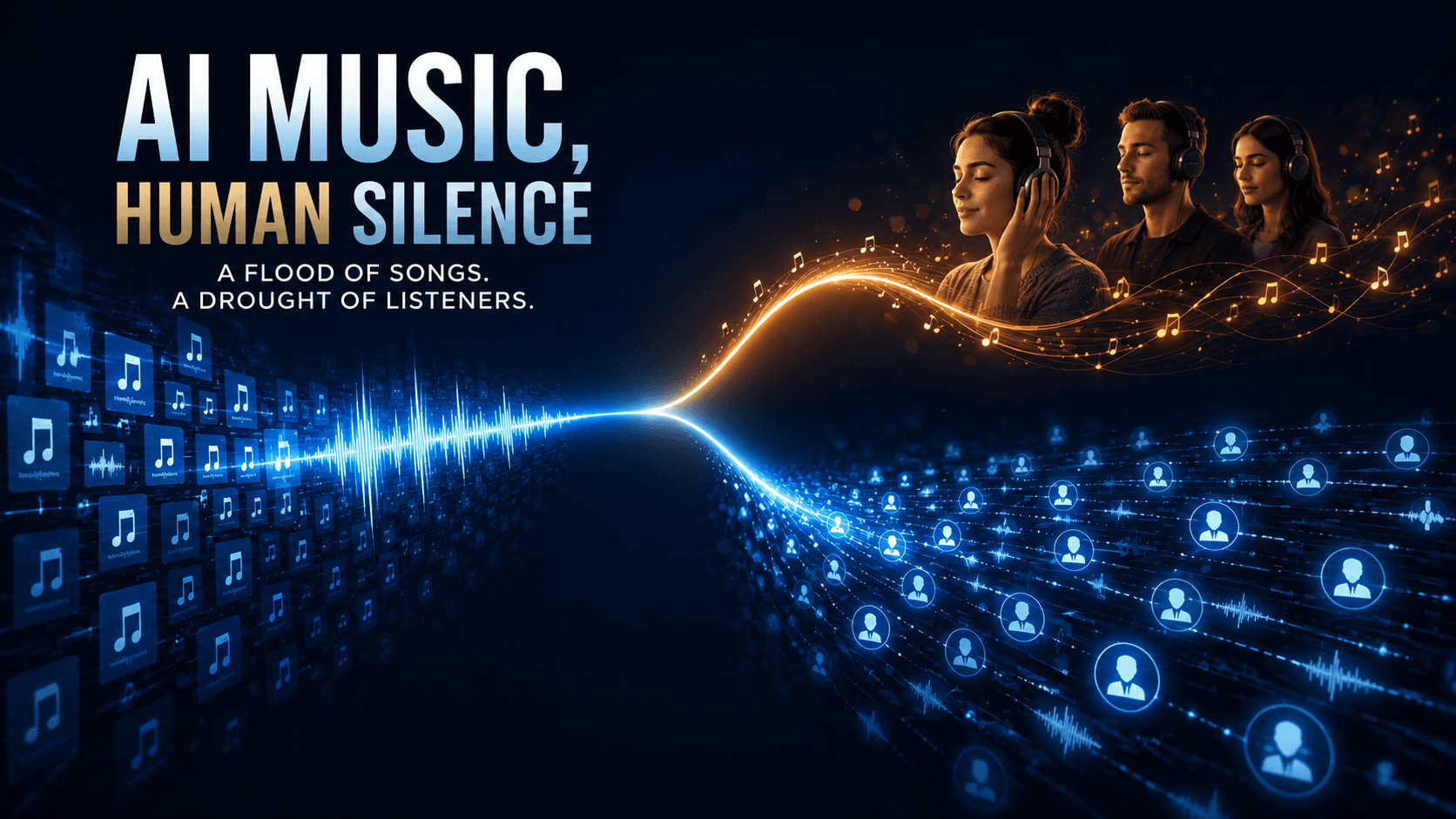
In January 2025, roughly 1 in 10 songs uploaded to Deezer each day was fully AI-generated. By the summer of 2026, that share had passed half more than 90,000 AI-generated tracks arriving every day.
If that sounds like a listening revolution, it isn't.
AI-generated tracks still account for only around 1–3% of Deezer's total streams. The interesting question, then, isn't why people suddenly love AI music.
It's where the streams those tracks do receive are coming from.
Deezer says up to 85% of streams on fully AI-generated tracks are detected as fraudulent and removed from monetization.
That changes the story completely.
The flood isn't primarily about machines replacing musicians. It's about what happens when music becomes almost free to produce while streaming systems still reward plays.
A Flood That Isn't About Taste
Open the upload dashboard at Deezer on an average day in mid-2026, and more than half of everything arriving is music no human wrote, performed or recorded.
Roughly 90,000 AI-generated tracks a day.
That number alone sounds like a listening revolution.
Millions of machine-made songs entering the world's music ecosystem every day.
But then you look at what people actually listen to.
The picture changes.
AI-generated tracks account for only around 1–3% of Deezer's total streams.
So there is a remarkable mismatch:
More than half of new uploads are AI-generated.
Yet:
Only a tiny fraction of listening is going to them.
That tells us something important.
The number of songs being created isn't necessarily measuring demand.
It may be measuring how cheap it has become to create supply.
And that distinction is where the story gets interesting.
Did You Know?
A 2025 Deezer and Ipsos survey played three songs, two AI-generated and one human-made to 9,000 people across eight countries and asked them to identify which were AI-generated.
97% couldn't correctly identify them.
The result suggests that AI-generated music can already sound remarkably convincing to listeners.
Where the Real Money Is
So why would anyone upload tens of thousands of AI-generated songs if barely anyone listens to them?
The answer begins with the economics of streaming.
Creating a song with AI can cost almost nothing.
Generating another song costs almost nothing.
And another.
And another.
The limiting factor is no longer necessarily the musician's time, recording budget or studio access.
The limiting factor can simply be how much music someone is willing to upload.
Now add a second ingredient:
streaming royalties.
Streaming platforms distribute money based partly on the number of plays songs receive.
That creates an unusual incentive.
If producing a song costs almost nothing, and generating streams can produce revenue, then producing enormous volumes of songs becomes cheap enough to experiment with at scale.
The song itself doesn't have to become popular.
The streams are what matter.
And some of those streams can be fraudulent.
Deezer says that up to 85% of the streams generated by fully AI-generated tracks are detected as fraudulent and therefore excluded from monetization.
That is the crucial number.
It suggests that a significant portion of the activity surrounding these tracks isn't genuine audience demand.
Think of it like a vending machine that pays out a small reward every time a coin is inserted.
If someone discovers that fake coins can be produced cheaply enough, the valuable thing isn't the product inside the machine.
It's the ability to insert more coins.
In this analogy:
AI-generated songs are the cheap vending-machine slots.
Fake streams are the coins.
And the royalty system is the machine paying them out.
Why Even Caught Fraud Still Matters
You might reasonably ask:
If Deezer catches up to 85% of fraudulent streams, what's the problem?
Detection helps.
But the economics of fraud create another problem.
Streaming royalties come from a shared pool.
When fraudulent streams escape detection, they can dilute the pool available to legitimate artists.
That means the damage isn't limited to the AI-generated song receiving the fraudulent plays.
It can affect everyone competing for the same pool of money.
This is why Deezer's investment in AI detection isn't simply about protecting the platform's reputation.
It's also about protecting the economics of the streaming ecosystem.
The company has an incentive to distinguish:
A real person listening to a song
from
a system generating artificial plays.
That distinction becomes harder when creating music itself becomes almost effortless.
An Industry Caught Between Lawsuits and Licensing
The fraud problem is only one part of the AI music story.
The other is much more complicated:
Who owns the music?
AI music companies have faced lawsuits from major music rights holders over the use of copyrighted recordings and other protected material in training and generation.
Universal Music Group spent more than a year in litigation with AI music generator Udio before reaching a settlement in October 2025 and moving toward a licensed AI music platform.
A separate lawsuit involving Suno remains part of the broader legal fight over AI-generated music.
But even settlements don't necessarily settle the underlying argument.
The American Federation of Musicians has sued major record labels, arguing that artists should receive a meaningful share of money connected to AI licensing arrangements involving their work.
That creates a complicated picture.
The music industry isn't simply deciding whether AI music should exist.
It's negotiating several questions at once:
What can AI systems learn from?
Who owns the resulting music?
Who gets paid?
How should AI-generated music be labeled?
And how do platforms distinguish genuine listeners from artificial streams?
The technology is moving faster than the answers.
The Strange Economics of Infinite Music
There is something fundamentally different about AI-generated music compared with earlier technological changes in the music industry.
A human musician has constraints.
They have time.
They have energy.
They may spend days writing a song, weeks recording it and months trying to build an audience.
AI can compress much of that process.
One person can potentially generate thousands of tracks.
That changes the economics of abundance.
When creating something becomes almost free, the number of things created can explode.
We have seen similar patterns elsewhere on the internet.
Cheap storage produced enormous amounts of digital content.
Social media made publishing almost free.
Generative AI has made producing text, images, video and music dramatically cheaper.
The result is not necessarily that people consume proportionally more.
Instead, the world becomes flooded with more supply than human attention can possibly absorb.
And human attention remains scarce.
That's why the headline number, 90,000 AI songs a day is both impressive and misleading.
There can be millions of songs without millions of listeners.
The Real Problem Isn't AI Music
This is where the story becomes bigger than music.
AI didn't invent streaming fraud.
It didn't invent fake engagement.
It didn't invent people trying to exploit payment systems.
What AI changed was the cost of attempting it.
If creating one song costs almost nothing, someone can create ten thousand.
If generating variations costs almost nothing, someone can create a hundred thousand.
The technology lowers the barrier to production.
That creates opportunities for legitimate creators.
But it also creates opportunities for people looking for weaknesses in the system.
And this is likely to become a much broader problem.
Imagine a future where AI can cheaply produce:
- Songs
- Videos
- Articles
- Podcasts
- Images
- Reviews
- Social posts
- Software
The internet could soon contain far more content than humans could ever meaningfully consume.
At that point, creation stops being the scarce resource.
Attention becomes the scarce resource.
And systems that reward attention will become increasingly valuable targets for manipulation.
The Next Battle Is About Trust
This is why the AI music story shouldn't be reduced to:
"AI is replacing musicians."
The evidence doesn't show that.
People are still listening overwhelmingly to music that isn't fully AI-generated.
The more immediate problem is different.
Can digital platforms tell the difference between genuine human interest and artificially generated activity?
That question extends far beyond music.
A fake stream is one example.
A fake social-media engagement is another.
A synthetic review.
A fabricated podcast download.
An automated video view.
An AI-generated article designed purely to attract advertising.
The underlying problem is the same:
When producing content becomes almost free, how do we know whether attention is real?
That's a much bigger question than whether AI can write a good song.
Knowlegic Perspective
It's tempting to read this as a story about AI replacing human musicians.
That's not quite what the numbers show.
Listeners aren't suddenly abandoning human-made music for machine-made songs.
The more accurate story is about incentives.
When something costs almost nothing to produce and a system rewards raw volume of plays, someone will eventually try to generate volume without generating genuine interest.
AI didn't create music fraud.
It simply made the cost of attempting it fall dramatically.
And that distinction matters.
Because the same pattern could appear anywhere AI makes production effectively unlimited.
The challenge for digital platforms may therefore shift from:
"How do we create more content?"
to:
"How do we determine which activity represents a real human?"
That may become one of the defining problems of the AI internet.
A large part of it appears to be driven by an economy where AI makes music almost free to produce, while fraudulent streams can still exploit the way digital royalties work.
And that points to something much bigger than music.
When creating something becomes almost free, proving that someone actually cared about it may become the valuable part.
Enjoyed this?
Get notified when a new Knowlegic story worth knowing is published.


