

Can AI Diagnose Better by Disagreeing With Itself?
When one AI makes a confident diagnosis, another AI can challenge it. The surprising result: sometimes the disagreement catches what the first model missed.
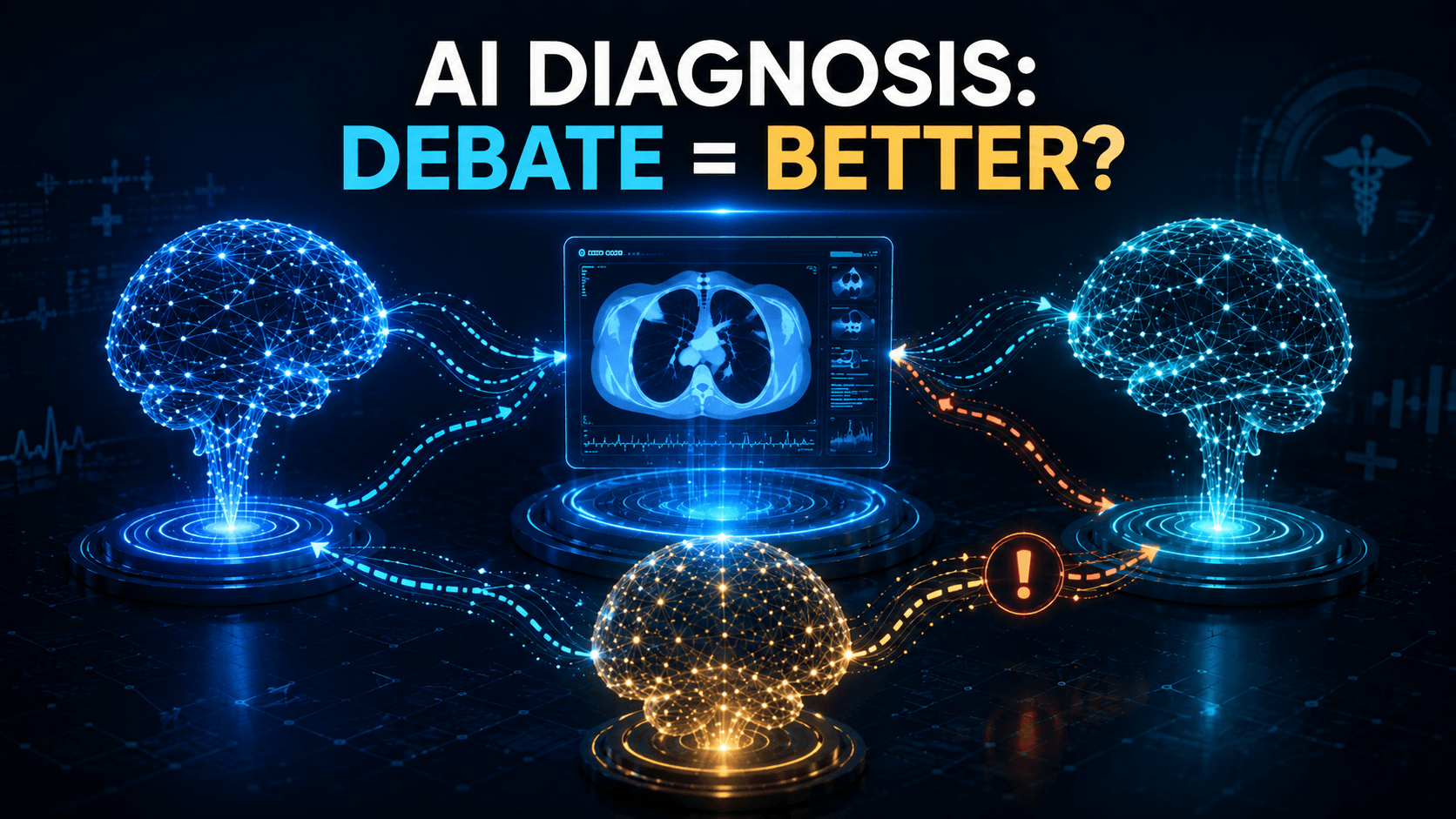
Doctors know an uncomfortable truth about diagnosis: the first plausible explanation can be surprisingly hard to let go of.
A patient arrives with symptoms. A doctor forms an initial hypothesis. New evidence appears and instead of starting from scratch, the brain often tries to fit that evidence into the story it has already built.
Psychologists call this anchoring.
AI models can fall into a similar trap.
So researchers are testing an unusual solution:
Don't ask one AI to think harder. Ask several AIs to disagree.
One model proposes a diagnosis.
Another challenges it.
A third looks for evidence both may have missed.
The system then compares the arguments before producing a final answer.
Early research suggests this can improve diagnostic performance, particularly for difficult and rare cases. But there is a catch that makes the story much more interesting:
A group of AIs can also become a very confident groupthink machine.
The real breakthrough, therefore, may not be simply getting AI to argue.
It may be learning which disagreement deserves to win.
The Human Bias Hiding Inside a Diagnosis
In 1974, psychologists Amos Tversky and Daniel Kahneman demonstrated how surprisingly powerful an irrelevant first number can be.
Participants watched a wheel stop on either 10 or 65. They were then asked to estimate the percentage of African countries in the United Nations.
The wheel had nothing to do with the answer.
Yet people who saw 65 generally gave much higher estimates than people who saw 10.
The random number had become an anchor.
Reference: Tversky and Kahneman's original research
The same basic problem can appear in medicine.
A doctor sees a patient's first symptoms and develops an initial explanation.
That explanation becomes the starting point for everything that follows.
Sometimes the first diagnosis is correct.
Sometimes it isn't.
But once an idea is established, contradictory evidence can become harder to interpret objectively.
Now researchers are discovering that AI systems can face a surprisingly similar problem.
What If the AI Had to Argue With Another AI?
Imagine asking one AI:
"What is the most likely diagnosis?"
It produces an answer.
Now imagine instead giving the same case to several AI agents.
One says:
Diagnosis A.
Another responds:
"I'm not convinced. What evidence rules out Diagnosis B?"
A third says:
"You're both overlooking this symptom."
The agents examine each other's reasoning, challenge assumptions and revise their conclusions.
Only after several rounds does a supervising system produce the final differential diagnosis.
This is known as multi-agent debate or multi-agent conversation.
The idea isn't completely new.
In fact, it resembles something medicine already does.
For difficult cases, specialists may discuss a patient together in a multidisciplinary team or seek a second opinion.
The difference is speed.
An AI system can create several analytical "voices" almost instantly.
The First Experiments Were Surprisingly Promising
Researchers at MIT and Google DeepMind explored this idea beyond medicine.
Their multi-agent debate approach gave several language-model agents the opportunity to propose answers, critique one another and revise their reasoning before reaching a final response.
The researchers found that this process could improve factual accuracy and reasoning compared with a single model answering alone.
Reference: Read the MIT CSAIL research overview
That raised an obvious question:
If AI can improve by debating difficult questions, could the same approach help with medical diagnosis?
Researchers began testing exactly that.
Give the Diagnosis to a Team
One of the more interesting studies appeared where researchers created a Multi-Agent Conversation (MAC) system that simulated a clinical team.
Instead of relying on one AI, the system used multiple "doctor" agents plus a supervising agent.
Each doctor agent could:
-
Propose possible diagnoses
-
Critique another agent's reasoning
-
Identify missing information
-
Suggest additional tests
-
Revise its own position
The supervisor then guided the discussion and helped determine when the system had reached a sufficiently strong conclusion.
The researchers tested the system on 302 rare-disease cases using GPT-3.5 and GPT-4-based configurations.
The multi-agent system outperformed the individual models on diagnostic accuracy and recommended follow-up tests in the study's simulated consultations.
Reference: Read the study in npj Digital Medicine
But there's an important qualification.
These were curated cases and simulated consultations not doctors using an AI debate system on real patients at the bedside.
That's a significant difference.
When the Disease Is So Rare That Everyone Misses It
Rare diseases create an especially difficult diagnostic problem.
A patient may spend years visiting different specialists before receiving the correct diagnosis.
This is where another 2025 research project produced a particularly striking result.
Researchers developed MD2GPS, a multi-agent system designed to reason about Mendelian diseases—conditions caused by changes in a single gene.
Instead of relying on one reasoning process, the system used separate data-driven and knowledge-driven agents and allowed them to debate the diagnosis.
Across 1,185 cases from four datasets, the researchers reported that average Top-1 diagnostic accuracy increased from 42.9% to 66%.
In a particularly difficult group of 72 unresolved cases, the system identified potentially pathogenic genes in 12 patients and reported a roughly 90% reduction in diagnostic time.
That sounds extraordinary.
But there's a crucial sentence that should always accompany numbers like these:
This was a research study, not evidence that patients should currently hand their diagnosis over to an AI debate panel.
The results need independent replication and real-world clinical validation.
Reference: Read the MD2GPS research paper
Here's the Interesting Twist: Different AIs May Be Better Than Identical AIs
You might assume that the solution is simply to run the same AI several times.
But there's a problem.
If three copies of the same model share the same blind spot, they can make the same mistake three times.
They may even reinforce one another.
That's why newer research is exploring mixed-model teams.
A 2026 study by researchers from MIT and Harvard Medical School compared single models, same-vendor multi-agent teams and mixed-vendor teams using models from OpenAI, Google and Anthropic.
The mixed-vendor teams consistently outperformed the single-vendor configurations on the evaluated clinical benchmarks.
The researchers suggest that different models bring different "inductive biases" and therefore may catch errors that another model misses.
That creates a fascinating possibility:
The best AI diagnostic team may not be five copies of one brilliant model.
It may be several different models with different strengths and weaknesses.
But More Voices Don't Automatically Mean Better Decisions
This is where the story takes another turn.
Imagine five people sitting around a table.
Four agree.
One disagrees.
Who is more likely to be heard?
Usually, the four.
Now imagine the lone dissenter actually has the correct answer.
A majority vote would produce the wrong result.
Recent research on multi-agent AI debates has identified exactly this type of failure.
A 2026 preprint called Minority Sentinel examined situations where heterogeneous AI agents disagreed. The researchers reported that in roughly one in four divergent cases, the minority position was actually correct.
Their work explores whether a separate system can identify when the minority opinion deserves another look rather than automatically accepting the majority.
This matters enormously in medicine.
Because the rare diagnosis is often the one that doesn't look like the majority answer.
The Real Challenge Isn't Getting AI to Disagree
It is tempting to think the future looks like this:
AI 1 → Diagnosis
AI 2 → Challenge
AI 3 → Challenge
AI 4 → Final answer
But the harder problem is deciding:
Who should we believe when the AIs disagree?
A debate system needs more than multiple opinions.
It needs a way to evaluate evidence.
It needs to recognize uncertainty.
It needs to preserve minority viewpoints.
And it needs to know when it simply doesn't have enough information.
That last point may be the most important.
A good medical system shouldn't always produce a confident answer.
Sometimes the best answer is:
"We don't know yet. These are the tests that could help distinguish between the possibilities."
That is much closer to how good clinical reasoning actually works.
AI Isn't Replacing the Doctor in These Studies
There's another distinction worth making.
These experiments are primarily testing whether multi-agent reasoning can improve diagnostic support.
They are not demonstrating that AI can independently diagnose and treat patients.
And broader research into AI clinical decision support continues to emphasize validation, safety and careful implementation before such systems can be trusted in routine care.
That matters because a diagnosis isn't just a reasoning problem.
It can involve:
-
Missing information
-
Physical examination
-
Patient history
-
Test quality
-
Clinical context
-
Risk tolerance
-
Communication
-
Ethical judgment
An AI debate can help analyze information.
It doesn't automatically acquire everything a physician knows by being in the room with a patient.
The Medical Version of "Second Opinion"
This may be the simplest way to understand the entire idea.
When a doctor says:
"I'd like another specialist to look at this."
they aren't necessarily admitting they are bad at diagnosis.
They're recognizing something fundamental:
Different perspectives can expose blind spots.
AI debate is essentially trying to automate part of that process.
One AI produces a hypothesis.
Another challenges it.
Another looks for overlooked evidence.
Another may deliberately search for alternatives.
Then a supervisor—or eventually a human clinician—decides what deserves attention.
The goal isn't more AI.
The goal is better reasoning.
Knowlegic Perspective
The most interesting thing about these experiments isn't that AI models are becoming "smarter."
It's that the process around the model can change its performance.
The same underlying intelligence can behave differently when forced to:
Explain → Challenge → Reconsider → Compare → Decide
That's a powerful idea.
Medicine has used versions of it for decades through second opinions, specialist consultations and multidisciplinary teams.
AI simply makes it possible to run many of those perspectives at machine speed.
But there's an important lesson hiding in the failure cases too.
Disagreement only helps if the disagreement is allowed to survive.
A system that automatically chooses the majority can turn several independent opinions into one very confident mistake.
The future of medical AI may therefore depend less on creating a single model that is always right and more on building systems that know when to question themselves, when to listen to a minority view, and when to ask a human.
The cure for one confident opinion isn't necessarily a smarter opinion.
Sometimes it's a second one.
And sometimes it's a third.
The fascinating possibility with AI is that those additional perspectives can be generated almost instantly.
But the real breakthrough won't come from making machines argue for the sake of arguing.
It will come from making them disagree intelligently.
Because the hardest medical cases aren't always the ones where nobody knows the answer.
They're often the ones where the correct answer is hiding behind a convincing wrong one.
And in those moments, the most valuable AI may not be the one that speaks first.
It may be the one that says:
"Wait. What if we're wrong?"
Enjoyed this?
Get notified when a new Knowlegic story worth knowing is published.


