

Can AI Tutors Replace Human Teachers?
AI can explain, repeat, adapt and practice with a student endlessly. But teaching involves something much harder to automate: knowing what a particular student needs next.
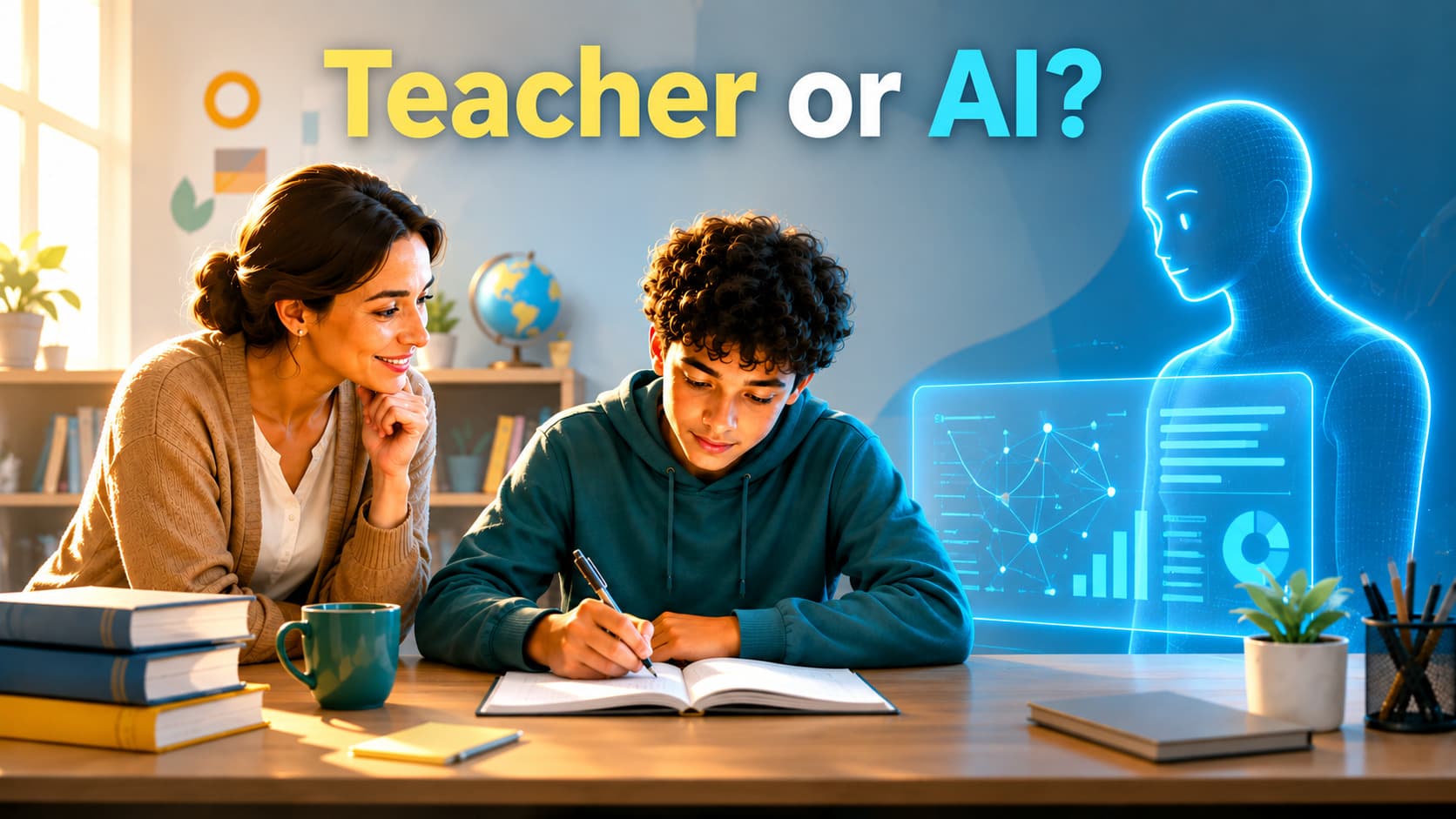
For decades, educators have known something frustratingly simple: one-to-one tutoring works remarkably well.
The problem was never whether personalized tutoring helped.
The problem was whether the world could afford to give every student a personal tutor.
Then came generative AI.
Suddenly, a student could open a laptop and have something resembling a personal tutor available at any hour.
A 2025 randomized controlled trial published in Scientific Reports found that students using a carefully designed AI tutor learned significantly more in less time than students receiving an active learning classroom lesson.
In Nigeria, a World Bank randomized trial involving 800 secondary school students found that six weeks of an AI-supported after-school program produced learning gains equivalent to roughly 1.5–2 years of typical schooling. Crucially, the program was implemented with teacher support.
So, is the answer finally here?
Not quite.
The research points to something more interesting:
AI may not replace the teacher. It may change what the teacher spends time doing.
The Problem AI Is Trying to Solve Is 40 Years Old
In 1984, educational psychologist Benjamin Bloom published a paper that became famous as the “Two Sigma Problem.”
Bloom compared different approaches to learning and found that students receiving individual tutoring could perform dramatically better than students taught through conventional classroom instruction.
The idea was powerful.
Imagine one teacher who could constantly adjust to one student's needs:
Too easy? Let's go deeper.
Still confused? Let's explain it differently.
Making the same mistake? Let's stop and work on that.
Ready for more? Let's move ahead.
That's what a great tutor does.
But giving every child that level of individual attention would require an enormous number of teachers.
Bloom's problem was therefore not really:
“Does tutoring work?”
It was:
“How can we make personalized learning scalable?”
For decades, technology tried to answer that question.
Generative AI suddenly made the answer much more plausible.
Did You Know?
Bloom's original paper was published in Educational Researcher in 1984. More than four decades later, AI tutoring is being tested against exactly the problem he described: how to bring some of the advantages of individualized instruction to many more learners.
Then AI Tutors Arrived
A traditional textbook gives every student roughly the same explanation.
An AI tutor can respond differently depending on what the student asks.
A student might say:
“I don't understand this.”
The AI can try another explanation.
“Can you give me an example?”
It can generate one.
“Explain it like I'm 10.”
It can simplify the language.
“Give me another question.”
It can create practice.
That combination of patience, personalization and availability is what makes AI tutoring so interesting.
But there's an important distinction.
A chatbot that answers questions is not automatically a good tutor.
A good AI tutor needs to understand how learning works.
And that's exactly what the strongest research is beginning to show.
What Happens When AI Is Designed to Teach?
One of the most interesting studies came from researchers at Harvard.
Published in Scientific Reports in June 2025, the randomized controlled trial compared a custom AI tutor with an active-learning classroom experience in an introductory physics course.
The AI tutor wasn't simply a chatbot thrown into a classroom.
It was deliberately designed around established teaching principles, including active learning, scaffolding, cognitive-load management, timely feedback and self-paced learning.
The results were striking.
Students using the AI tutor demonstrated significantly greater learning gains and spent less time on the learning task.
That sounds like the moment AI wins.
But look more closely.
The important part wasn't simply:
“AI is better than teachers.”
It was:
“AI can be remarkably effective when it is designed around good teaching.”
That's a very different conclusion.
The Harvard researchers didn't compare students with a generic chatbot against a teacher.
They built an AI tutor around pedagogical principles that good teachers already use.
In other words, part of the experiment was really about good teaching translated into an AI interface.
The Nigeria Experiment Makes the Story Even More Interesting
The next question is obvious:
Does this work outside an elite university environment?
A World Bank study provides an important clue.
In Edo State, Nigeria, researchers ran a six-week after-school program involving 800 secondary-school students.
Students worked with generative AI for English-language learning, including grammar and writing activities.
The results were substantial.
The intervention produced a 0.31 standard-deviation improvement across the assessment used in the study, an effect the World Bank described as roughly equivalent to 1.5–2 years of typical learning.
But there is a detail that matters enormously.
This wasn't simply:
Student + AI = learning
Teachers remained part of the intervention.
The World Bank describes the results as evidence that generative AI can work effectively as a virtual tutor when implemented thoughtfully with teacher support.
That makes the result more nuanced and more useful.
The AI provided scalable individual practice.
The educational program provided structure.
And teachers remained part of the learning environment.
But Here's Where Things Get Complicated
Give students unrestricted access to AI and the results aren't automatically positive.
A student who is struggling with a math problem has two choices.
They can ask:
“Give me the answer.”
Or:
“Give me a hint so I can solve it.”
Those two experiences may look almost identical on a screen.
Educationally, they're completely different.
The first removes the struggle.
The second supports the struggle.
And that distinction matters.
Research examining generative AI in learning has repeatedly raised concerns about students becoming better at completing tasks without necessarily becoming better at understanding the underlying subject.
A 2024 study involving high-school mathematics students found that students using unrestricted ChatGPT performed better during AI-assisted practice but subsequently performed worse on a test without AI. A version designed to provide hints rather than answers produced a different pattern, reinforcing the importance of how AI is used rather than simply whether it is available.
The lesson is surprisingly simple:
Making homework easier isn't the same as making students smarter.
The AI Tutor Needs Guardrails
This is where the difference between a chatbot and an AI tutor becomes important.
A general-purpose chatbot is optimized to respond.
A tutor should be optimized to help the student learn.
That might mean:
-
Asking a question instead of giving an answer
-
Providing a hint before revealing a solution
-
Breaking a difficult concept into smaller steps
-
Checking whether the student actually understands
-
Giving progressively harder problems
-
Encouraging students to explain their reasoning
-
Identifying misconceptions
-
Making the student do some of the thinking
The goal isn't to eliminate friction.
Sometimes friction is the learning.
What a Human Teacher Does That AI Doesn't
Imagine a student who normally talks constantly suddenly becoming quiet.
A teacher might notice.
The teacher might know that something changed at home.
Or perhaps the student isn't struggling academically at all—they're embarrassed that they don't understand something everyone else seems to understand.
A teacher can notice body language.
A teacher can build confidence.
A teacher can decide when to push and when to pause.
A teacher can understand the social dynamics of a classroom.
And perhaps most importantly, a teacher can form a relationship with a student.
AI can imitate warmth.
It can produce encouragement.
It can remember conversational context within a system.
But that isn't the same thing as having a human relationship.
This is why the question “Can AI replace teachers?” may actually be the wrong question.
The Bigger Problem: There Aren't Enough Teachers
The debate becomes much more practical when we look at the global teacher shortage.
UNESCO estimates that the world needs 44 million additional primary and secondary teachers by 2030 to achieve universal education goals.
That changes the conversation.
If AI can handle some of the repetitive work, practice questions, explanations, revision, instant feedback, it could potentially give teachers more time for the work that requires human judgment.
Instead of:
Teacher → explains the same concept 30 times
we could move toward:
AI → handles repetition and practice
Teacher → focuses on misconceptions, motivation, discussion and deeper understanding
That's not teacher replacement.
It's teacher augmentation.
So, Can AI Tutors Replace Human Teachers?
Not based on the evidence we have today.
AI tutors can already do some parts of tutoring remarkably well.
They can:
Explain.
Repeat.
Adapt.
Generate practice.
Provide immediate feedback.
Stay available 24/7.
But teaching is much larger than those tasks.
A teacher isn't simply a knowledge-delivery system.
A teacher is also a mentor, observer, motivator, evaluator, role model and human connection.
The most promising future may therefore look less like:
AI vs Teacher
and more like:
AI + Teacher + Student
The AI handles what machines are exceptionally good at.
The human handles what humans remain exceptionally good at.
And the student gets something neither can provide alone.
Knowlegic Perspective
The most interesting thing about AI tutoring isn't that machines might finally replace teachers.
It's that AI is forcing us to reconsider what a teacher should spend time doing.
If an AI can patiently explain fractions twenty different ways, perhaps the teacher doesn't need to spend the entire lesson repeating explanations.
If AI can generate endless practice problems, perhaps the teacher can spend more time understanding why a student keeps making the same mistake.
If AI can provide instant feedback, perhaps teachers can focus more on motivation, curiosity, collaboration and deeper thinking.
The technology may therefore make the teacher more human, not less.
And that's a far more interesting future than simply replacing one with the other.
AI may finally give us part of the answer.
But it doesn't mean we've automated teaching.
We've automated some of the delivery of teaching.
The harder part remains.
Knowing when a student needs another explanation.
Knowing when they need a challenge.
Knowing when they need encouragement.
Knowing when the best response isn't another answer—but another question.
AI can become an extraordinarily capable learning partner.
But the strongest evidence so far points toward a future where the winning model isn't AI replacing the teacher.
It's AI giving teachers more time to teach like humans.
Enjoyed this?
Get notified when a new Knowlegic story worth knowing is published.


