

The Robotaxi Picking You Up in Europe Isn't European
Europe's first commercial robotaxi looks like an ordinary ride-hailing service. Underneath, its driving intelligence comes from a Chinese self-driving company.
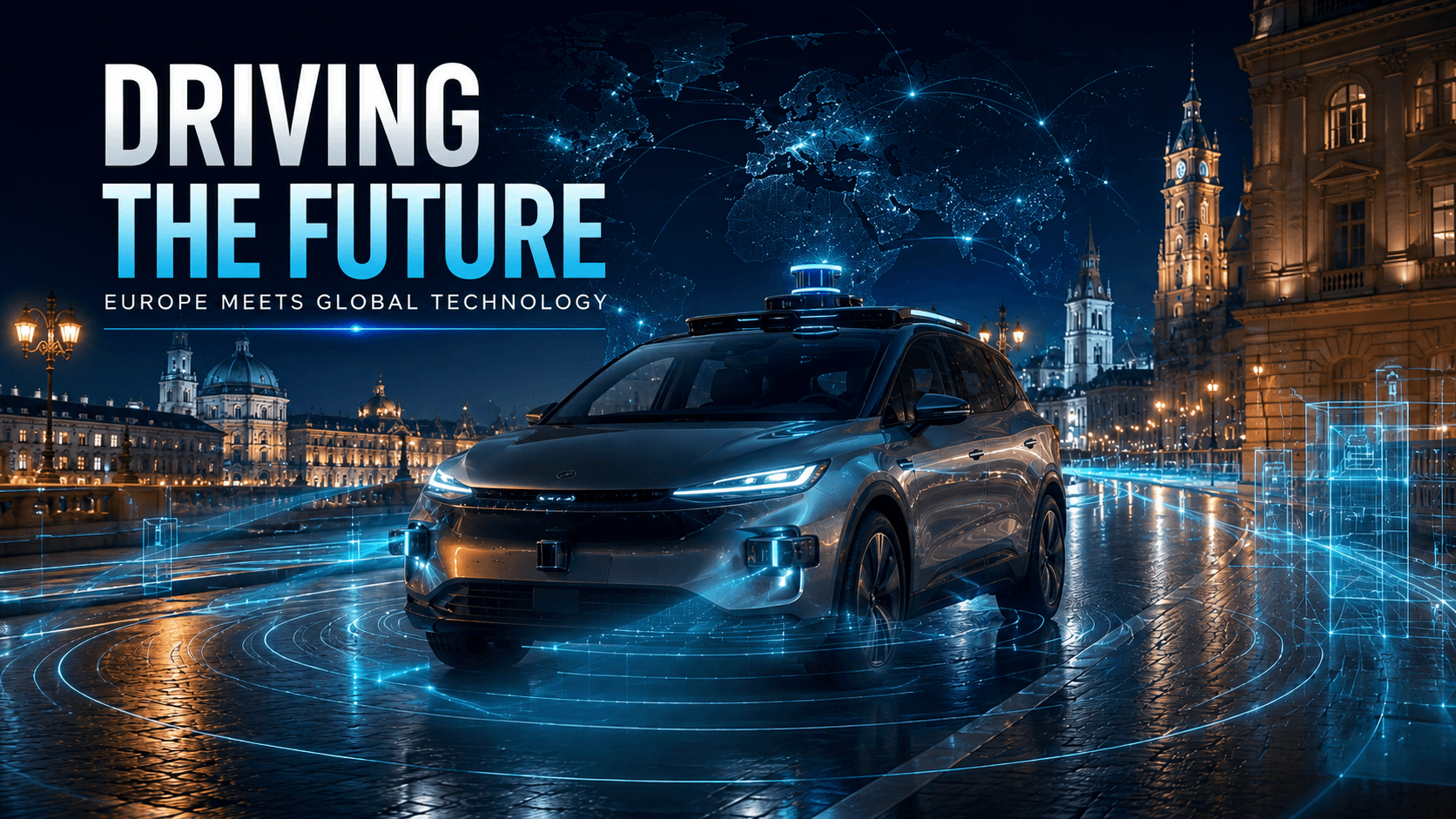
The car pulls up.
There is no driver.
The wheel turns on its own.
To the passenger, the experience feels familiar. You book the ride through an app, get into an electric vehicle and arrive at your destination.
But look beneath that simple experience and the story becomes much more interesting.
Europe's first commercial robotaxi service launched in Zagreb, Croatia, in April 2026. The service uses vehicles based on Chinese made BAIC Arcfox cars and self-driving technology from Pony ai,** a Chinese autonomous-driving company.
The local operator is Croatian. The booking experience is connected to Uber. The technology doing the driving is Chinese.
And in August 2026, Uber and Pony.ai announced plans to expand the partnership to more than 2,000 robotaxis across Europe, alongside further expansion into the Middle East.
That raises a bigger question than who is driving the car:
Who actually owns the intelligence behind Europe's autonomous vehicles?
A Ride That Started Quietly, in One City
Europe's first commercial robotaxi service didn't launch in London, Paris or Berlin.
It launched in Zagreb, Croatia.
The service operates daily from 7 a.m. to 9 p.m., covering roughly 90 square kilometres of the city, including the airport.
Passengers book through Verne, a Croatian mobility company backed by Rimac Group, with Uber integration following soon after.
The cars are Chinese-made BAIC Arcfox electric vehicles fitted with Pony.ai's autonomous-driving system.
For now, a trained safety operator still rides along.
That's an important detail.
The service may be autonomous in its driving technology, but the rollout is still deliberately cautious.
To a passenger, however, none of that is particularly visible.
The car arrives.
You get in.
It drives.
And there is no driver to make small talk with.
That's what makes the story interesting.
The technology shaping the experience is almost completely invisible.
Did You Know?
According to Pony.ai, the seventh-generation robotaxi platform used in Zagreb carries 34 sensors, including 9 lidar units, 14 cameras and 4 radar units.
Together, they give the vehicle a 360-degree view and the ability to detect objects more than 600 metres away.
That's roughly six football fields.
It's Small, Cheap and Surprisingly Well-Reviewed
The Zagreb launch is much smaller than the headline about thousands of robotaxis might suggest.
Verne currently operates a fleet of around 10 vehicles, with approximately 300 people having access to the service and another 4,000 on a waiting list.
The introductory fare is just €1.99.
That is a promotional price rather than necessarily the long-term cost of the service.
Early feedback has also been encouraging.
Verne reports that around 90% of riders have given the service four or five stars, with no collisions reported across tens of thousands of kilometres driven so far.
But scale is not the point yet.
This is a carefully controlled beginning.
The real test comes later.
Can a robotaxi service move from a handful of vehicles in one city to thousands of vehicles operating across multiple countries?
That's where the partnership becomes much more significant.
How One Company Ended Up Driving on Two Continents
The company providing the driving intelligence is Pony.ai.
And it didn't arrive in Europe from nowhere.
Pony.ai says it already operates paid, fully driverless robotaxi services in Beijing, Guangzhou, Shanghai and Shenzhen.
That gives the company something extremely difficult to manufacture quickly:
real-world driving experience.
Millions of rides create data.
Data helps improve systems.
More rides create more edge cases.
More edge cases create more opportunities to improve.
That's one reason autonomous driving is such a difficult technology to build.
A company doesn't simply need an impressive demonstration.
It needs to handle thousands of unpredictable situations repeatedly and safely.
Uber appears to have chosen a different strategy this time.
Rather than building the entire autonomous-driving system itself, it is partnering with companies that already have the technology.
The arrangement effectively divides the job into three layers:
Pony.ai
Self-driving technology
Verne
Local operations and regulatory requirements
Uber
Booking and customer access
The passenger sees one ride.
Underneath it are several companies performing very different jobs.
From Four Chinese Cities to Europe
In August 2026, Uber and Pony.ai announced plans to deploy more than 2,000 robotaxis across Europe, expanding into four additional European cities that had not yet been named at the time of the announcement.
The partnership also includes plans for the Middle East.
This changes the significance of the Zagreb experiment.
Ten robotaxis in one city are an interesting demonstration.
Thousands across multiple countries are something else entirely.
It starts to look like an attempt to establish a transportation platform.
And that is where autonomous driving becomes bigger than the car itself.
Pony.ai says its robotaxis use fail-operational redundancy.
If a critical sensor, computer or steering component fails, a backup system is designed to take over sufficiently to bring the vehicle to a safe state.
For autonomous vehicles, redundancy isn't an optional feature.
It's part of the basic safety architecture.
The Question Europe Is Still Working Through
Here's the part that gets less attention than the ride itself.
A robotaxi isn't only a vehicle.
It is also a moving sensor platform.
Every journey involves cameras, lidar, radar, positioning systems and computers continuously interpreting the environment around the vehicle.
The car sees roads.
It sees traffic.
It sees buildings.
It can see pedestrians.
And when passengers are inside, it operates within a highly connected environment containing people and their data.
That creates a question that extends beyond autonomous driving:
Who controls the data generated by connected vehicles?
European regulators and security researchers have been examining this issue more broadly in relation to connected and Chinese-made vehicles.
The important point is not that Europe has no rules.
It does.
But the regulatory framework is still evolving as vehicles become increasingly connected and autonomous.
The EU Data Act has applied since September 2025, giving users greater rights over data generated by connected products, including vehicles.
The Cyber Resilience Act adds further cybersecurity obligations for connected products, with reporting requirements beginning in September 2026 and broader obligations phasing in later.
Neither regulation was created specifically for robotaxis.
That's important.
Europe is therefore trying to apply a broader connected-device framework to a technology that is becoming significantly more capable and autonomous.
The question isn't simply:
"Can this car drive itself?"
It is increasingly:
"What is this car allowed to see, collect, store and share?"
That is a much bigger question.
The Invisible Technology Behind a Simple Ride
Think about what happens when you book a robotaxi.
You open an app.
You select your destination.
A car arrives.
From your perspective, that's the entire experience.
But underneath it, something much more complicated is happening.
The booking platform finds the vehicle.
The vehicle identifies its surroundings.
Sensors constantly scan the road.
Software predicts what nearby objects might do.
The autonomous-driving system decides how to steer, accelerate and brake.
The car continuously checks whether those decisions are safe.
And all of that happens while you are sitting inside, probably looking at your phone.
This is what makes autonomous vehicles different from many other AI applications.
The AI isn't simply generating an answer.
It is making decisions inside the physical world.
And mistakes don't produce a bad paragraph.
They can produce a collision.
That is why the race to build autonomous driving systems is ultimately a race to build trustworthy physical AI.
The Bigger Race Isn't Really About Cars
This is where the story becomes more interesting.
We often describe the autonomous-driving race as a competition between car companies.
But the Zagreb example tells us something different.
The vehicle manufacturer doesn't necessarily need to own the autonomous-driving technology.
The ride-hailing company doesn't need to build it either.
A local company can operate the fleet.
A technology company can provide the intelligence.
A global platform can provide the customers.
That creates a new model:
Vehicle + AI + Local Operator + Platform
And it means the company controlling the most important part of the experience may not be the company whose name appears on the vehicle.
The car could be manufactured by one company.
The autonomous system could come from another.
The service could be operated by a third.
The passenger could book it through a fourth.
One ride. Four layers of technology and business.
That's the future of autonomous mobility beginning to reveal itself.
Knowlegic Perspective
The global self-driving race is usually presented as a contest over who can build the best autonomous car.
But the more consequential question may be:
Who controls the intelligence that millions of cars rely on?
A successful autonomous-driving system doesn't just sell a vehicle.
It can become part of a city's transportation infrastructure.
Every ride generates operational experience.
Every road introduces new scenarios.
Every passenger interaction creates another connection between software, vehicles and people.
That's why the partnership in Zagreb matters beyond Zagreb.
A European city has effectively opened its roads to a transportation system in which the driving intelligence was developed elsewhere.
That isn't necessarily a problem.
It is, however, strategically significant.
Because in the autonomous era, the most important technology inside a vehicle may no longer be the engine or even the battery.
It may be the software making the decisions.
That's the real story of Europe's first robotaxi.
The most important part of the car isn't necessarily the part you can see.
Sources & References
Verne, Pony.ai, and Uber Partner to Launch Europe's First Commercial Robotaxi Service
Pony.ai and Uber Expand Partnership to Deploy Over 2,000 Robotaxis in Europe
Uber and China's Pony AI to launch over 2,000 robotaxis across Europe
(https://www.letsverne.com/news-grid/verne-launches-europe’s-first-commercial-robotaxi-service.)
EU Needs Smart-Car Data Security Rules And Can Learn From China, Group Says
Security recall: The risk of Chinese electric vehicles in Europe
Enjoyed this?
Get notified when a new Knowlegic story worth knowing is published.


