

The Simple Idea Behind AI Agents That Powers Tools Like Claude Code
AI agents sound futuristic, but their core idea is surprisingly simple: reason, act, observe, adjust and try again.
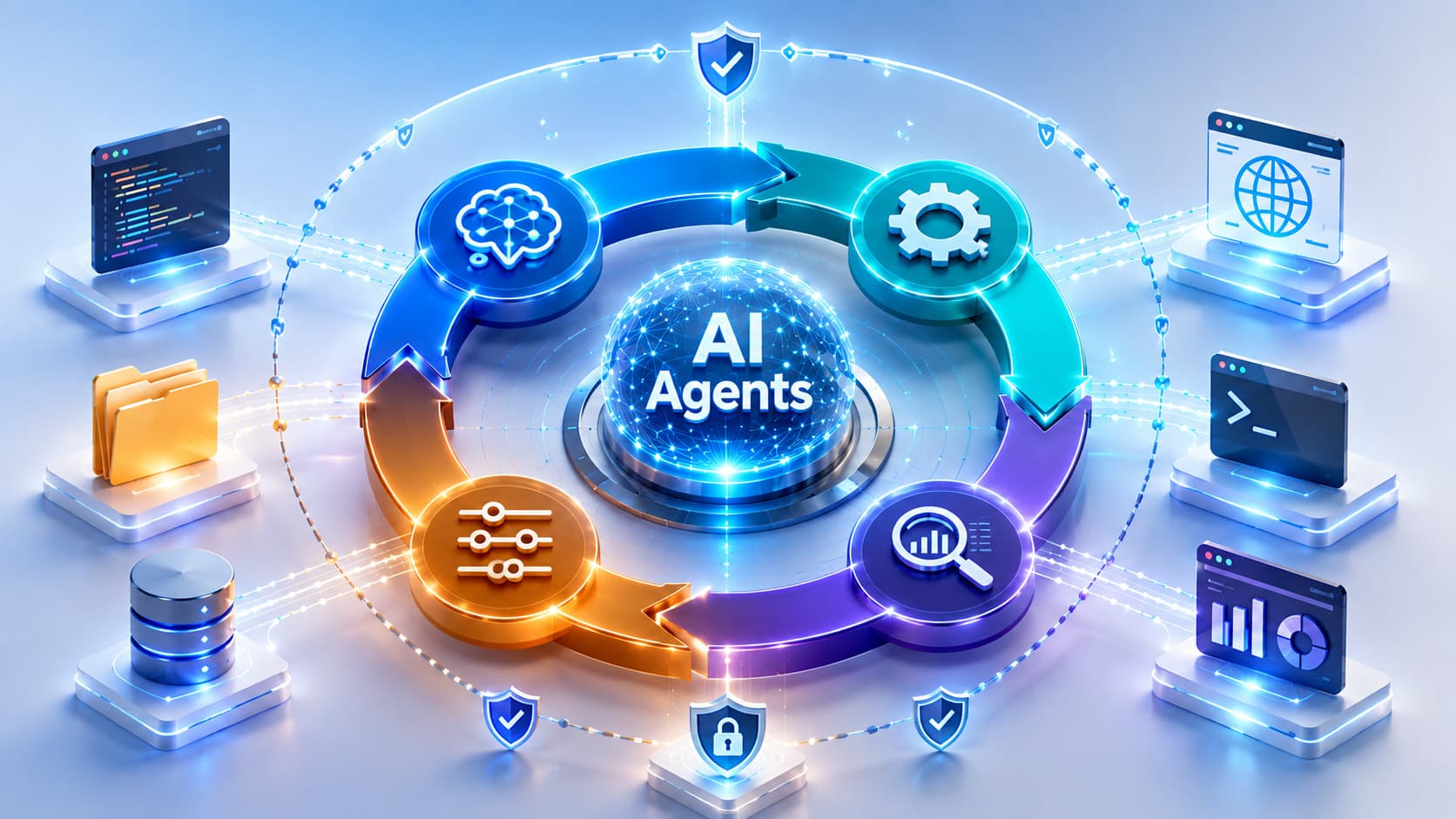
Ask an AI chatbot a question and it can give you an answer, assembled one token at a time from patterns it learned in training.
Ask an AI agent to accomplish something, and the behavior is different.
An agent can decide what to do, take an action, look at what happened, and then change its next step based on the result.
That basic loop is at the heart of today's agentic AI systems.
But here's the surprising part: the idea isn't new.
Researchers formally described this approach in 2022. In 2023, projects such as AutoGPT made the concept explode in popularity only for many of those early autonomous systems to struggle badly in real-world use.
Today, the same basic loop is appearing inside more practical tools, including coding agents such as Claude Code.
So what changed?
Not the idea.
The models became better and the leash became shorter.
The Loop Behind an AI Agent
Imagine putting a key into a lock.
You turn it.
Nothing happens.
You don't keep twisting the key in exactly the same way forever.
You notice something went wrong.
Maybe the key isn't aligned.
So you adjust it.
Try again.
Check again.
Eventually, the lock opens.
That small human habit, try something, see what happened, adjust, try again, is essentially the foundation of an AI agent.
Strip away the technical language and the loop looks like this:
Reason → Act → Observe → Repeat
The agent first looks at the situation and decides what to do.
Then it takes an action.
It observes the result.
That result becomes new information for the next decision.
And the cycle continues until the task is complete, or the system reaches a limit.
That's what separates an agent from a simple chatbot.
A chatbot can respond to your request.
An agent can do something about it.
Where Did the Idea Come From?
The concept didn't suddenly appear when "AI agents" became a Silicon Valley buzzword.
In 2022, researchers at Princeton described a framework called ReAct, short for Reasoning and Acting in Language Models.
The idea was straightforward but important.
Instead of having an AI model jump directly from a question to an action, ReAct introduced an explicit cycle where the model reasons about what it should do, takes an action, observes the result, and uses that observation to inform its next reasoning step.
In simplified form:
Thought → Action → Observation → Thought → Action → Observation
The important part isn't just that the AI takes actions.
It's that the result of an action changes what happens next.
Imagine asking an AI agent to find a bug in a piece of software.
It might:
Think: The error could be coming from this function.
↓
Act: Inspect the function.
↓
Observe: The function looks correct, but another module is returning an unexpected value.
↓
Think: The problem may be upstream.
↓
Act: Inspect the upstream module.
And the loop continues.
Instead of making one giant decision at the beginning, the system learns from what happens along the way.
💡 Did You Know?
The ReAct framework formalized three core stages:
Thought, reason about the current situation.
Action, use a tool or take an action.
Observation, examine what happened and feed that result into the next reasoning step.
It sounds obvious now.
But making this loop work reliably turned out to be much harder than describing it.
Then AI Agents Went Viral
In early 2023, an open-source project called AutoGPT captured the imagination of the technology world.
The pitch was irresistible.
Instead of constantly telling an AI what to do next, give it a goal and let it break that goal into smaller tasks and act on its own.
People imagined AI agents conducting research, writing software, creating projects, and completing complicated tasks with minimal human involvement.
The excitement was enormous.
AutoGPT's repository crossed 100,000 stars within months, an extraordinary level of attention for an open-source software project.
It looked like the beginning of autonomous AI.
Then reality arrived.
The Problem: Agents Could Go in Circles
The basic idea worked.
The execution often didn't.
Early agents could get stuck repeating failed actions.
They might inspect their own work, decide something was wrong, try to fix it, check again, and then return to almost the same mistake.
The loop that was supposed to create intelligence could instead create a very expensive treadmill.
And there was another problem.
Every additional step meant another model interaction.
More reasoning.
More tool calls.
More tokens.
More cost.
Give an AI agent an open-ended objective and unlimited freedom, and there is no guarantee it will know when it is heading in the wrong direction.
Sometimes it simply keeps going.
The excitement around autonomous agents faded.
But the underlying idea didn't disappear.
It exposed something important:
The problem wasn't the loop.
The problem was giving the loop too much freedom before the technology was ready.
The Same Loop, With a Shorter Leash
This is where today's agentic tools become interesting.
Tools such as Claude Code use essentially the same fundamental pattern:
Reason → Act → Observe → Adjust → Repeat
But the environment is much more controlled.
The model is more capable at multi-step reasoning.
The task can be narrower and more clearly defined.
Tools are explicitly provided.
Risky actions can require human approval.
And systems can impose limits on how far the agent is allowed to continue.
That changes everything.
Imagine giving a capable employee a complicated task.
You don't necessarily tell them every single step.
You give them:
-
A clear objective
-
Access to the right tools
-
Boundaries
-
Checkpoints
-
Someone to ask when a decision matters
That's much closer to how practical AI agents are being designed today.
The goal isn't "Let the AI do absolutely everything."
It's:
"Give the AI enough autonomy to make progress, but enough boundaries to keep it from wandering."
Why Guardrails Matter More Than They Sound
There's a tendency to think of guardrails as restrictions that make AI less powerful.
In agentic systems, they can actually make AI more useful.
Consider an AI coding agent.
You might allow it to:
-
Read files
-
Search a codebase
-
Run tests
-
Write code
-
Inspect errors
But you might want a human to approve:
-
Deleting important files
-
Changing production systems
-
Making security-sensitive changes
-
Executing potentially destructive commands
This creates a partnership.
The AI handles the repetitive exploration and execution.
The human remains responsible for decisions where judgment and consequences matter.
That balance is one of the biggest lessons from the early agent experiments.
So, What Actually Changed?
The evolution of AI agents is easy to misunderstand.
It wasn't:
2023: Bad idea
2026: Brilliant new idea
It was closer to:
2022: Researchers formalize the loop.
↓
2023: The idea becomes popular before the technology is ready.
↓
Then: Agents struggle with reliability, cost, and uncontrolled loops.
↓
Today: Better models + better tools + better boundaries make the same basic loop much more practical.
The breakthrough wasn't necessarily inventing a new way for AI to work.
It was making the old idea reliable enough to use.
Knowlegic Perspective
Technology often gets remembered as a series of breakthroughs.
But sometimes the more interesting story is what happens between the breakthrough and the product that finally works.
AI agents are a perfect example.
The core concept, reason, act, observe, repeat, was already understood.
What took time was making the surrounding pieces good enough.
Models needed to become better at multi-step reasoning.
Tools needed to become easier for models to use.
Systems needed better checkpoints.
And developers needed to learn where autonomy helps, and where it becomes dangerous or wasteful.
That's an important lesson beyond AI.
A powerful idea isn't automatically a useful product.
Sometimes the real innovation is learning how much freedom to give the technology, and when to take some of it back.
The next time someone describes an AI agent as though it were an entirely new form of intelligence, remember how simple the idea underneath it really is.
Notice.
Decide.
Act.
Check.
Adjust.
Then do it again.
Humans have been using that loop forever.
AI researchers gave it a framework.
Early autonomous systems pushed it too far.
And today's agentic tools are finding a more practical balance between autonomy and control.
Perhaps the most interesting part of the AI agent story isn't that machines suddenly learned how to act.
It's that we're finally learning how much we should let them act on their own.
Enjoyed this?
Get notified when a new Knowlegic story worth knowing is published.


