

What Is Claude Code, and Why Is It Different From a Chatbot?
A chatbot answers a question. Claude Code takes the next step—it can inspect, change, test, and improve real software.
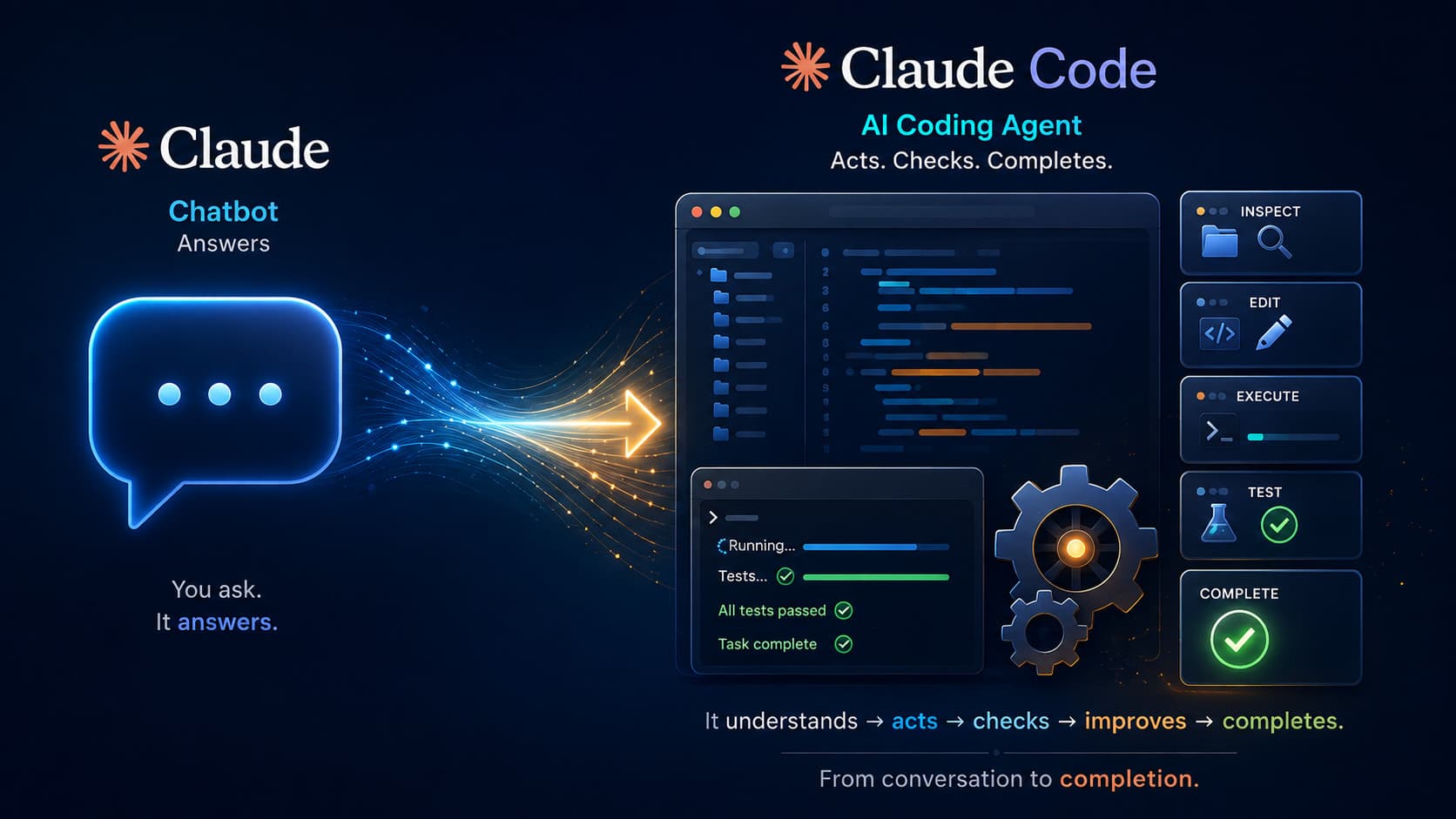
Most of us have learned to think about AI through chat.
You ask a question.
AI gives you an answer.
You decide what to do next.
Claude Code changes that relationship.
Instead of simply telling you how to fix a bug, it can inspect the project, find the relevant files, make changes, run commands, see what happened, and try again if the first attempt didn't work.
That may sound like a small difference.
It isn't.
A chatbot primarily produces an answer. An AI coding agent can work toward an outcome.
And once AI can act, rather than simply talk, an entirely new set of questions appears: How much should it be allowed to do? When should it ask permission? And what happens when it gets something wrong?
The Moment AI Stops Just Talking
Imagine you ask an AI chatbot:
"There's a bug in my application. Can you fix it?"
The chatbot might explain what the problem is and give you a piece of corrected code.
Helpful—but you're still holding the keyboard.
You need to:
-
Find the right file.
-
Change the code.
-
Run the application.
-
Check whether the fix worked.
-
Investigate again if it didn't.
Now give the same request to Claude Code.
It can inspect the project, locate the relevant files, make the change, run commands or tests, see the actual result, and adjust its approach when necessary.
That's the important distinction.
The chatbot gives you instructions. The agent can execute the work.
From Autocomplete to an AI That Works Across a Project
The evolution becomes clearer if we look at earlier AI coding tools.
Many started as extremely capable autocomplete systems.
You begin typing:
function calculateTotal(
The AI predicts what you might type next.
You accept or reject the suggestion.
Then you continue.
This is useful. It can save enormous amounts of time.
But the AI is essentially waiting for you.
Claude Code operates at a different level.
Instead of saying:
"Complete this line."
You can say:
"Find why the tests are failing and fix the problem."
The AI can then determine which files it needs to inspect, what commands might help, what changes are necessary, and whether the result actually works.
You move from writing code with AI assistance toward supervising AI while it works on code.
It's a subtle shift in wording.
But it's a major shift in how humans interact with software.
Did You Know?
According to the source material, Claude Code began in September 2024 as a side project by a single engineer experimenting with an early version of Claude.
It was publicly launched as a research preview in February 2025 and reached general release three months later.
That is an unusually short journey from experiment to major product.
The Real Magic Is Not Writing Code
Here's where Claude Code becomes much more interesting.
Its most important capability isn't necessarily that it can generate code.
Modern AI models can already generate code remarkably well.
The bigger difference is what happens after the code is written.
Imagine an AI suggests a fix.
A normal chatbot might stop there.
Claude Code can potentially:
Propose → Run → Observe → Correct → Run again
Suppose it changes a function and runs the tests.
The test fails.
Now the failure isn't the end of the conversation.
It becomes new information.
The agent can examine the error, rethink the change, modify the code, and run the test again.
This creates a feedback loop.
And that loop is the heart of agentic software.
A chatbot can tell you
"This code should work."
An agent can actually find out whether it works.
That difference matters enormously.
But Should We Really Let AI Touch Our Computers?
This is where things get interesting.
Giving an AI access to files and a terminal isn't like asking it to write an email.
A badly worded sentence in a chatbot is usually just a bad sentence.
A badly executed command can actually change something on your computer.
It could modify files.
It could run the wrong command.
It could potentially interact with external systems.
So Claude Code's ability to act comes with another important feature:
permission.
By default, the system can operate in a read-only mode.
When it needs to perform actions with real consequences—such as editing files, executing commands, or accessing a network—it can ask for permission.
Think of it like giving an employee access to your office.
You might allow them to look around.
But before they open the locked cabinet, access sensitive information, or make an irreversible change, you want them to ask.
That's not unnecessary friction.
It's part of the design.
Why AI Needs Guardrails
There's another problem that is easy to overlook.
An AI agent doesn't only read the instructions you intentionally give it.
It may also encounter instructions inside the files it reads.
Imagine a code comment, document, or other piece of content containing text designed to trick the AI into following an instruction it shouldn't.
This is one reason permission systems and boundaries matter.
The more capable an AI becomes at acting independently, the more important it becomes to control what it is allowed to do.
Claude Code provides different permission approaches, ranging from asking about actions frequently to allowing more routine activity with fewer interruptions.
The source material also describes Anthropic's sandboxing work, designed to establish safer boundaries upfront rather than requiring the AI to ask permission for every individual action. Anthropic reported that this reduced permission interruptions in its internal use by roughly 84%.
The bigger lesson is simple:
The smarter the agent becomes, the more carefully we need to define its boundaries.
Did You Know?
According to figures cited in the source material, Claude Code usage grew roughly tenfold between early and late 2025, while Anthropic projected that the product could reach more than $500 million in annualized revenue.
These are company-reported figures and should be viewed as a snapshot of a rapidly evolving product category rather than a prediction of its eventual ceiling.
Where Does Claude Code Actually Live?
You might imagine Claude Code as something that only works inside a black terminal window.
That's no longer the whole picture.
According to the source material, it is available through:
-
Terminal-based workflows
-
Desktop applications for Mac and Windows
-
A web interface
-
Popular coding environments such as VS Code
-
JetBrains tools
The important idea isn't really the interface.
It's that the underlying AI can move beyond conversation and interact with the environment where the work actually happens.
That could eventually become a much bigger shift than simply making programmers type less code.
Claude Code Is Not a Magic Programmer
There's an important warning here.
Claude Code can act. That doesn't mean it is always right.
In fact, the ability to act makes mistakes more consequential.
If a chatbot gives you incorrect code, you can ignore it.
If an agent edits ten files incorrectly, the problem is much larger.
That's why human review remains important.
The goal isn't necessarily:
Human disappears → AI does everything.
A more realistic model is:
Human defines the objective → AI explores and executes → Human reviews important decisions.
Think of it less like replacing a programmer and more like having a very fast junior engineer who can inspect enormous amounts of information, perform repetitive tasks, test its own work, and come back with a result—but still needs supervision.
Chatbot vs. AI Coding Agent
The difference becomes much easier to understand when you put the two side by side.
 The key isn't simply intelligence.
It's agency.
A chatbot can be extremely intelligent and still remain conversational.
An agent takes that intelligence and connects it to tools, actions, feedback, and boundaries.
Knowlegic Perspective
It's tempting to describe Claude Code as "a smarter chatbot."
But that misses the most important part of the story.
The breakthrough isn't that AI became better at writing sentences or even better at writing code.
It's that AI can now be connected to the environment where the work happens.
That changes the fundamental loop.
With a chatbot:
You ask → AI answers → You act.
With an agent:
You ask → AI acts → AI observes → AI adjusts → You review.
That last loop is where things get interesting.
And it's also where the risks begin.
Because the moment an AI stops merely suggesting what you should do and starts doing it for you, capability and control become equally important.
A chatbot answers a question.
Claude Code can work toward finishing a task.
That difference is only one word on paper.
In practice, it changes the entire relationship between humans and AI.
The interesting part isn't that an AI can write a few lines of code.
It's that it can inspect the environment, take an action, see the result, learn from what happened, and keep moving toward an outcome.
But there's an equally important second half to that story.
An AI that can act needs boundaries.
Permission prompts, sandboxing, human review, and controlled access aren't obstacles sitting in the way of AI's future.
They are part of what makes that future usable.
The real evolution of AI may therefore not be from chatbots to autonomous machines.
It may be from:
AI that tells us what to do → AI that does some of the work → AI that knows when to act, when to check, and when to ask us.
And that last step could be the most important one of all.
Enjoyed this?
Get notified when a new Knowlegic story worth knowing is published.


