

Why Doesn't Dubai Have Income Tax?
Why Doesn't Dubai Have Income Tax? The Business Strategy Behind One of the World's Fastest-Growing Cities
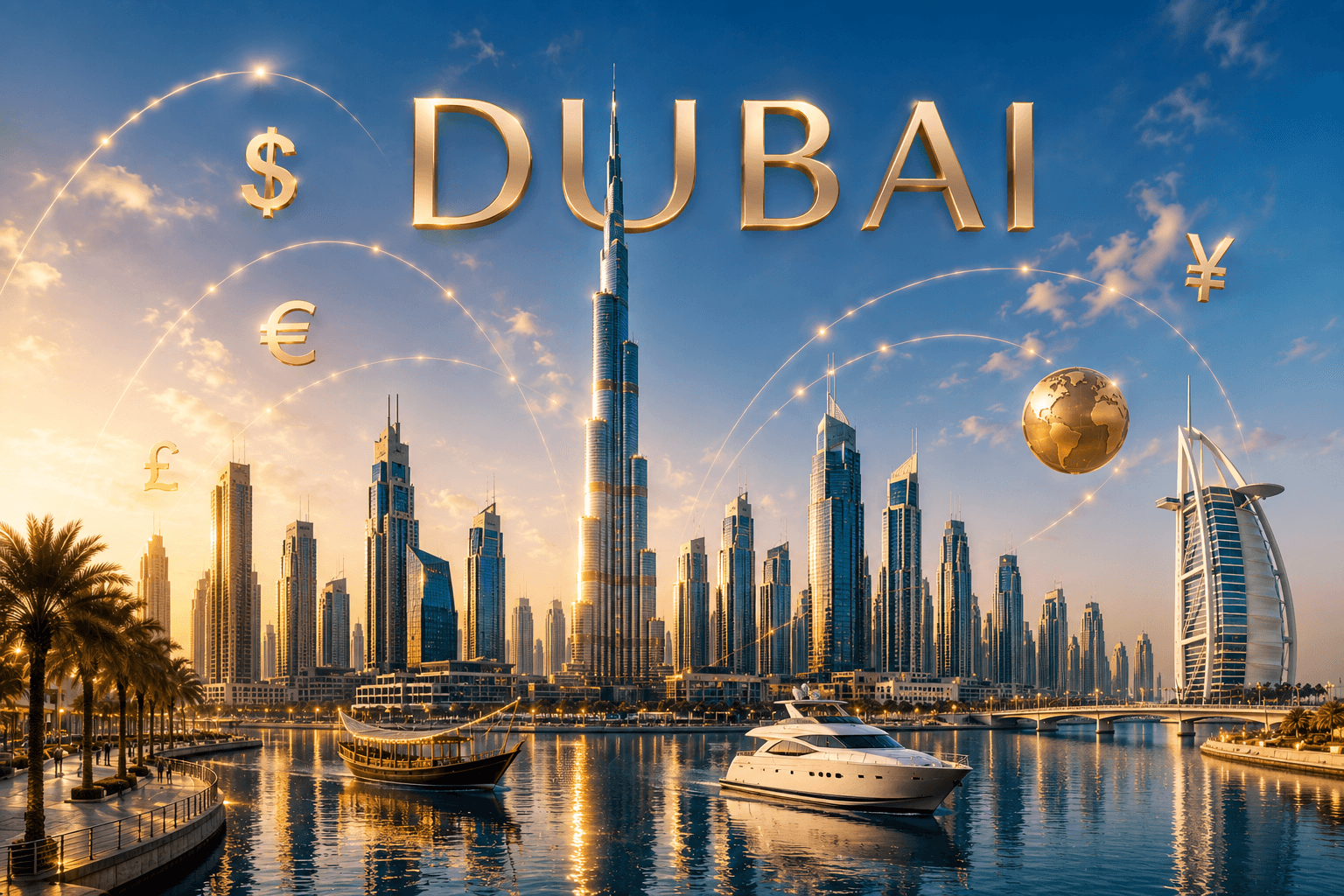
Dubai is widely known as a place where people don't pay personal income tax. That reputation has helped attract millions of professionals, entrepreneurs, and global businesses over the past few decades.
But the story is more interesting than simply "no taxes."
Instead of relying heavily on taxes on salaries, Dubai has built an economic model that generates revenue through consumption, business activity, tourism, property, and trade. This approach has helped transform a small trading port into one of the world's leading financial and commercial hubs.
In this article, we'll explore how Dubai's tax system works, why it exists, and the advantages and challenges of a low-tax economy.
Timeline: Dubai's Economic Journey

More Than Just a Tax-Free City
Imagine receiving your monthly salary and not seeing any personal income tax deducted from your paycheck.
For many professionals living in Dubai, that's reality.
It's one of the biggest reasons people from around the world choose to work there. Higher take-home pay, modern infrastructure, and a globally connected economy make the city an attractive destination for skilled workers and international businesses alike.
But here's the surprising part.
Dubai isn't truly "tax-free."
Instead, it has chosen a different way of collecting government revenue, one that focuses less on taxing income and more on encouraging investment, trade, tourism, and business activity.
That strategy has helped transform Dubai from a regional trading port into one of the world's most dynamic business cities.
What Does "No Income Tax" Actually Mean?
When people say Dubai has "no income tax," they're referring to personal income tax.
In general, individuals working in Dubai do not pay tax on their salaries or wages.
However, that doesn't mean taxes don't exist.
The government still collects revenue through several other channels, including:
- Value Added Tax (VAT)
- Customs duties on imported goods
- Business registration and licensing fees
- Municipal and property-related charges
- Tourism and hospitality fees
- Excise duties on selected products
The important distinction is this:
Dubai doesn't eliminate taxation, it shifts it.
Instead of taxing what people earn, it relies more heavily on what people spend, own, and the businesses they operate.
Did You Know?
The UAE introduced a federal Value Added Tax (VAT) in 2018, marking a significant evolution in how government revenue is generated while still maintaining a relatively low direct-tax environment.
Why Did Dubai Choose This Model?
Every country's tax system reflects its broader economic strategy.
Dubai's strategy was never simply to reduce taxes.
It was to attract opportunity.
Unlike countries with large populations and diversified tax bases, Dubai built its economy around international trade, aviation, logistics, tourism, finance, and real estate.
To compete globally, it needed to make itself attractive to businesses and skilled professionals.
A low-tax environment helps achieve several goals at once:
- Encourages foreign investment
- Makes salaries more attractive to international talent
- Supports entrepreneurship
- Strengthens global competitiveness
- Helps diversify the economy beyond oil
Over time, this strategy helped position Dubai as a gateway connecting Europe, Asia, and Africa.
Today, multinational companies, startups, investors, and entrepreneurs all view the city as an attractive regional base not just because of taxes, but because of its overall business ecosystem.
Today, Dubai International Airport has frequently ranked among the busiest airports in the world for international passenger traffic, highlighting the city's role as a global business and travel hub.
The Secret Behind Dubai's Business Boom: Free Zones
One of Dubai's biggest competitive advantages isn't its skyline.
It's its free zones.
These specially designated business districts were designed to make it easier for international companies to establish operations.
Many free zones offer benefits such as:
- 100% foreign ownership
- Streamlined company registration
- Easier profit repatriation
- Industry-specific ecosystems
- Tax incentives for qualifying businesses
Rather than creating one-size-fits-all regulations, Dubai built specialized environments for sectors such as technology, logistics, media, healthcare, finance, and manufacturing.
This has encouraged thousands of multinational companies to establish regional headquarters in the city.
Free zones have become one of the pillars supporting Dubai's reputation as a global business destination.
If There Is No Income Tax, How Does Dubai Make Money?
This is one of the biggest misconceptions about Dubai.
Many people assume that without income tax, the government has little revenue.
In reality, Dubai relies on a diversified mix of income sources.
Think of it like this:

Rather than depending primarily on wages, Dubai benefits when businesses grow, tourism increases, trade expands, and consumer spending rises.
It's a model that aligns government revenue closely with economic activity.
Dubai's economy depends heavily on sectors such as tourism, aviation, logistics, financial services, and real estate, making economic growth itself an important source of public revenue.
Why Professionals and Businesses Choose Dubai
For individuals, the attraction is straightforward.
Keeping more of your salary can significantly improve disposable income.
For businesses, lower direct taxes can reduce operating costs and improve returns on investment.
But taxes alone don't explain Dubai's success.
The city also offers:
- World-class infrastructure
- Excellent global connectivity
- Modern airports and ports
- A diverse international workforce
- Business-friendly regulations
- A strategic location linking three continents
When combined, these factors create an ecosystem that's difficult for many cities to match.
The 2023 Corporate Tax Change
For many years, Dubai's low-tax reputation was built around the absence of personal income tax and a generally business-friendly tax environment.
That changed in 2023.
The United Arab Emirates introduced a federal corporate tax, marking one of the country's biggest tax reforms in decades.
Under the new framework, many businesses with taxable profits above a specified threshold are subject to a 9% corporate tax, while qualifying exemptions and relief remain available for certain entities and activities.
Did this change Dubai's reputation?
Not dramatically.
Compared with many developed economies, the UAE still maintains a relatively competitive corporate tax environment. The reform was designed to align with evolving international tax standards while preserving the country's attractiveness for investment and business growth.
The key takeaway is simple:
Dubai is evolving.
Its tax system continues to adapt as the economy matures and integrates further into the global financial system.
Every Tax Model Comes with Trade-Offs
No economic model is perfect.
Dubai's low-tax approach offers significant advantages, but it also presents challenges.
Because the government relies heavily on business activity, tourism, trade, and consumer spending, public revenue is closely linked to economic performance.
When tourism grows.
Government revenue grows.
When businesses expand.
Government revenue increases.
But if global trade slows, consumer spending declines, or the real estate market weakens, revenue can also come under pressure.
This means Dubai must continuously diversify its economy rather than relying on a single industry.
Fortunately, diversification has become one of the city's biggest priorities over the past two decades.
Is Dubai's Tax System Fair?
Whether a tax system is "fair" depends on what a society wants to achieve.
Supporters argue that Dubai's model encourages investment, entrepreneurship, job creation, and economic growth.
Critics point out that relying more on consumption based taxes and fees can shift part of the tax burden toward spending rather than income.
Both perspectives have merit.
Rather than asking whether Dubai has "good" or "bad" taxes, it's more useful to ask a different question:
What is the government trying to achieve?
Dubai's objective has been clear for decades:
Build a globally competitive city that attracts businesses, investors, and skilled professionals.
Its tax policy is one tool supporting that broader vision, not the vision itself.
Knowlegic Perspective
Dubai's success demonstrates that governments don't all finance themselves in the same way.
Some countries rely heavily on personal income taxes.
Others depend more on natural resources.
Dubai chose a different route, building an economy around global trade, tourism, investment, and business activity while keeping direct taxes relatively low.
That doesn't mean every country should copy Dubai.
Every nation has different economic priorities, demographics, public spending commitments, and social policies.
But Dubai reminds us that taxation is ultimately a strategic choice, not simply a financial necessity.
The way a country raises revenue often shapes the type of economy it creates.
The phrase "Dubai has no income tax" makes for a great headline.
But it tells only half the story.
Dubai didn't become a global business hub simply because it reduced taxes.
It succeeded because it combined low direct taxation with world-class infrastructure, strategic geography, efficient regulation, international connectivity, and a long-term vision for economic growth.
Perhaps the biggest lesson isn't about taxes at all.
It's about strategy.
Rather than asking, "How much should we tax income?", Dubai asked a different question:
"How can we build a city where talented people and ambitious businesses want to be?"
That shift in thinking transformed a regional trading port into one of the world's most globally connected cities.
Enjoyed this?
Get notified when a new Knowlegic story worth knowing is published.


