

Chernobyl Tourism and the Ethics of Dark Sightseeing
Tens of thousands of people paid to walk through the world's most famous nuclear disaster zone. What they were really looking at, and what separates witness from spectacle.
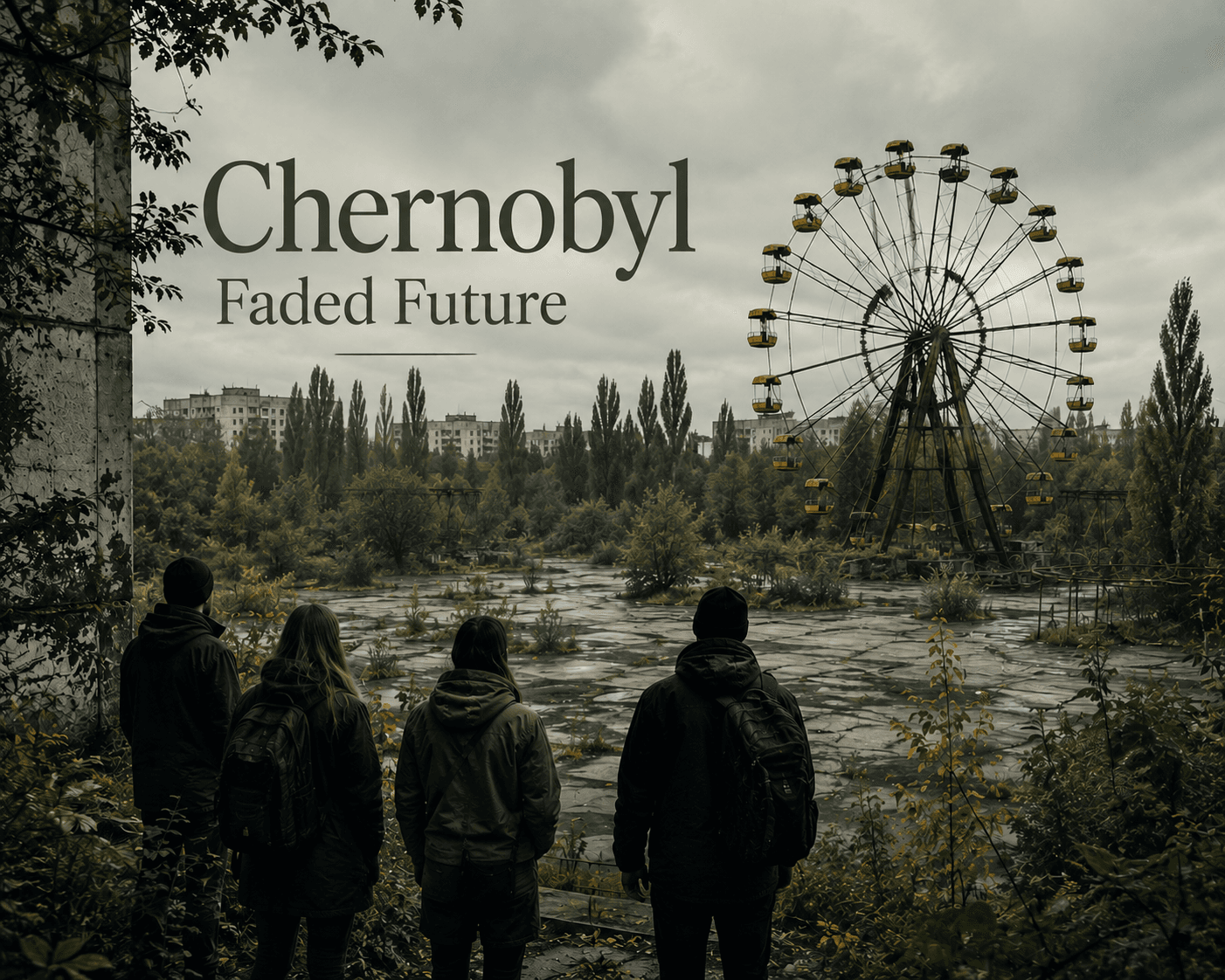
The bus from Kyiv leaves early. Two hours north, the guide hands out dosimeters, points out the checkpoint, and reminds everyone not to sit on the ground or touch the trees. Then the doors open onto Pripyat, a city of 50,000 that emptied in a single afternoon in 1986 and has been returning to forest ever since.
Most people walk through it carefully, cameras down, listening. A few peel off toward the abandoned amusement park, put on a rented gas mask, and pose. In the summer of 2019, right after HBO's miniseries aired, enough of those photos flooded Instagram that the show's own writer publicly asked visitors to remember that a terrible thing had happened there.
That gap, between the person taking in a catastrophe and the person using it as scenery, is the whole question. A ruined place can teach you something, or it can just be a backdrop, and which one it becomes depends almost entirely on how you decide to stand in it.
A Name for the Urge to Visit the Worst Places
People have traveled toward death for as long as they have traveled. Romans toured the battlefield at Cannae. Victorians booked tickets to watch public hangings. What is new is the study of it: in 1996, two Scottish professors, John Lennon and Malcolm Foley, published a paper on visitors to the site of John F. Kennedy's assassination and gave the behavior a name, "dark tourism."
Their point was not that it is shameful. It is that it is everywhere, and mostly unexamined. Auschwitz receives more than a million visitors a year. So does the 9/11 Memorial. Ground where something unbearable happened exerts a pull, and the interesting question is what people are actually seeking when they follow it.
Chernobyl sharpens that question because the disaster is recent enough to still have witnesses, and strange enough to photograph well. The 1986 reactor explosion spread fallout across Europe, forced the permanent evacuation of an area the size of a small country, and left a death toll that epidemiologists still argue about, running from fewer than 100 confirmed cases to projections in the thousands. It also left a perfectly preserved Soviet city with a Ferris wheel in it.
Did You Know?
The rusting Ferris wheel in Pripyat's amusement park, now the zone's single most photographed object, never carried a paying passenger. The park's grand opening was scheduled for May 1, 1986, the May Day holiday. The reactor exploded five days before.
The Safety Question Is the Easy One
Ask most people what stops them visiting Chernobyl and they say radiation. It turns out to be the least complicated part.
Tours stick to monitored routes where the contamination has decayed or washed away over four decades. A standard day trip delivers a few microsieverts (which is a one-millionth of a Sievert, which is the standard international unit used to measure the biological effect and health risk of ionizing radiation on the human body) of extra exposure, roughly what a passenger absorbs on a transatlantic flight, and far less than the hundred or so microsieverts of a single chest X-ray. The zone was formally opened to visitors in 2011, adults only, and by the late 2010s more than 80 percent of them were foreigners.
The 2022 Russian occupation was a grim natural experiment in what unmanaged exposure looks like. Soldiers dug trenches and fortifications in the Red Forest, the most contaminated woodland on the site, disturbing soil that guided tourists are never allowed near. Ukraine's nuclear agency reported that troops received significant doses and left in a hurry, though independent confirmation of their health was never possible. The lesson held: the danger is in the ground and the behavior, not in standing on a paved road for an afternoon.
So if the physical risk is manageable, the discomfort people feel about Chernobyl tourism has to be coming from somewhere else.
What You Are Standing In
Pripyat is not only a monument. Roughly 1,200 people, mostly elderly, quietly moved back into the exclusion zone after the evacuation and lived out their lives there, farming contaminated land because it was home. Counts vary by who is doing the counting, but by the exclusion-zone administration's own tally only around 130 of these self-settlers remained by the late 2010s, a number that keeps falling because almost no one young ever joined them. Some tours stop to meet them.
There are also the workers: the staff who kept the plant's remaining reactors running until 2000, the engineers monitoring the containment structure, the guides themselves, many from Slavutych, the town built to rehouse plant families. For them the zone is a workplace and a family history, not an attraction.
This is the texture that a rushed visit misses. Pompeii, another disaster site that became a destination, has the mercy of distance; its dead have been gone for two thousand years. Chernobyl's have not. The evacuation is within living memory, the cleanup workers are still being counted, and the war that closed the zone in 2022 added a fresh layer to the region's tally of what conflict costs a place.
Interesting Fact: For years, the biggest single driver of interest in Pripyat was not a documentary but a video game. The 2007 shooter Call of Duty 4 built its most celebrated level in a recreated Pripyat, ending beneath the Ferris wheel, and the S.T.A.L.K.E.R. series set entire games inside a fictionalized zone. Many early visitors arrived wanting to walk a landscape they had first explored on a screen.
The Line Between Witness and Spectacle
The HBO series in 2019 pushed annual visitors from around 70,000 to a record 124,000 almost overnight. Tour operators reported bookings up by a third or more within weeks. That surge is what produced the backlash: not the crowds themselves, but a specific style of visit, the staged shot in protective gear, the influencer in the empty nursery, the disaster treated as a set.
The distinction that critics keep reaching for is roughly this. A visitor who reads the timeline, listens to the guide, keeps their camera respectful, and leaves understanding what a failed safety culture and a slow official response did to real families has done something defensible, arguably valuable. A visitor who arrives for a profile picture has extracted a trophy from someone else's catastrophe and given nothing back.
Ukraine, for its part, leaned into tourism as legitimate. The government formalized routes, licensed guides, and before the war projected up to a million visitors a year. The money supported the zone's upkeep and the towns around it. Framed that way, staying away is not obviously more ethical than going thoughtfully, it just feels cleaner.
Then the question was suspended altogether. Tourism to the zone has been closed since Russia's 2022 invasion, and as of 2025 no regular tours were running. Slavutych and the plant authorities have signed agreements to rebuild a more sustainable kind of tourism once the war allows, this time with the disaster and its wartime chapter both written into the tour.
Knowlegic Perspective
Dark tourism tends to get argued about as a yes-or-no question, as though the ethics lived in the destination. They do not. Auschwitz, Ground Zero, Hiroshima, and Chernobyl are all visited in enormous numbers, and in each case the visit can be an act of memory or an act of consumption, sometimes within the same tour group on the same afternoon.
What Chernobyl exposes especially clearly is how much the meaning depends on timing and attention. The catastrophe is close enough that people who lived it are still around to be photographed without consent, still around to guide the buses. A site like that asks more of a visitor than an ancient one does, because the wound is not yet historical.
The useful shift is to stop asking whether it is acceptable to go and start asking how to be there: learn the history before arriving, follow the guide's rules, point the camera at the buildings rather than at yourself in a gas mask.
Chernobyl never asked to be visited, and it is visited anyway. A ruined place can teach you something, or it can just be a backdrop, and which one it becomes depends almost entirely on how you decide to stand in it.
Sources & References
- Chernobyl and 'dark tourism': Is this an ethical way to travel?, CNN Travel (2019)
- HBO Miniseries Success Drives Chernobyl Tourism Boom, NBC News / Reuters (2019)
- 'Chernobyl' miniseries creator asks tourists to show 'respect' when taking photos, NBC News (2019)
- Satellite photo shows Russian troops were stationed in Chernobyl's radioactive zone, NPR (2022)
- Chernobyl's Legacy: Health, Environmental and Socio-Economic Impacts, IAEA / The Chernobyl Forum (2006)
Enjoyed this?
Get notified when a new Knowlegic story worth knowing is published.


