

Why Is Switzerland So Rich?
How a small, landlocked nation became one of the world's wealthiest economies through trust, innovation, and long-term thinking.
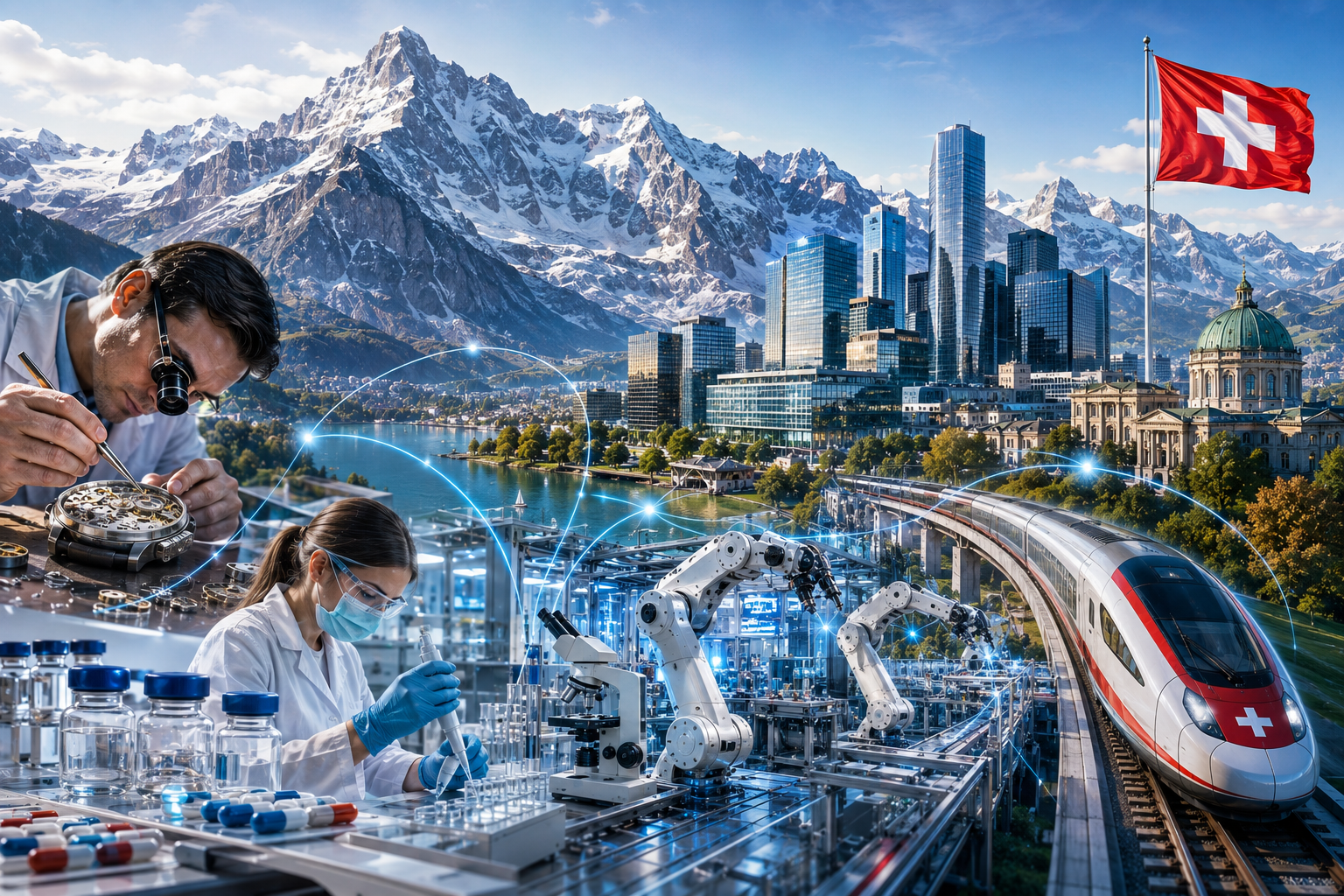
Switzerland consistently ranks among the richest countries in the world but not because it discovered vast oil reserves or built the world's largest economy. Instead, it developed a unique economic model based on highly skilled workers, world-class industries, political stability, and institutions people trust.
Rather than competing on low costs or mass production, Switzerland focuses on creating products and services with exceptional quality and high value. From life-saving medicines and precision engineering to financial services and luxury watches, its economy is built around expertise rather than size.
This article explores how Switzerland became rich, the trade-offs behind its success, and what other countries and businesses can learn from its remarkable journey.
A Small Country with an Outsized Influence
Imagine a country with just over nine million people, no access to the sea, limited natural resources, and mountains covering much of its landscape.
Would you expect it to become one of the wealthiest nations on Earth?
Probably not.
Yet Switzerland has achieved exactly that.
For decades, it has ranked among the world's leading economies in terms of income per person, innovation, quality of life, and competitiveness. It is home to globally recognized companies, produces some of the world's most trusted products, and consistently attracts businesses, investors, and skilled professionals.
So what makes Switzerland different?
The answer isn't a single policy or industry. It's a combination of education, productivity, political stability, innovation, and long-term planning that has been refined over generations.
Switzerland's story reminds us that sustainable wealth is rarely created overnight. It is built patiently through systems that reinforce one another over time.
Wealth Begins with Productivity
Many people assume countries become rich because they have abundant natural resources.
Switzerland proves otherwise.
Instead of relying on oil, gas, or large-scale manufacturing, the country specializes in industries that create significant value through knowledge and precision.
Its economy is built around sectors such as:
- Pharmaceuticals and biotechnology
- Precision engineering
- Machinery
- Chemicals
- Financial services
- Luxury watches
- Scientific instruments
These industries don't compete by producing the cheapest products.
They compete by producing some of the best.
A single Swiss pharmaceutical breakthrough or precision instrument can generate far more economic value than mass-producing low-cost goods.
That's why Switzerland consistently ranks among the world's most productive economies.
Did You Know?
Swiss watches account for a relatively small share of the world's watches by quantity, yet they represent a much larger share of global export value because they compete on craftsmanship, engineering, and premium branding rather than volume.
Education Isn't Just About Degrees
One of Switzerland's biggest strengths is how closely education is connected to industry.
Instead of assuming every student should attend university, Switzerland places equal value on vocational education and apprenticeships.
Many students combine classroom learning with practical workplace experience.
This creates a workforce that is ready to contribute from day one.
Engineers, laboratory technicians, healthcare professionals, precision machinists, and manufacturing specialists all benefit from hands-on training that reflects real industry needs.
The result?
Companies gain highly skilled employees.
Students develop practical expertise.
The economy becomes more competitive.
It's a system where education doesn't end in the classroom it continues in factories, laboratories, hospitals, and research centers.
Switzerland's apprenticeship system is often cited internationally as a successful model for preparing young people with practical skills while supporting advanced industries.
High Value Beats High Volume
Unlike many manufacturing economies, Switzerland doesn't try to produce everything.
Instead, it focuses on products where precision, reliability, and expertise matter more than low prices.
Think about a luxury Swiss watch.
Its value doesn't come from the amount of steel it contains.
It comes from decades of craftsmanship, engineering, design, and brand reputation.
The same principle applies to pharmaceuticals, medical devices, scientific instruments, and specialized machinery.
This strategy allows Switzerland to pay high wages while remaining globally competitive.
Rather than winning through low costs, it wins through exceptional quality.
Switzerland consistently ranks among the world's leading countries for innovation, supported by strong research institutions, advanced manufacturing, and significant investment in scientific development.
Geography Helped—But Didn't Create the Success
Switzerland's location in the heart of Europe certainly provides advantages.
It sits close to many of the continent's largest markets, making trade easier.
But geography alone doesn't explain its prosperity.
The country is landlocked.
Much of its territory is mountainous.
It lacks the vast natural resources enjoyed by many larger economies.
Instead of seeing these limitations as obstacles, Switzerland adapted.
It invested in people instead of natural resources.
It specialized instead of trying to do everything.
It focused on quality instead of quantity.
And over time, those choices created one of the strongest economies in the world.
The Role of Banking and Finance
When people think of Switzerland, they often think of banking.
While banking has certainly contributed to the country's prosperity, it's only one piece of a much larger economic story.
Switzerland has built a global reputation for financial stability, wealth management, insurance, and investment services. Over many decades, businesses and investors have viewed the country as a reliable place to manage assets because of its political stability, strong legal system, and well-developed financial sector.
However, modern Switzerland is no longer an economy driven solely by banking.
Today, pharmaceuticals, biotechnology, precision engineering, medical technology, advanced manufacturing, and scientific research contribute significantly to the country's economic strength.
The Swiss economy succeeds because it is diversified.
When one sector slows, others continue to support growth.
That balance has made Switzerland more resilient than many economies that depend heavily on a single industry.
High Salaries Come with High Costs
Being one of the world's richest countries doesn't automatically make life inexpensive.
In fact, Switzerland consistently ranks among the most expensive places to live.
Housing, healthcare, transportation, and everyday essentials often cost significantly more than in many other countries.
Fortunately, salaries are generally higher as well.
This balance allows many residents to maintain a high standard of living, although affordability remains an ongoing challenge, particularly in major cities such as Zurich and Geneva.
This highlights an important economic principle:
A wealthy country isn't necessarily a cheap country.
Higher productivity often leads to higher wages, which can also contribute to higher prices.
Prosperity and affordability don't always grow at the same pace.
Switzerland regularly appears near the top of international rankings for both average wages and cost of living, illustrating the trade-off between earning more and spending more.
Why Other Countries Can't Simply Copy Switzerland
Many governments admire Switzerland's success.
But copying the Swiss model isn't as simple as lowering taxes or strengthening one industry.
Switzerland's prosperity is built on decades of institutional development, education, political consensus, and economic specialization.
Its vocational education system supports advanced manufacturing.
Its stable political environment encourages long-term investment.
Its research institutions drive innovation.
Its businesses compete globally by focusing on quality rather than scale.
These systems reinforce one another.
Trying to copy only one part of the model rarely delivers the same results.
That's why Switzerland should be viewed as inspiration not as a blueprint that can be replicated overnight.
Switzerland consistently ranks among the world's most innovative economies because of its strong collaboration between universities, research institutions, and private industry.

Why It Matters
Switzerland's story is about much more than one successful country.
It demonstrates that long-term prosperity isn't built through shortcuts.
Countries don't become wealthy simply by discovering natural resources or attracting one large company.
They become prosperous by investing in education, encouraging innovation, building trusted institutions, and creating industries that generate lasting value.
These lessons extend beyond governments.
Businesses can learn the importance of quality over quantity.
Students can see the value of developing specialized skills.
Entrepreneurs can understand why trust and reputation often become their greatest competitive advantages.
Switzerland reminds us that sustainable success is rarely accidental.
It is carefully built over generations.
Key Takeaways
- Switzerland became wealthy through high productivity, not abundant natural resources.
- Its economy focuses on high-value industries such as pharmaceuticals, precision engineering, finance, and advanced manufacturing.
- Strong institutions, political stability, and relatively low corruption create trust that attracts investment.
- Education and vocational training play a central role in developing a highly skilled workforce.
- High incomes come with high living costs, illustrating that prosperity often involves trade-offs.
- Switzerland's success is the result of interconnected systems developed over many decades—not a single policy or industry.
Knowlegic Perspective
Many countries search for the next breakthrough that will transform their economy.
Switzerland chose a different path.
Instead of depending on natural resources or rapid expansion, it invested steadily in people, precision, education, and trust.
Those investments may not produce overnight success, but over time they create something far more valuable—a resilient economy that can adapt, innovate, and compete on quality rather than size.
Perhaps that's Switzerland's greatest lesson.
In today's knowledge-driven world, the most valuable resource isn't what's beneath the ground.
It's what people know, create, and trust.
Enjoyed this?
Get notified when a new Knowlegic story worth knowing is published.


