

How Bitcoin Actually Works, Without the Jargon
No bank. No central ledger keeper. No one in charge. So how does everyone agree on who owns what?
Forget the price charts, crypto hype, and complicated vocabulary for a moment.
At its core, Bitcoin is trying to solve a surprisingly simple problem:
How can strangers exchange digital money without needing a bank or another trusted middleman to keep track of everything?
Bitcoin's answer is ingenious.
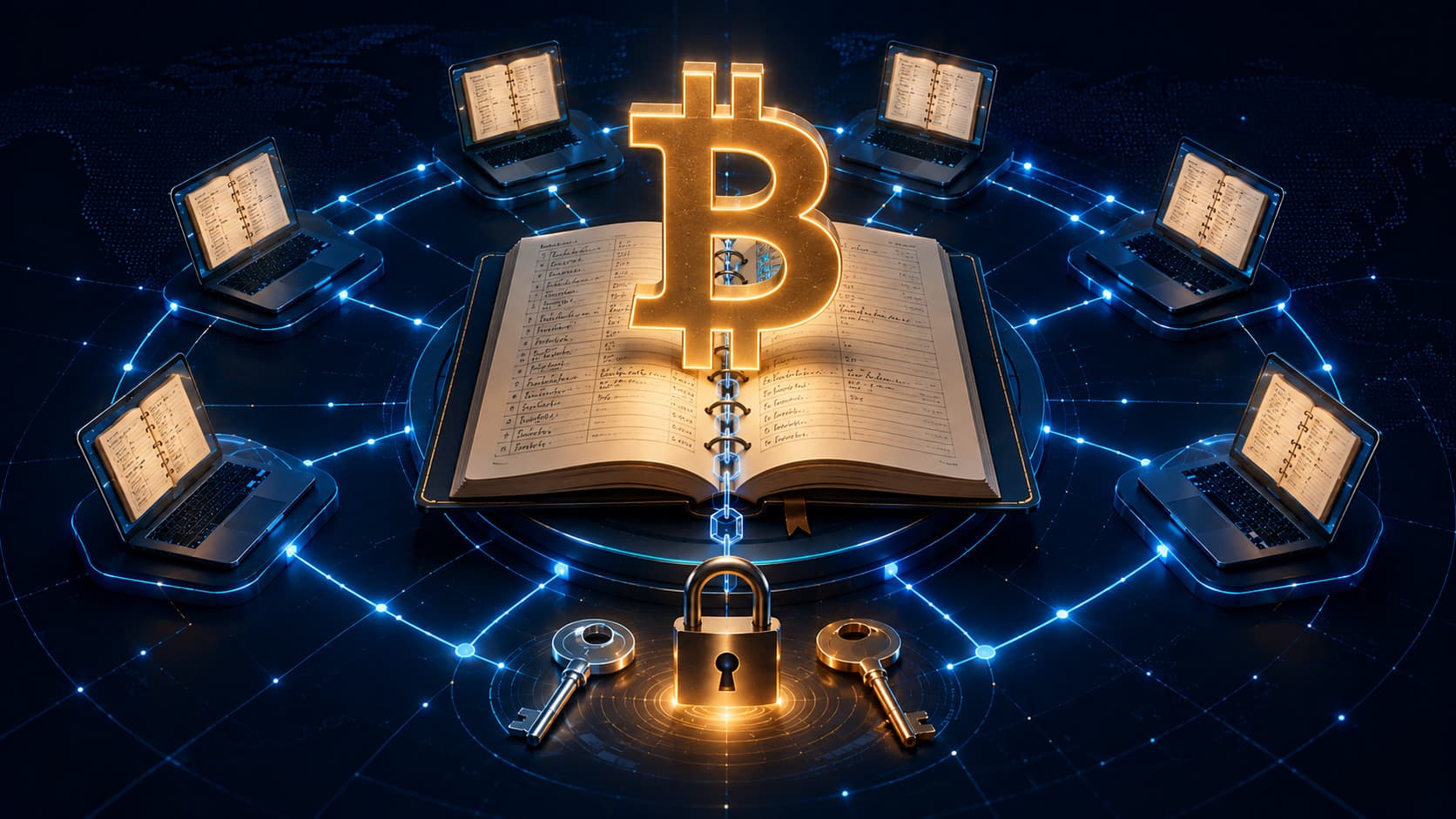
Imagine a notebook that thousands of people around the world keep an identical copy of. Every time bitcoin moves from one person to another, the transaction is recorded in that notebook. New pages are added through a deliberately difficult process, and cryptography allows people to prove they own bitcoin without revealing a secret key.
That notebook is the blockchain.
The difficult page-writing process is proof-of-work.
And the mathematical keys are what allow you to prove ownership.
Put those three ideas together, and Bitcoin suddenly becomes much easier to understand.
The Problem Bitcoin Had to Solve
Imagine you have $1,000 in your bank account and send $500 to a friend.
You don't have to worry about accidentally spending the same $500 twice.
Why?
Because your bank keeps the master record.
It knows:
-
how much money you have,
-
which transactions you've made,
-
whether you've already spent that money,
-
and whether your payment should be approved.
The bank is effectively the referee.
But digital information has a peculiar problem.
A photograph can be copied.
A document can be copied.
A digital file can be copied.
So what would stop someone from copying a digital "coin" and spending the same coin twice?
This is known as the double-spending problem.
Bitcoin's radical idea was:
What if we could solve this without having one central referee?
That is where the story gets interesting.
Imagine a Notebook Everyone Has a Copy Of
Forget the word blockchain for a moment.
Imagine a notebook.
Every page records a batch of transactions:
A sends bitcoin to B.
C sends bitcoin to D.
And so on.
Now imagine thousands of computers around the world each have their own copy of this notebook.
Nobody owns the master copy.
Nobody sits in a central office approving every page.
Instead, the computers communicate and compare their records.
When a new page is accepted, everyone updates their copy.
That's the basic idea behind Bitcoin's blockchain.
A block is essentially a page of transactions.
The chain comes from the fact that each new block is connected to what came before it.
And here's the important part:
The notebook is designed to move forward, not be rewritten.
Once information has been recorded and additional blocks are built on top of it, changing old history becomes increasingly difficult.
So when people say Bitcoin has a "distributed ledger," this is what they're talking about:
A shared record that thousands of independent computers maintain together.
💡 Did You Know?
Bitcoin's blockchain isn't a mysterious database floating somewhere on the internet.
It's essentially a continuously growing history of transactions that participating computers maintain and verify according to a common set of rules.
But Who Gets to Write the Next Page?
Now we have another problem.
If thousands of computers have a copy of the notebook, what's stopping all of them from trying to write the next page simultaneously?
Bitcoin needed a way to decide:
Who gets to add the next block?
Its answer is called proof-of-work.
And this is probably the part of Bitcoin that sounds most complicated until you picture it correctly.
Imagine a lock with billions of possible combinations.
You don't know which combination will open it.
So you start guessing.
And guessing.
And guessing.
Finding the correct combination takes enormous trial and error.
But once someone finds it, everyone else can check the answer almost instantly.
That's broadly what Bitcoin mining does.
Miners use computers to repeatedly attempt to solve a computational puzzle.
The process requires real computing power and electricity.
But checking whether a solution is valid is comparatively easy.
The network adjusts the difficulty so that, on average, a new block is added roughly every ten minutes.
The miner that successfully produces the winning result gets to add the next block and receives a reward that includes newly created bitcoin.
Why Make It So Difficult?
This is the clever part.
Bitcoin deliberately makes adding a block costly.
Why?
Because that cost helps protect the history already recorded.
Imagine someone wanted to secretly change an old transaction.
Changing that block wouldn't be enough.
They would effectively need to redo the computational work associated with that block and the blocks that came after it, while competing against the rest of the network continuing to add new blocks.
The more blocks that come after a transaction, the harder it becomes to reverse the history.
So the cost of rewriting the notebook becomes enormous.
Bitcoin's security isn't based on everyone being trustworthy.
It's based partly on making dishonesty expensive enough to discourage.
That's a very different way of creating trust.
Your Bitcoin Doesn't Actually Sit Inside Your Wallet
Here's another common misconception.
When you hear someone say:
"My bitcoin is in my wallet."
It sounds as though the wallet contains digital coins.
It doesn't work quite that way.
Think back to the notebook.
The blockchain contains the record of transactions.
Your wallet contains the information you need to prove you can authorize a transaction involving those funds.
And that's where two mathematically connected keys come in.
One Key You Can Share. One You Must Protect.
Think about a mailbox.
You can give people your mailing address.
They need it to send something to you.
But you wouldn't hand everyone the key that opens the mailbox.
Bitcoin uses a similar concept.
You have a public key that can be shared.
And you have a private key that must remain secret.
The private key is what allows you to authorize transactions.
When you send bitcoin, your wallet uses the private key to create a digital signature.
The network can then verify that signature using the corresponding public information.
Here's the clever part:
You can prove that you authorized a transaction without revealing your private key.
It's like proving you have the right key without handing the key to the person checking the lock.
That's how Bitcoin allows ownership to be verified without a bank sitting in the middle.
💡 Did You Know?
Your private key is not a password that can simply be reset by calling customer support.
It is fundamental to controlling access to the bitcoin associated with it.
That's why protecting private keys is so important.
Let's Follow One Bitcoin Transaction
Now let's put everything together.
Imagine you want to send bitcoin to a friend.
Step 1 — You Authorize It
Your wallet uses your private key to digitally sign the transaction.
This proves that the transaction was authorized by whoever controls the relevant private key.
Step 2 — The Network Sees It
The transaction is broadcast to participating computers on the Bitcoin network.
They check whether it follows the rules.
Step 3 — Miners Gather Transactions
Valid transactions waiting to be confirmed are gathered into a candidate block.
Miners compete to solve the proof-of-work puzzle.
Step 4 — Someone Wins
A miner finds a valid solution.
That miner gets to propose the next block.
Step 5 — The Network Verifies It
Other computers can quickly check whether the block and its transactions follow the rules.
If valid, the block becomes part of the blockchain.
Step 6 — More Blocks Follow
The network continues building new blocks on top.
As more blocks accumulate, changing the earlier transaction becomes increasingly difficult.
And that's it.
No bank approved the payment.
No single company updated a master database.
No central server decided whether the transaction was legitimate.
A distributed network followed a shared set of rules and arrived at agreement.
Visual representation:

So, Is Bitcoin Really "Trustless"?
This is where the Bitcoin story gets more interesting.
Bitcoin doesn't eliminate trust entirely.
Instead, it tries to replace trust in a central institution with trust in a system of rules, mathematics, cryptography, and economic incentives.
You don't have to personally know the thousands of computers maintaining the network.
You don't have to trust one bank to maintain the ledger.
You don't even have to trust the other participants personally.
The system is designed so that everyone can independently verify whether transactions follow the rules.
That's the deeper innovation.
The Three Ideas You Actually Need to Understand Bitcoin
You can forget most of the jargon.
If you understand these three ideas, you understand the foundation of Bitcoin.
1. Blockchain = The Notebook
A shared record of transactions maintained across many computers.
2. Proof-of-Work = The Costly Lottery
A computationally expensive process that determines who gets to add the next block and makes rewriting history increasingly difficult.
3. Public + Private Keys = Proof of Ownership
One can be shared.
The other must remain secret.
Together, they allow transactions to be authorized and publicly verified without a central authority.
That's Bitcoin in a nutshell.
Knowlegic Perspective
The biggest misconception about Bitcoin is that its most important invention is digital money.
It isn't.
The more interesting breakthrough is the mechanism underneath it.
Bitcoin asks a question that sounds almost impossible:
How do thousands of strangers agree on a shared record without appointing someone to referee it?
Its answer is remarkably elegant.
Give everyone a copy of the record.
Use cryptography to prove who is authorized to spend.
Use a deliberately costly computational process to decide who gets to add the next page.
Then make changing old pages increasingly expensive as new ones are added.
Suddenly, you don't need one trusted keeper of the notebook.
You have a network that can collectively maintain it.
That idea reaches far beyond cryptocurrency.
And that's why Bitcoin remains such an important technology story even if you never buy a single bitcoin.
Strip away the price charts, speculation, and crypto jargon, and Bitcoin becomes much easier to appreciate.
It's an answer to a very old problem:
How do strangers agree on what is true without having someone in charge?
The answer is a shared notebook nobody is supposed to rewrite, a computational puzzle that makes cheating expensive, and a pair of mathematical keys that let you prove ownership without exposing your secret.
Bitcoin's most fascinating invention isn't really the coin.
It's the system that lets thousands of strangers agree on who owns it.
Enjoyed this?
Get notified when a new Knowlegic story worth knowing is published.


