

How UPI Turned India Into the World's Largest Real-Time Payments Market
India's instant payments network now handles roughly half of the world's real-time payment volume. But the more interesting story isn't the number—it's how India built it.
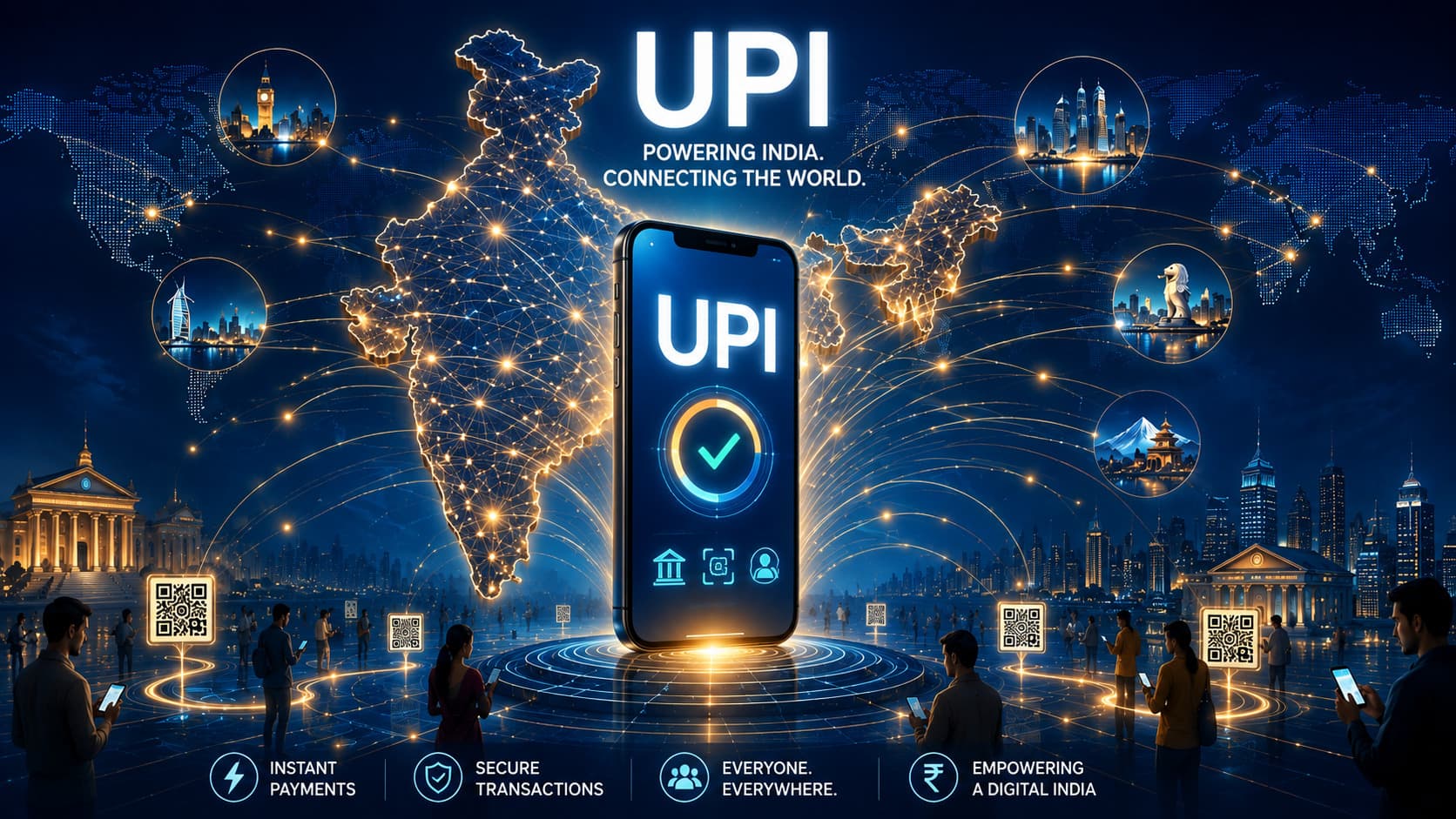
In 2016, India's Unified Payments Interface (UPI) launched with just 21 banks and almost no transaction activity.
A decade later, it had become one of the world's largest real-time payment systems, accounting for roughly 49% of global real-time payment transaction volume according to figures cited by the International Monetary Fund.
That scale wasn't created by one technology company, a clever app, or an aggressive marketing campaign.
It came from a different idea: build payments as shared public infrastructure.
Make it interoperable. Make it simple. Make it effectively free for users. Then put it in the hands of banks, fintech companies, merchants, and consumers.
The result changed what people in India expect from digital payments—and is now influencing how other countries think about instant payments.
From Almost Nothing to Half the World's Volume
When UPI launched in 2016, there was little reason to assume it would become a global payments phenomenon.
The system started with 21 participating banks. During its first three months, transaction activity was almost negligible.
Today, that beginning seems almost impossible to reconcile with its scale.
By May 2026, UPI processed approximately 23.2 billion transactions in a single month, worth nearly ₹30 trillion.
That's not the number of transactions since launch.
That's one month.
And according to real-time payments data cited by the IMF, UPI represented roughly 49% of global real-time payment transaction volume by 2026, more than the next four countries combined.
The question is obvious:
How did a payment system that barely anyone used in 2016 become this big?
The answer begins with one deceptively simple idea.
The Single Idea That Made UPI Different
Before UPI, sending money electronically often meant dealing with bank account numbers, IFSC codes, cards, wallets, and different payment systems.
UPI tried to make that experience feel much simpler.
Instead of asking someone for a long bank account number and routing information, users could send money using a Virtual Payment Address (VPA) essentially a simple digital identifier connected to a bank account.
The complexity stayed behind the scenes.
For the person making the payment, the experience became:
Choose a person → enter an amount → authenticate → pay.
That simplicity mattered.
But there was something even more important happening underneath.
UPI wasn't designed as a closed network belonging to one company.
The National Payments Corporation of India (NPCI) operates the core payment rails. Banks and licensed payment providers connect to the infrastructure, while consumer-facing apps such as Google Pay and PhonePe operate on top of it.
The systems remain interoperable.
In other words, one person's payment app doesn't have to be the same as the recipient's.
That may sound obvious today.
It wasn't always.
UPI effectively turned payments into a shared digital highway rather than a collection of competing private roads.
💡 Did You Know?
NPCI was created in 2008 by India's banking ecosystem, with support from the Reserve Bank of India and the Indian Banks' Association, to build and operate retail payment infrastructure.
UPI was therefore never simply another fintech app.
It was designed from the beginning as infrastructure.
And that distinction would become incredibly important.
Then Something Unexpected Happened
UPI launched in 2016.
Later that same year, India experienced one of the biggest disruptions to its cash economy.
In November 2016, the government withdrew the ₹500 and ₹1,000 banknotes that represented the majority of cash in circulation at the time.
Suddenly, millions of people and businesses had a reason to look for alternatives to cash.
UPI was still young.
But it was there.
The timing wasn't the result of careful coordination between the launch and demonetization. The two events happened within months of each other.
Yet the coincidence mattered.
A technology that had struggled to find users suddenly found itself in a country where digital payments had become much more relevant.
Then, four years later, the COVID-19 pandemic provided another push.
People became more comfortable with contactless and digital transactions, accelerating a shift that was already underway.
Sometimes technology doesn't grow simply because it is better.
It grows because the world suddenly gives people a reason to use it.
What Does "World's Largest" Actually Mean?
The phrase sounds impressive, but what does it really tell us?
Consider the numbers.
By May 2026, UPI was processing around 23.2 billion transactions every month, with a value approaching ₹30 trillion.
Now combine that with its estimated 49% share of global real-time payment transaction volume.
The important point isn't simply that Indians use UPI frequently.
It is that UPI has changed the baseline expectation for digital payments.
For millions of people, transferring money instantly doesn't feel like a special financial service.
It feels normal.
A small merchant can accept a digital payment.
A friend can split a restaurant bill.
A customer can pay a local shop.
A business can move money between accounts.
And the transaction can happen within seconds.
That's what successful infrastructure does.
Eventually, people stop noticing it.
The Secret Behind "Free"
There's another reason UPI feels so different from traditional card payments:
The consumer experience is remarkably inexpensive.
Since January 2020, regulations have prevented banks and payment providers from charging merchants a fee the Merchant Discount Rate (MDR) on standard UPI transactions.
This is a significant difference from many card payment networks, where transaction fees are part of the economics of the system.
But there's a catch.
Running infrastructure at this scale isn't free.
Servers cost money.
Networks cost money.
Security costs money.
Banks and payment providers need to maintain systems capable of handling billions of transactions.
The government has therefore provided financial support to help compensate parts of the ecosystem.
And this creates an uncomfortable question:
Can a system handling billions of transactions remain effectively free forever?
According to the source material, one recent allocation provided around ₹1,500 crore in support, while industry estimates put annual costs of running and expanding the system at around ₹10,000 crore.
Banks and payment providers have argued that the economics need reconsideration.
The government, meanwhile, has continued to maintain that there are no plans to introduce merchant charges on standard UPI transactions.
So the fundamental tension remains.
UPI has made digital payments extraordinarily accessible.
But someone still has to pay for the infrastructure underneath.
UPI isn't India's entire digital public infrastructure story.
It sits alongside other major pieces of what is often described as the India Stack.
Think of it as three connected layers:
Aadhaar → Identity
Jan Dhan → Bank access and financial inclusion
UPI → Payments
Together, these systems helped create a digital foundation that made financial services accessible to a much larger population.
UPI Is Starting to Cross Borders
UPI's story doesn't end at India's borders.
By 2026, the network had expanded into roughly ten countries, including Singapore, the UAE, France, Sri Lanka, Mauritius, Nepal, Bhutan, Qatar, Cambodia, and Greece.
Some of these developments are particularly interesting.
Singapore's PayNow system has been linked with UPI, allowing near-instant cross-border transfers between participating accounts.
In the UAE, UPI acceptance has expanded across a large network of merchants and point-of-sale terminals.
And France became the first European country to accept UPI payments, with merchant acceptance launched at the Eiffel Tower.
These international deployments are nowhere near India's domestic scale yet.
And replicating UPI isn't as simple as copying the app.
It requires banks, regulators, payment operators, and governments to agree on common infrastructure and interoperability.
That's difficult.
But the direction is significant.
A system originally built to solve India's payment challenges is gradually becoming part of the infrastructure connecting countries.
The Bigger Lesson Isn't About Payments
It's tempting to look at UPI as a technology success story.
But that misses the more interesting lesson.
UPI didn't win because it had the prettiest interface.
It didn't succeed because one private company built a better product.
And it didn't become enormous overnight.
Its success came from a combination of choices:
Shared infrastructure.
Interoperability.
Simple identifiers.
Low friction.
Government backing.
And, perhaps most importantly, timing.
The technology existed.
Then circumstances created urgency.
People began using it.
Businesses adapted.
More banks joined.
More apps appeared.
More merchants accepted it.
And the network became more valuable as more people joined.
That's the classic network effect—but built on public infrastructure rather than a single private platform.
Knowlegic Perspective
UPI's biggest achievement may not be the number of transactions it processes.
It's the change in expectations it created.
A payment that once felt like a banking transaction can now feel almost as simple as sending a message.
That's a powerful idea.
And it reveals something important about technology: the most transformative systems aren't always the ones consumers notice most.
We notice the app on our phone.
We don't notice the infrastructure underneath.
We notice the QR code.
We don't think about the banking rails, authentication, routing, settlement, security, and regulatory framework making that two-second payment possible.
UPI is therefore more than a payment interface.
It is an example of what can happen when digital infrastructure is designed as a shared utility rather than a closed product.
But its biggest question is still unanswered.
Can a system built to be free remain financially sustainable as it becomes essential infrastructure?
That may be the next chapter of the UPI story.
UPI began with 21 banks and almost no users.
Today, roughly half of the world's real-time payment transactions pass through the system.
That's an extraordinary transformation.
But perhaps the most interesting part isn't how quickly UPI grew.
It's why it grew.
India didn't simply build another payment app.
It built a common set of rails that banks, fintech companies, merchants, and consumers could share.
Then history gave those rails a reason to matter.
And once millions of people experienced instant, simple, interoperable payments, going back became difficult to imagine.
That is when infrastructure becomes something more than technology.
It becomes a habit.
And eventually, it becomes invisible.
Enjoyed this?
Get notified when a new Knowlegic story worth knowing is published.


