

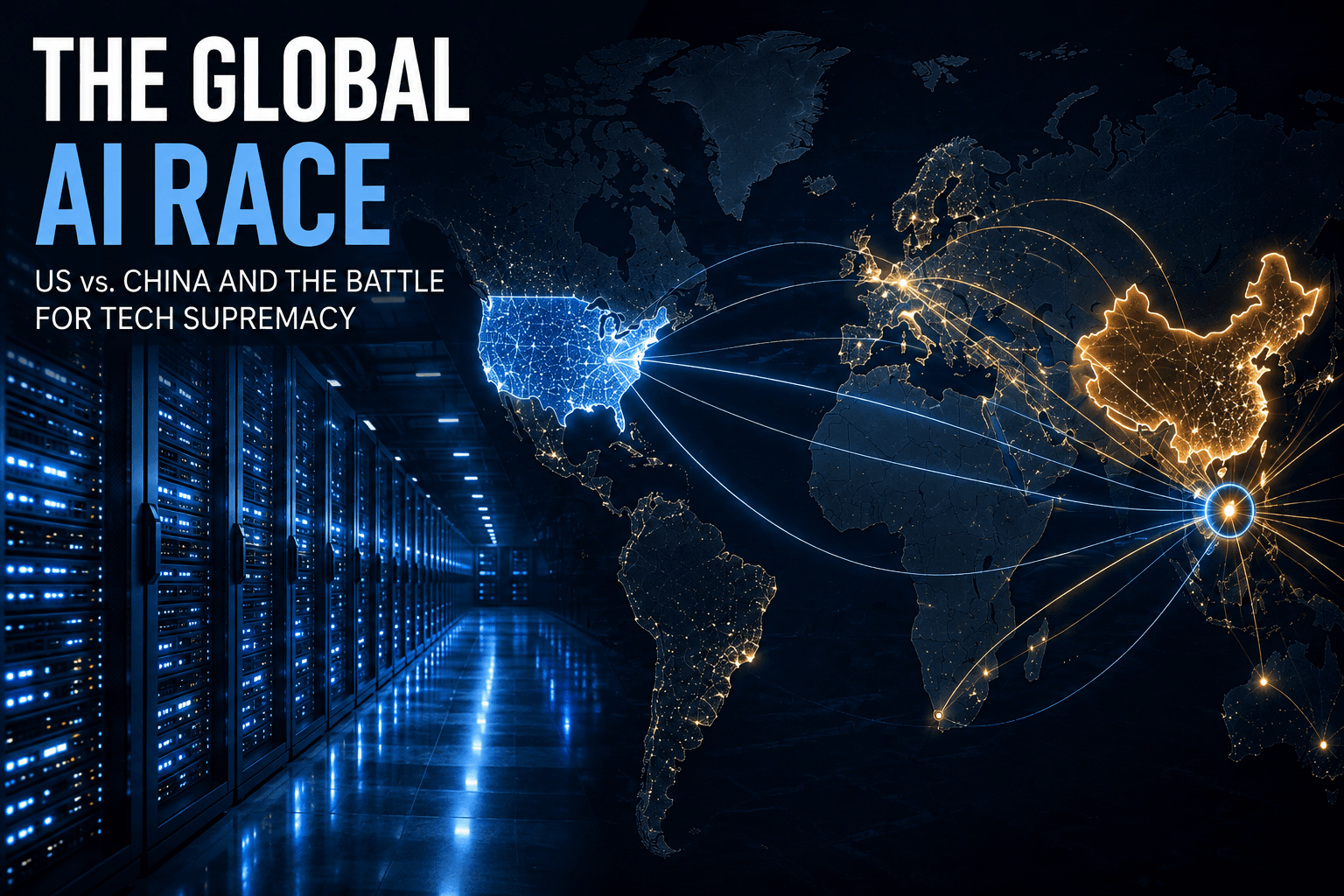
The Global AI Race: US vs. China and the Battle for Tech Supremacy
Who's actually ahead in compute, chips, talent, and models and why the honest answer depends entirely on which race you're watching.
On January 27, 2025, Nvidia lost nearly $600 billion in market value in a single trading day, the largest one-day loss in stock market history after a Chinese startup called DeepSeek showed that it could produce a competitive AI model at a fraction of the cost associated with leading American systems.
It was the moment the "US vs. China AI race" stopped feeling like an abstract geopolitical competition.
But the real picture is more complicated than a single scoreboard.
The US still dominates private AI investment by more than 20 to 1, while China produces more AI research papers and leads the world in industrial robot deployment. The gap between the two countries in frontier model performance has also narrowed dramatically.
So who is winning?
The more honest answer is:
It depends on which race you're measuring.
The $600 Billion Afternoon
On January 27, 2025, Nvidia's stock fell 17% in a single day, wiping out nearly $600 billion in market value.
The trigger wasn't a scandal.
It wasn't an earnings miss.
It was a research paper.
A Chinese startup called DeepSeek had released its R1 model, demonstrating performance competitive with leading American systems while claiming dramatically lower training costs.
The exact cost comparison was debated, but the message was enough to unsettle the market.
For years, a central assumption in Washington and Silicon Valley had been that staying ahead in AI required an ever-growing supply of the world's most powerful and expensive chips.
DeepSeek challenged that assumption.
If similar performance could be achieved more efficiently, then the question wasn't simply:
Who has the biggest pile of computing power?
It became:
Who can get the most intelligence from the computing power they have?
That single moment captures the larger dynamic.
The US and China aren't competing in one AI race.
They're competing across several.
Money.
Chips.
Talent.
Models.
And increasingly, the ability to turn AI into something useful in the physical world.
Did You Know?
China's AI ambitions were laid out years before the current AI boom.
In 2017, China's State Council published its New Generation Artificial Intelligence Development Plan, setting a three-stage roadmap: match the US in AI technology by 2020, achieve major breakthroughs by 2025, and become the world's primary AI innovation center by 2030.
Outspending Isn't the Same as Winning
By raw investment, the US isn't close to losing.
According to Stanford's 2026 AI Index, US private AI investment reached roughly $286 billion in 2025 more than 23 times China's reported $12 billion.
America's four largest technology companies alone are projected to spend roughly $760 billion combined on AI infrastructure in 2026.
That is an extraordinary gap.
But the comparison becomes more complicated when China's state-directed investment is included.
Researchers estimate that Chinese government guidance funds have channelled roughly $184 billion into AI firms since 2000, through state-linked funds rather than conventional venture capital.
So the numbers don't tell a simple story of one country spending more than the other.
They reveal two different approaches.
The US relies heavily on private capital and technology companies.
China combines private investment with substantial state direction.
And then there is the most important question:
What are they buying with all that money?
The Chip Battle
Hardware is where the US has tried hardest to maintain an advantage.
Washington began restricting advanced semiconductor exports to China in 2022 and tightened those controls further under subsequent policy changes.
But the rules have continued to evolve.
As of early 2026, Nvidia can sell certain high-end chips to Chinese customers again, under conditions including shipment limits and additional oversight.
The policy keeps changing.
And that instability is revealing.
It shows how difficult it is to use access to hardware as a permanent strategic advantage.
The US also isn't acting alone.
Since 2019, Washington has worked with the Netherlands and Japan to restrict China's access to the machinery required to manufacture the most advanced chips not just the chips themselves.
That brings us to a company most consumers have never heard of.
ASML.
The Dutch company produces extreme ultraviolet lithography systems the machines required to manufacture some of the world's most advanced semiconductors.
Think of chipmaking as baking.
The semiconductor is the finished cake.
The manufacturing equipment is the oven.
And ASML makes the extraordinary ovens needed for the most advanced recipes.
Under Dutch export restrictions aligned with broader US policy, ASML cannot sell its most advanced systems to Chinese customers.
The result has been predictable.
China is trying to build more of its own semiconductor supply chain.
One estimate from Morgan Stanley puts China's AI-chip self-sufficiency at roughly 40% in 2026, up from around 20% in 2023, led by Huawei's Ascend chips and domestic manufacturing through SMIC.
But China still faces important bottlenecks, particularly in high-bandwidth memory.
So the restrictions may be doing two things at once:
slowing China's access to the most advanced hardware while accelerating its push to build alternatives.
The Taiwan Chokepoint
Behind all of this sits a single geographic vulnerability:
Taiwan.
TSMC controls roughly 90% of the market for the most advanced chip nodes the manufacturing processes that underpin many frontier AI systems.
That makes Taiwan extraordinarily important to both sides.
The US depends on Taiwanese manufacturing.
China depends on the broader semiconductor ecosystem.
Neither country can easily replace that capacity today.
So the AI race isn't entirely taking place in laboratories.
Part of it is happening across oceans, factories, trade routes and supply chains.
The most powerful AI system in the world still needs something very physical:
a chip.
And that chip has to be manufactured somewhere.
Who Actually Owns the Best Minds?
This is where the scoreboard gets interesting again.
On paper, China is winning the numbers game in AI research.
Chinese researchers now produce roughly 23% of global AI publications, compared with about 13% from the US.
China also files close to 70% of AI patents worldwide.
That sounds decisive.
But publication volume and patent counts don't necessarily equal influence.
The US still leads in highly cited AI research, and roughly half of AI patent citations worldwide point back to American patents.
In other words:
China is producing enormous amounts of AI research.
The US continues to have disproportionate influence over the research being built upon.
And then comes the most interesting variable:
talent.
Research from the Paulson Institute's MacroPolo project has found that around 57% of the world's top AI researchers work in the United States.
At the same time, Chinese-origin researchers represent roughly 38% of the world's top AI talent working in US institutions.
China is producing an increasing share of the world's elite AI talent.
But many of those researchers are working elsewhere.
Producing talent and retaining talent are two different achievements.
For now, the US still has the stronger position on the second.
Did You Know?
China now files close to 70% of AI patents worldwide, but patent volume alone doesn't translate directly into influence.
Around half of AI patent citations worldwide still point to US patents.
The difference illustrates an important lesson:
More patents don't necessarily mean more technological influence.
The Race That's Actually Closing
If there is one area where the gap has changed dramatically, it is model performance.
In May 2023, the strongest Chinese AI models trailed the best American models by roughly 18–32 percentage points across major benchmarks, depending on the test.
By 2026, Stanford's AI Index put that gap at just under 3 percentage points.
That's a remarkable change in a relatively short period.
And it changes the question.
The US may still have the strongest individual frontier models.
But the distance between the two countries has become much smaller.
Meanwhile, China is pulling ahead in another dimension:
deployment.
According to the International Federation of Robotics, China accounted for 54% of industrial robots installed globally in 2024.
That matters because AI doesn't ultimately create economic value by sitting inside a benchmark.
It creates value when someone uses it.
On factory floors.
In warehouses.
Inside vehicles.
Across logistics networks.
And eventually, wherever machines interact with the physical world.
Put the two trends together and a pattern emerges.
American labs tend to lead the race to build highly capable frontier models.
China is increasingly strong at putting AI into the physical economy at enormous scale.
Those are different races.
And both matter.
Knowlegic Perspective
The instinct to ask "Who's winning the AI race?" comes from an older mental model.
Two superpowers.
One finish line.
One winner.
AI doesn't fit that shape.
Money, hardware, talent, models and deployment are different competitions with different rules.
A country can dominate one while trailing another.
Both facts can be true at the same time.
That's why a headline declaring that one country has "won" the AI race can be technically impressive and still miss the bigger story.
The US has enormous financial resources, world-leading technology companies and a powerful concentration of elite AI talent.
China has enormous manufacturing capacity, growing research strength, state-directed investment and an extraordinary ability to deploy technology at scale.
And sitting between them is a semiconductor supply chain that neither can easily replace.
The real competition may therefore not be:
US vs. China.
It may be:
Who can build the strongest AI ecosystem from research to chips to deployment?
That is a much harder race to win.
Sources & References
Stanford HAI - The 2026 AI Index Report: Economy
CNBC - Nvidia Sheds Almost $600 Billion in Market Cap, Biggest Drop Ever
CSIS - DeepSeek's Latest Breakthrough Is Redefining the AI Race
MacroPolo - The Global AI Talent Tracker
International Federation of Robotics — World Robotics 2025 Report: Global Robot Demand in Factories Doubles Over 10 Years
Semiconductors Insight - US China Chip Export Controls H200 2026: The Policy Shift Explained
CNBC — ASML Blocked from Exporting Some Critical Chipmaking Tools to China
Enjoyed this?
Get notified when a new Knowlegic story worth knowing is published.


