

The Fight Over Where Data Centers Get Built
The industry has the money and the chips. What it increasingly cannot get is a town willing to host the building.
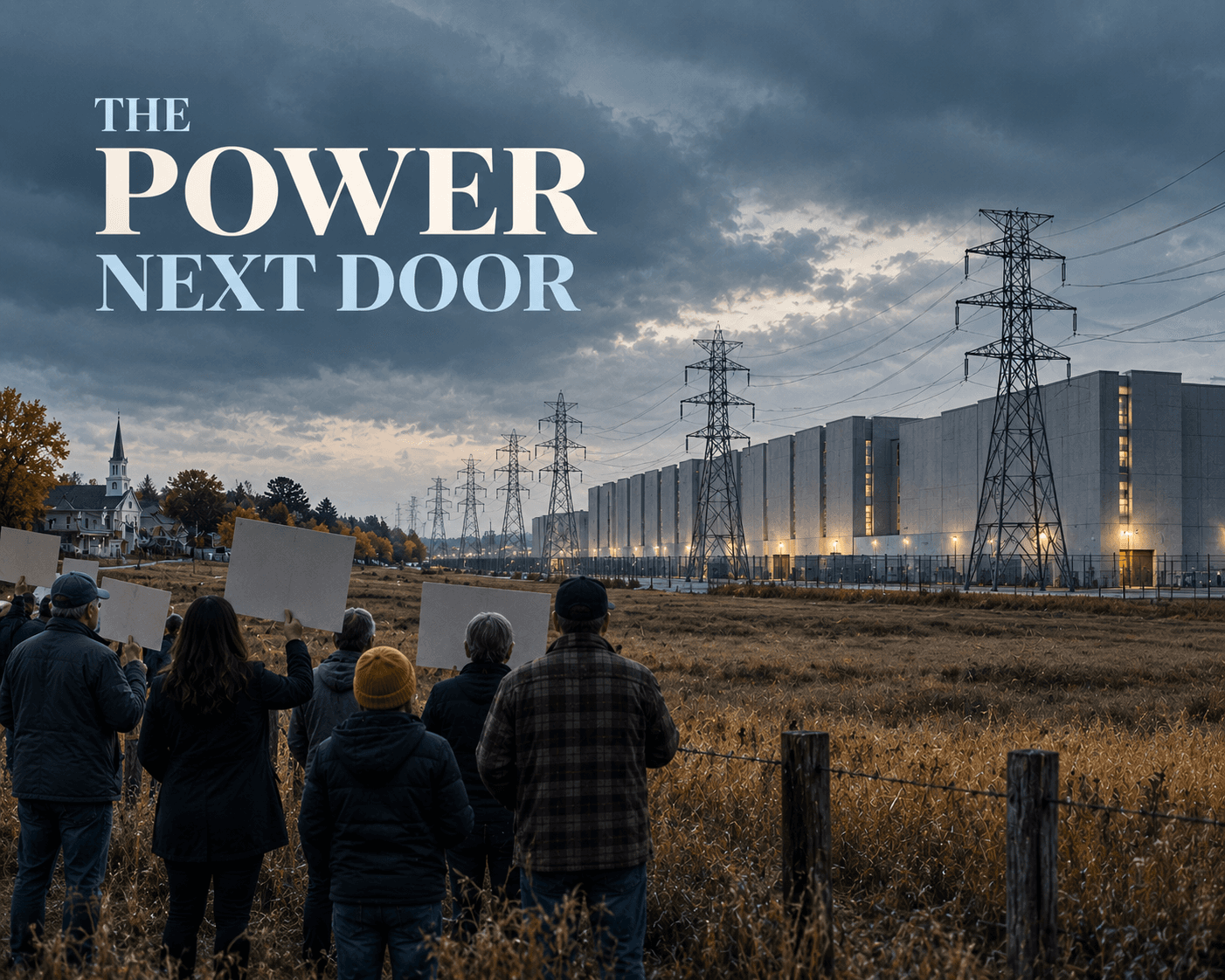
The meeting is in a county building most people in the state could not find on a map. The agenda item is a rezoning request for farmland on the edge of town. The company behind it will not say which technology giant it represents.
The room is full anyway. People who have never attended a planning meeting are holding index cards with questions about groundwater, night-time noise, and what happens to their electricity bill. A few months later the project is on hold, and the company is looking at a different state.
Scenes like this are now the real limit on how fast computing can grow. The money is there and the chips are increasingly there. What is running short is the supply of communities willing to live next to the result.
The Building Nobody Wants Next Door
For most of the past decade, a data center was something that happened to a town rather than something it debated. The buildings are low, quiet from a distance, and pitched to local officials as tax revenue that arrives without schools or traffic attached.
That reception has curdled. More than 160 large AI data centers have been proposed or built across the country in three years, a sharp jump over the previous stretch, and the pushback has scaled with it. By one tracking effort, communities in more than 15 states are now actively fighting projects, and a recent poll found a clear majority of Americans do not want one built near them.
The opposition is unusual in who it unites. Rural conservatives worried about farmland sit alongside climate groups worried about emissions and suburban homeowners worried about their water pressure. A project can clear every financing hurdle and still die in a zoning vote.
The pattern is visible case by case. In August 2026, voters in Wrightstown, Wisconsin, rejected a referendum on whether the village should help build infrastructure for large data centers, after residents forced a construction pause so they could weigh in at the polls. Officials in a Pennsylvania township unanimously turned down a nearly two-million-square-foot proposal for a historic hospital site. San Marcos, Texas, went further and rewrote data centers out of its zoning code entirely after rejecting a $1.5 billion campus.
Why a Windowless Box Draws a Crowd
The concern comes down to two utilities most people never think about: water and power.
A hyperscale data center, the largest class, generally uses between one and five million gallons of water a day, mostly to shed the heat its servers produce. That is the daily household use of a town of tens of thousands of people, drawn continuously, often from the same aquifer the town drinks from. The National Security Agency's facility in Bluffdale, Utah, used more than 126 million gallons in one reported year, enough to cover the indoor needs of hundreds of local homes.
The electricity figures are larger still. American data centers used a little over 4 percent of the nation's electricity in 2023, and a Department of Energy analysis expects that to reach somewhere between 7 and 12 percent by 2028. A single campus can be designed to draw as much power as a mid-sized city, and it wants that power around the clock, which is the hardest kind for a grid to supply. This is the physical reality behind the abstract question of why a data center drinks so much water and power in the first place.
Did You Know?
The water a data center loses is mostly evaporated, not returned. Many large centers use evaporative cooling, which works like sweat: water is passed over warm air and allowed to evaporate, carrying heat away. The cooling is efficient, but the water leaves as vapor rather than flowing back into the local system, which is why "withdrawal" and "consumption" figures for these buildings diverge so sharply.
The Bill That Arrives on Everyone's Statement
The most politically potent argument is the one that lands in the mailbox.
When a data center needs hundreds of megawatts, a utility often has to build new transmission lines, substations, and sometimes new generation to serve it. Under most rate structures, those costs are spread across the whole customer base rather than billed entirely to the company that triggered them. Residential electricity prices have risen fastest in regions dense with data centers, with increases well above the national average in parts of the mid-Atlantic over five years.
The size of the effect is genuinely disputed. One figure widely quoted, a 267 percent jump, refers to wholesale power prices in certain markets, not household bills. A Rutgers analysis of the years through 2024 found no strong evidence that data centers had meaningfully raised residential bills yet, while cautioning that the hyperscale wave was only beginning. Federal researchers list data centers as one cause of rising prices among several, alongside an aging grid and equipment costs. What is not disputed is the direction, and by 2030 the average American bill is projected to be higher specifically to pay for grid expansion tied to this demand.
Interesting fact: The first three months of 2026 saw about $130 billion in data center projects delayed or cancelled in the United States, by a Time tally of the slowdown. Financing trouble and power-connection queues explained much of it, but organized local resistance was a named factor in a large share of the stalled projects.
When a State Hits Pause
In July 2026, New York's governor signed an executive order creating what the state described as the country's first statewide moratorium on new hyperscale data centers, defined as those drawing 50 megawatts or more. It pauses discretionary state environmental permits for up to a year while regulators write rules covering energy, water, and cost.
Projects already holding complete permits can proceed, so the order is a slowdown rather than a wall. But it is a signal. Pennsylvania, Michigan, and South Carolina have all seen similar proposals floated, and dozens of towns have passed their own local pauses without waiting for the state.
Industry groups argue that every blocked project is jobs lost and ground ceded in the competition with China to lead in AI. That framing works less well at the county level, where the jobs number for a finished data center, which runs on a small permanent staff, is modest, and the water is local.
The Map Is the Strategy Now
Faced with resistance, the industry is doing what constrained industries do: moving.
Some of the movement is to friendlier states with cheap power and few objections, which concentrates the strain on a handful of regional grids and river basins. Some is offshore, to countries offering electricity and speed. And some is technical, toward closed-loop cooling that recycles water and toward building dedicated power plants, including nuclear, so a project does not have to fight over the shared grid at all.
The through-line is that siting has become the hard part. A decade ago the question was whether a company could afford the servers and whether the chips existed to fill them. Now it is whether there is a place that will take them, and that question increasingly gets answered in a packed county meeting room rather than a boardroom.
Knowlegic Perspective
The buildout of artificial intelligence has been described mostly as a race for chips and capital, and for a while that was accurate. Those constraints are easing. Chip supply is expanding and the money committed to infrastructure is enormous.
The constraint that replaced them is older and slower to solve: physical infrastructure has to sit somewhere, and the somewhere has residents. A data center is not a factory that employs the town or a road that serves it. It is a large private claim on the town's water table and its share of the regional grid, offering tax revenue in exchange. Communities are getting more precise about whether that trade is worth it, and their answer is often no.
That is not necessarily a failure of the system. It is the part of the system, local land use and utility regulation, that was always going to decide where this stuff physically goes. The industry has the money and the chips. What it increasingly cannot get is a town willing to host the building.
Sources & References
- Community Backlash to AI Data Centers Is Growing Across the U.S., Time (2026)
- First Statewide Moratorium on New Hyperscale Data Centers Launched by Governor Kathy Hochul, Office of the Governor of New York (2026)
- Can you build data centers in a desert without draining the water supply? Utah is finding out., Grist (2026)
- How much have data centers increased electricity prices?, PolitiFact (2026)
- Are Data Centers Raising Your Electric Bill? Mostly Not. Yet., New Jersey State Policy Lab, Rutgers University (2026)
- From Energy Use to Air Quality, the Many Ways Data Centers Affect US Communities, World Resources Institute (2026)
Enjoyed this?
Get notified when a new Knowlegic story worth knowing is published.


