

Huawei vs. Nvidia: How Export Controls Redrew the AI Chip Map
How four years of U.S. chip restrictions cost Nvidia its China business, handed Huawei the home market, and then partly reversed themselves.
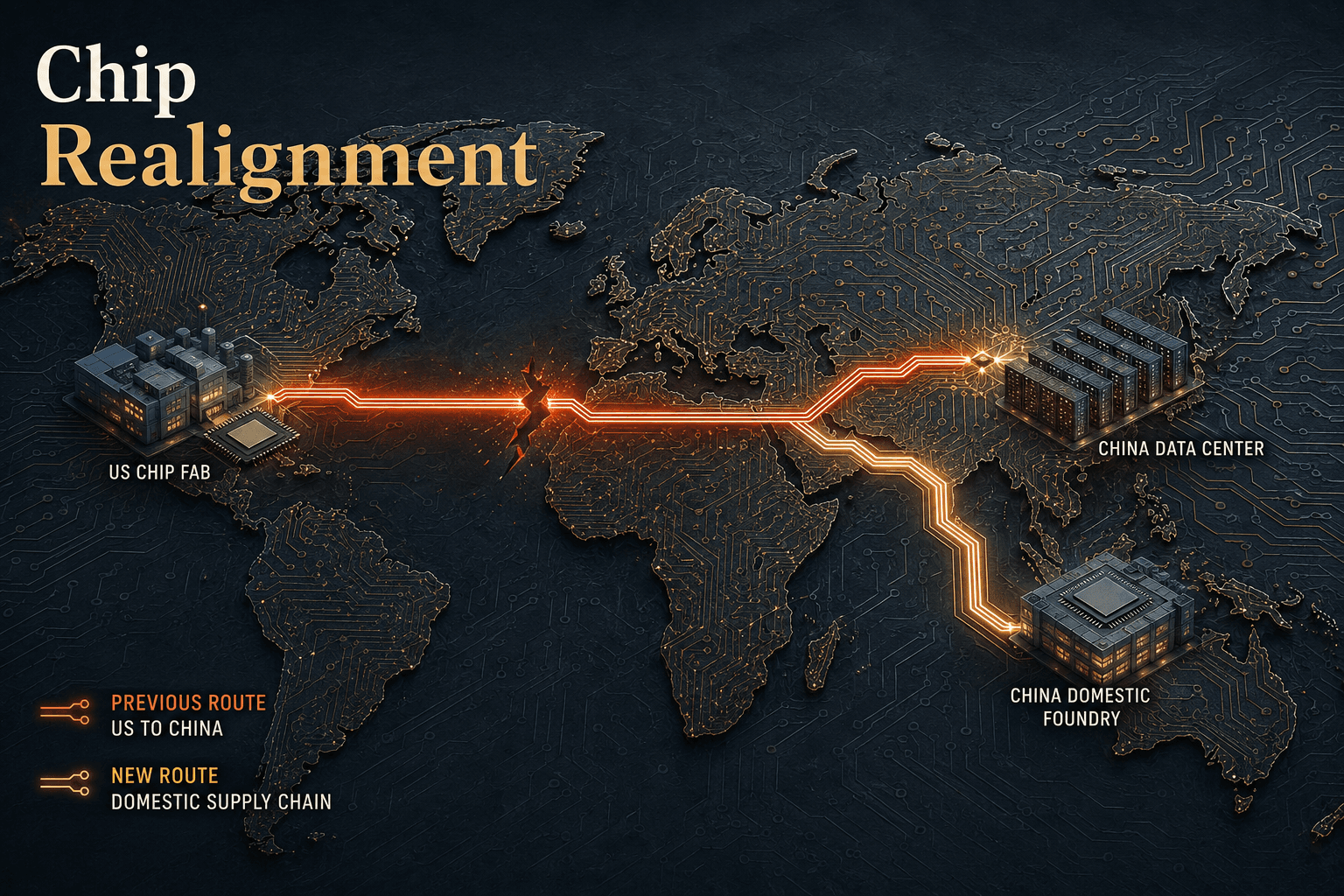
In the spring of 2025, Nvidia told investors it was writing off about $4.5 billion worth of chips. The hardware was finished and sitting in warehouses. It had been built for one market, China, and a new licensing rule had just made it illegal to ship there without permission that was not going to come. Losing that market mattered precisely because of how fast China had built itself into a technology power.
For years, the United States had treated advanced chips as a faucet it could turn down whenever it wanted. Restrict the best processors, the thinking went, and China's AI ambitions would slow while American companies kept their lead. Nvidia, the company whose chips train nearly every large AI model, was both the crown jewel being protected and the business being cut off from one of its largest markets.
Export controls proved easy to write and hard to aim. They cost Nvidia its China sales without stopping China's AI build-out, and by 2026 Washington was quietly walking some of them back. Chips are only one front in the wider contest between the United States and China over AI.
The faucet that fed a whole industry
For most of the last decade, if you wanted to train a serious AI model anywhere in the world, you bought Nvidia. Its graphics chips turned out to be unexpectedly good at the math behind neural networks, a story told in how a niche graphics feature became the backbone of modern AI. China was no exception. Chinese cloud providers and internet giants were among Nvidia's biggest customers, and the company held something close to a monopoly there.
Washington saw that dependence as leverage. Starting in 2022, the Commerce Department's Bureau of Industry and Security limited which chips Nvidia could sell to China, then tightened the limits each time Nvidia designed a slower part to fit under them. The A800 gave way to the H20, and in April 2025 the H20 was blocked too.
The logic was a chokepoint strategy. The United States and its allies dominate a few narrow steps in chipmaking: the design software, the most advanced factories, the machines that pattern circuits at the smallest scales. Control those steps, analysts at the Center for Strategic and International Studies argued, and you control who can build frontier AI hardware.
What the controls actually did to Nvidia
The financial hit was immediate. On top of the $4.5 billion inventory charge, Nvidia said it could not ship another $2.5 billion in orders that quarter. China had once been a fifth to a quarter of its data center revenue. That contribution shrank toward nothing.
By late 2025, Nvidia chief executive Jensen Huang was blunt about it. The company's share of China's market for advanced AI accelerators, he said, had gone from about 95 percent to zero. That figure describes the newest restricted chips rather than every processor Nvidia had ever sold into the country, and independent trackers put the blended 2025 number higher, closer to half. Either way the direction was the same, and it was steep.
Did You Know?
When the H20 ban landed, Chinese regulators added their own discouragement. State media and government bodies warned domestic companies against buying Nvidia's China-only chips on security grounds, effectively pushing buyers toward local suppliers at the same moment Washington was pushing them away from Nvidia.
The opening Huawei walked through
A market that big does not stay empty. Huawei, already under U.S. sanctions since 2019 and shut out of Google's Android abroad, had spent years building an AI chip line called Ascend. When Nvidia's supply dried up, Huawei had the one thing that mattered: a product that was available.
Its Ascend accelerators are not as fast as Nvidia's best, and the software around them is younger and rougher. Nvidia's real moat was never just the chip. It was CUDA, the programming layer that a generation of AI researchers already knows by heart, along with the libraries and tooling built on top of it over nearly two decades. Moving a large model to Huawei's stack means rewriting low-level code, chasing down bugs the tools do not yet catch, and losing the shortcuts that make Nvidia hardware feel routine. Chinese labs describe weeks of engineering effort to get training runs stable on Ascend that would have started on day one with Nvidia.
Huawei's answer to the raw speed gap has been to wire many chips together into large clusters, trading the elegance of a single powerful processor for the brute force of a crowd. Its flagship system links hundreds of Ascend chips across more than a dozen racks and leans on sheer numbers to rival Nvidia's top configurations. Think of it as winning a moving job with a fleet of small vans because the big trucks are not for sale: it works, but it burns more fuel, more drivers, and more space to haul the same load.
Analysts expect Huawei to supply somewhere around half of China's AI accelerators in 2026, up sharply from a much smaller slice the year before. Those are projections, not audited results, and estimates vary by firm. The trend line, again, is not really in dispute.
The ceiling Huawei is still under
Being the only option at home is not the same as catching up. Huawei's chips are made by SMIC, China's largest foundry, which is stuck producing at what the industry calls the 7-nanometer node. It gets there using older patterning machines, because the newer extreme-ultraviolet tools are themselves under export control.
Taiwan's TSMC, which builds Nvidia's chips, is already two generations ahead at 3 nanometers, with production yields reported well above 90 percent. Estimates of SMIC's yield on its advanced line run far lower, meaning a large share of each batch is scrapped. Each Huawei accelerator therefore costs more to make and delivers less, and China cannot easily buy the machines that would close the gap. The demand for computing power keeps rising anyway, a pressure visible in why AI data centers consume so much electricity and water.
Even with Nvidia officially frozen out, Chinese firms reportedly ordered more than two million of Nvidia's H200 chips for 2026, according to people cited by Reuters, far more than Nvidia had in stock. The appetite for Nvidia hardware never went away. Only the legal path to buying it did.
Washington changes its mind
By the end of 2025, the calculus in Washington had shifted. In December, President Trump announced that H200 sales to approved Chinese customers could resume, with the U.S. government taking a 25 percent cut of the proceeds. In January 2026, the Bureau of Industry and Security made it official: license applications for chips like Nvidia's H200 and AMD's MI325X would move from near-automatic denial to case-by-case review.
The new policy came with conditions. Exporters have to show the sales will not starve American customers of supply, buyers have to accept screening and monitoring, and the chips have to pass independent testing in the United States first.
Two arguments drove the reversal. One held that a mid-tier Nvidia chip sold under supervision was better than pushing China fully onto Huawei and forfeiting the revenue that funds American research. The other held that the controls had already done their damage and were now mostly subsidizing a competitor. Both point at the same uncomfortable conclusion: the leverage was real, but it was a blunt instrument, and holding it too tightly cut the hand using it.
Knowlegic Perspective
Sanctions and export controls are often discussed as if precision were a given, as if a government could reach into a global industry and remove exactly one capability from exactly one country. The chip story is a useful corrective. The same rule that emptied Nvidia's China revenue also guaranteed Huawei a captive market, accelerated China's push to build its own tools, and left American policymakers negotiating against a domestic industry they had inadvertently strengthened.
None of this means the controls achieved nothing. China's leading chips are still years behind, made in smaller volumes at higher cost, and that gap has strategic weight. But the case is a reminder that in a supply chain this entangled, there is no clean cut. Every restriction is also an incentive, and the target usually gets a vote.
Export controls turned out to be easy to write and hard to aim. They cost Nvidia its China business without stopping China's AI build-out, and within a few years Washington was walking some of them back, having learned that a lever this powerful is also this difficult to pull cleanly.
Sources & References
- Department of Commerce Revises License Review Policy for Semiconductors Exported to China, U.S. Bureau of Industry and Security (2026)
- NVIDIA Announces Financial Results for First Quarter Fiscal 2026, NVIDIA Corporation via U.S. Securities and Exchange Commission (2025)
- Jensen says Nvidia's China AI GPU market share has plummeted from 95% to zero, Tom's Hardware (2026)
- Choking off China's Access to the Future of AI, Center for Strategic and International Studies (2022)
- The Limits of Chip Export Controls in Meeting the China Challenge, Center for Strategic and International Studies (2025)
- Huawei AI CloudMatrix 384: China's Answer to Nvidia GB200 NVL72, SemiAnalysis (2025)
Enjoyed this?
Get notified when a new Knowlegic story worth knowing is published.


