

The Gut-Brain Connection: How Your Stomach Talks to Your Brain
The nerve connecting your gut and brain carries far more information upward than downward meaning your gut may be talking to your brain more than you realize.
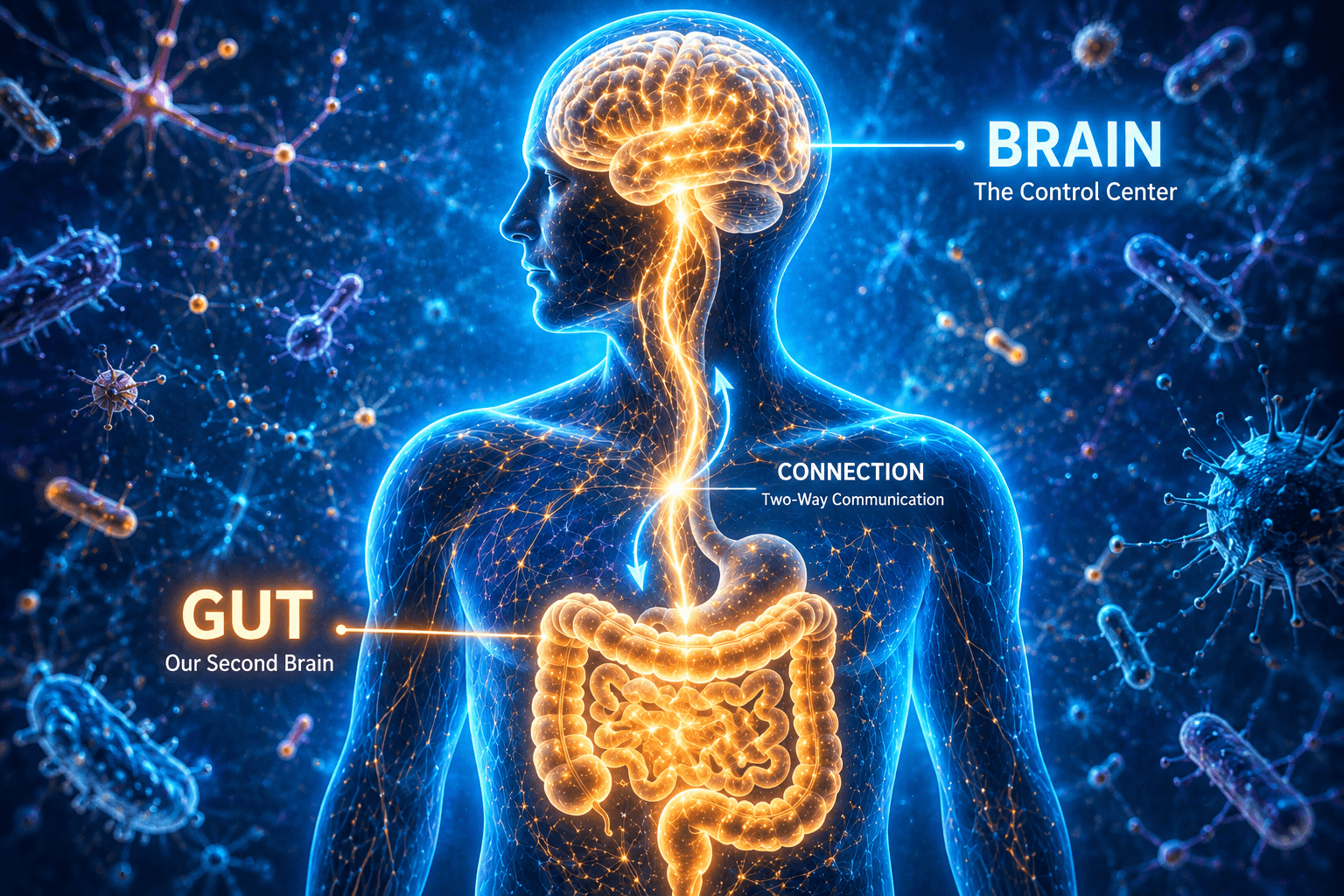
Somewhere inside your intestines, a microscopic workforce is operating around the clock.
These bacteria help break down fiber your own digestive enzymes cannot process. They produce useful compounds and contribute to your vitamin supply. They help train the immune system to distinguish harmless substances from potential threats. They compete with invading microbes for space and nutrients.
And, surprisingly, they can even chemically alter certain medicines.
The familiar story is that gut bacteria help with digestion.
The more interesting story is that they are part of a biological partnership your body relies on every day.
The Microscopic Workforce Living Inside You
Somewhere Inside You, a Workday Has Already Begun
You haven't thought about them today.
You can't see them.
You can't feel most of what they're doing.
Yet right now, inside your intestines, an enormous population of microorganisms is going about its work.
Some are fermenting the fiber you ate.
Some are producing compounds your body can use.
Some are interacting with immune cells.
Others are occupying territory that potentially harmful microbes would like to claim.
And some can even alter what happens to a medicine after you swallow it.
Digestion may be the least interesting thing they do.
The Workforce Is Bigger Than the Old Number Suggested
You've probably heard the famous claim:
There are 10 bacterial cells in your body for every human cell.
It sounds extraordinary.
It was also wrong.
The statistic can be traced to a rough estimate from 1972. In 2016, researchers recalculated the numbers and arrived at something much closer to an even relationship: approximately 38 trillion bacterial cells compared with about 30 trillion human cells.
Imagine hiring 38 trillion employees.
None of them ask for a salary.
None ever sleep.
None clock out.
And every single one is working inside your body...
right now.
Some manufacture vitamins.
Some defend you against dangerous bacteria.
Others quietly decide whether the medicine you swallowed this morning will actually work.
Most people call them "gut bacteria."
Scientists call them one of the most important ecosystems you'll ever own.
Researchers estimate that bacteria in the human gut collectively possess around 3.3 million unique genes, compared with roughly 20,000 genes in the human genome.
That's around 150 times more genetic machinery.
And a healthy gut can contain around a thousand different bacterial species.
Think about what that means.
Your body isn't operating using only the instructions encoded in human DNA.
It is working alongside an enormous genetic ecosystem.
Job One: Breaking Down What You Physically Cannot
Think about the last time you ate an apple, vegetables, oats, or another fiber-rich food.
Your digestive system immediately went to work.
But there is a problem.
Human digestive enzymes cannot break down most dietary fiber.
So what happens to it?
It travels farther down the digestive tract.
And eventually reaches a community of organisms that can do something your own cells cannot.
Gut bacteria ferment it.
That process produces short-chain fatty acids, including one of the most studied compounds, butyrate.
Butyrate becomes an important fuel source for cells lining the colon.
So the fiber you cannot digest isn't necessarily waste.
It becomes raw material for another biological workforce.
Your Meal Is Also a Message
This changes the way we can think about dietary fiber.
Every time fiber reaches the gut, it becomes an indirect instruction to the bacterial community living there.
Here is something you can work with.
The bacteria ferment it.
The resulting compounds interact with the cells lining your intestine.
And the relationship continues.
Food isn't simply feeding you.
Some of it is feeding the ecosystem that helps your body function.
You eat the food. Your microbiome gets the ingredients.
What happens next is a biological collaboration.
Job Two: Running a Tiny Vitamin Factory
Breaking down fiber is impressive.
But the microbiome has another job that sounds almost industrial.
Vitamin production.
Certain gut bacteria, including strains from groups such as E. coli, Bacteroides, Bifidobacterium, and Lactobacillus can manufacture vitamins as part of their metabolism. Some of that production becomes available to their human host.
The source article notes that gut bacteria may contribute as much as half of the body's daily vitamin K requirement, alongside contributions to B vitamins including B12, biotin, and folate.
That's more than a nutritional bonus.
It suggests that the relationship between humans and their microbiome is deeply integrated.
In laboratory settings, animals raised without gut bacteria develop vitamin deficiencies more readily than normal animals evidence that microbial activity can become an important part of nutritional biology.
A Factory You Never Have to Turn On
You don't plug it into electricity.
You don't press a button.
You don't even consciously operate it.
The production line simply runs.
Every day.
Inside you.
Job Three: Training Your Immune System
Now the story gets even more interesting.
Your gut isn't merely a digestive tube.
It's also a major meeting point between the outside world and your immune system.
The source article estimates that roughly 70–80% of the body's immune cells are stationed in or around the gut. Gut bacteria actively influence how those immune cells behave.
And the training isn't simply:
"Learn how to attack."
It is also:
"Learn when not to attack."
The Immune System Needs Restraint
Every day, your gut encounters food particles, microorganisms, and countless substances.
If the immune system treated everything unfamiliar as an enemy, the intestine would be in a constant state of unnecessary inflammation.
Gut bacteria help shape the immune system's ability to distinguish between threats and harmless signals.
This calibration is particularly important early in life, when the immune system is developing. The source article notes that disruptions during this early period have been associated with increased risk of allergic and autoimmune conditions later on.
And these immune cells don't necessarily stay in the gut.
They can circulate elsewhere in the body, carrying some of that immune "training" with them.
A well-trained immune system isn't simply one that attacks efficiently.
It's one that knows when to stand down.
Did You Know?
Between 90% and 95% of the body's serotonin is produced in the gut, primarily by specialized cells called enterochromaffin cells.
But there's an important nuance.
That serotonin doesn't simply travel into the brain and directly determine your mood, as popular explanations sometimes suggest.
Much of its role is local helping regulate intestinal movement and secretion.
Gut bacteria can still influence communication between the gut and brain through other pathways, including the vagus nerve and circulating metabolites.
The Defense System Inside You
Your Gut Has a "No Vacancy" Sign
Imagine walking into a hotel.
Every room is occupied.
There is no food left in the kitchen.
Every available seat is taken.
Now imagine you're an invading microbe looking for somewhere to settle.
You're out of luck.
Something remarkably similar happens inside a healthy gut.
The resident microbiome occupies space and consumes resources, making it difficult for harmful organisms to establish themselves.
Scientists call this colonization resistance.
Job Four: Guarding the Door
Healthy gut bacteria compete with newcomers for two things invaders desperately need:
nutrients and physical space.
Some resident bacteria can also produce compounds that suppress competing organisms.
So protection isn't always about actively attacking an invading pathogen.
Sometimes it's much simpler.
There is nowhere for it to move in.
That is why disruption of the normal microbiome can matter.
Antibiotics can eliminate substantial portions of the resident bacterial community. In some circumstances, that creates an opening for organisms such as Clostridioides difficile to establish themselves.
The defense system hasn't necessarily become weaker because the invading organism suddenly became stronger.
The neighborhood has changed.
The vacancy appeared.
Job Five: Filtering What You Swallow
Now comes one of the strangest jobs of all.
You swallow a tablet.
You expect your body to absorb it.
The medicine enters your digestive system, moves through the intestine, and eventually reaches the bloodstream.
But there's another participant in the process.
Your gut bacteria.
Some microorganisms can chemically modify medicines before they are fully absorbed.
And that can potentially change how much active drug ultimately reaches the bloodstream.
Your gut bacteria don't need to fight every invader.
Sometimes the best defense is simply:
Don't leave an empty seat.
Job Five: Filtering What You Swallow
Now comes one of the strangest jobs of all.
You swallow a tablet.
You expect your body to absorb it.
The medicine enters your digestive system, moves through the intestine, and eventually reaches the bloodstream.
But there's another participant in the process.
Your gut bacteria.
Some microorganisms can chemically modify medicines before they are fully absorbed.
And that can potentially change how much active drug ultimately reaches the bloodstream.
Five Jobs. One Invisible Workforce
Let's step back.
The same ecosystem inside your intestine is involved in at least five very different processes:
1. Fermentation
Gut bacteria process dietary fiber your digestive enzymes cannot break down.
2. Vitamin Production
Some bacteria contribute to vitamin K and certain B vitamins.
3. Immune Training
They help shape how immune cells distinguish harmless signals from threats.
4. Pathogen Defense
They occupy space and consume resources that invading microbes need.
5. Drug Metabolism
Some bacteria chemically modify medicines, potentially changing their activity or availability.
And these aren't five shifts happening one after another.
They're happening continuously and simultaneously.

Your Gut Is Less Like a Pipe and More Like a City
This is perhaps the most useful mental model.
Don't imagine your gut as an empty tube through which food simply passes.
Imagine a living city.
There are factories.
There are defensive walls.
There are recycling systems.
There are chemical laboratories.
There are communication networks.
And there are millions of microscopic residents competing, cooperating, and interacting with their environment.
That's why the microbiome is so fascinating.
It's not one organism.
It's an ecosystem.
And you are its environment.
Your microbiome isn't simply living inside your body.
Your body and microbiome are participating in a biological partnership.
The Bigger Picture
It's tempting to think of bacteria as passengers.
Something that happens to live inside us.
The science suggests something much more interesting.
The microbiome contributes to processes that our own human cells cannot perform alone.
It helps extract value from fiber.
It contributes to vitamin production.
It helps calibrate immune responses.
It creates resistance against invading microbes.
And in some cases, it changes what happens to medicines after we swallow them.
That's a very different way of thinking about "gut health."
It's not simply about digestion.
It's about maintaining an ecosystem that participates in multiple aspects of human biology.
Knowlegic Perspective
It's easy to think of gut bacteria as passengers quietly along for the ride while the human body does the real work.
The research points in the other direction.
Vitamin supply.
Immune calibration.
Pathogen defense.
Fiber fermentation.
Drug metabolism.
All of these processes can involve a population of organisms that isn't technically part of the human genome at all.
That changes what "gut health" means.
It's not simply one organ doing one job in the background.
Tonight, while you're asleep, the microscopic workforce inside you won't be.
It will still be fermenting.
Producing.
Defending.
Communicating.
And interacting with what you've eaten and, potentially, what you've swallowed as medicine.
Digestion turns out to be only the beginning.
Your gut bacteria are helping run a biological system that has been operating quietly inside you all along.
You don't have to think about it.
It's already working.
Enjoyed this?
Get notified when a new Knowlegic story worth knowing is published.


