

The Unexpected Second Job of Ozempic
Ozempic was built to quiet hunger. New clinical trials suggest it may also quiet a much older, much harder craving.
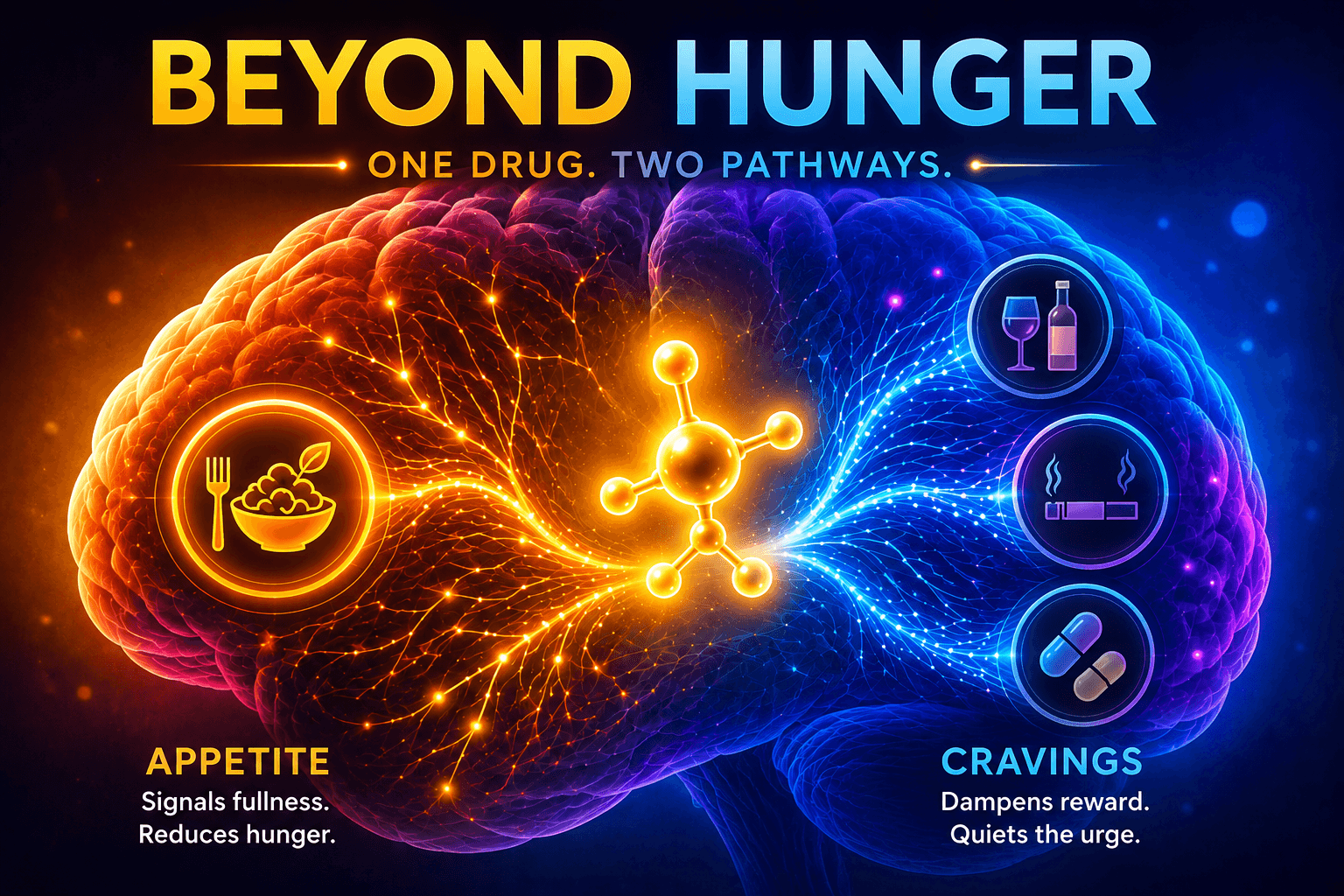
Ozempic was built for diabetes. Its active ingredient, semaglutide, later became widely known for its effects on appetite and weight.
But researchers are now investigating an unexpected possibility.
The same drug that can make food feel less compelling may also reduce certain addictive cravings.
Recent clinical research has found promising effects in people with alcohol use disorder, while studies involving nicotine and opioids are still developing.
The explanation may not be in the stomach at all.
It may be in the brain's reward system.
A Drug Designed for One Job
Semaglutide belongs to a class of medicines called GLP-1 receptor agonists.
GLP-1 is a hormone involved in regulating appetite and blood sugar. Semaglutide mimics some of its effects, helping people feel fuller and reducing food intake.
That's the job the drug was designed to do.
But GLP-1 receptors aren't limited to the systems involved in hunger.
They're also found in parts of the brain involved in reward, motivation, and reinforcement.
That creates an intriguing possibility.
Perhaps semaglutide isn't simply telling the brain:
"You've had enough food."
Perhaps it's also influencing:
"How strongly do I want this?"
The Craving Connection
The brain's reward system isn't dedicated to any one substance.
It helps us learn which experiences feel rewarding and which behaviors are worth repeating.
Food can activate it.
So can alcohol, nicotine, and addictive drugs.
These substances can effectively hijack a system that evolved to help us pursue things that matter for survival.
If semaglutide can influence parts of that system, it could potentially affect cravings beyond food.
That's the basic idea researchers are now testing.
One drug. Different kinds of wanting.
What the Trials Are Finding
The strongest evidence so far is around alcohol.
In a 2026 clinical trial, people with alcohol use disorder who received low-dose semaglutide showed greater reductions in alcohol consumption and craving than those receiving placebo.
They also experienced fewer heavy-drinking days.
A separate large observational study found that people prescribed semaglutide were hospitalized for alcohol-related reasons less often than comparable people who weren't taking the drug.
Those findings are encouraging.
But they don't mean semaglutide is already an addiction treatment.
The evidence beyond alcohol is more limited.
Research involving a related GLP-1 drug has suggested possible reductions in smoking cravings and withdrawal symptoms.
Studies are also investigating whether semaglutide could help people with opioid use disorder.
Those results are still pending.
So the evidence isn't equally strong across every type of addiction.
Alcohol is currently where the signal is clearest.
Did You Know?
Researchers have also explored whether reduced alcohol consumption could simply be caused by nausea.
In one experiment involving vervet monkeys, semaglutide reduced voluntary alcohol consumption without producing the sickness that would normally make an animal avoid drinking.
That suggests something more interesting may be happening.
The alcohol may have become less rewarding, rather than simply unpleasant.
Why This Matters
Addiction treatment has never had a single solution that works for everyone.
Existing medications can help some people, but treatment remains difficult and outcomes vary.
That's why an already-developed drug attracting attention for another potential use is significant.
Semaglutide is already manufactured and widely prescribed for diabetes and obesity.
If further research confirms that it can meaningfully reduce addictive cravings, researchers would be starting with a medicine that already has a substantial clinical history.
But there's an important difference between promising evidence and an approved treatment.
The Caveat That Stays Attached
As of 2026, semaglutide is not FDA-approved to treat alcohol, nicotine, or opioid use disorder.
Using it for these conditions would be considered off-label.
And the evidence differs depending on the substance being studied.
The strongest clinical evidence so far concerns alcohol.
The nicotine research involves a related GLP-1 drug.
The opioid research is still underway.
So calling Ozempic an "addiction cure" would go far beyond the evidence.
A more accurate description is simpler:
A drug developed for appetite is showing unexpected effects on craving and researchers are now trying to understand why.
One Molecule, Two Conversations
The easiest way to understand the research is to imagine semaglutide influencing two related conversations in the brain.
Appetite
"I've had enough."
The body receives signals that reduce hunger and food intake.
Reward and craving
"How badly do I want this?"
The brain's reward circuitry influences motivation and the desire to repeat an experience.
These aren't the same process.
And that's what makes the research interesting.
Semaglutide may not simply be making people less hungry.
It may also be influencing how strongly certain rewards are wanted.
Knowlegic Perspective
This is a useful example of how scientific discoveries often happen.
A medicine is developed for one purpose.
Ozempic was designed to make hunger quieter.
Now researchers are asking whether semaglutide can do something even more unexpected: make certain addictive cravings quieter too.
The evidence is most promising around alcohol.
Research involving nicotine and opioids is still developing.
So this isn't yet the story of Ozempic becoming an addiction treatment.
It's the story of a medicine revealing an unexpected second job.
And scientists are only beginning to discover how far that second job might go.
Sources & Reference
GLP-1 plus therapy can reduce heavy drinking — NIH News in Health (2026).
GLP-1 Drug Semaglutide (Ozempic, Wegovy) Reduced Heavy Drinking & Craving in Adults with Alcohol Use Disorder — Brain & Behavior Research Foundation (2026).
Weight-loss drugs like Ozempic may also curb drug and alcohol addiction — ScienceDaily (2025).
Can GLP-1s Help With Addiction? New Research on Cravings & Dopamine — U.S. News & World Report (2026).
Enjoyed this?
Get notified when a new Knowlegic story worth knowing is published.


