

The Internet Under the Ocean: The Hidden World of Submarine Cables
The internet doesn't live in the cloud. It travels through thousands of kilometers of fiber-optic cables lying silently on the ocean floor.
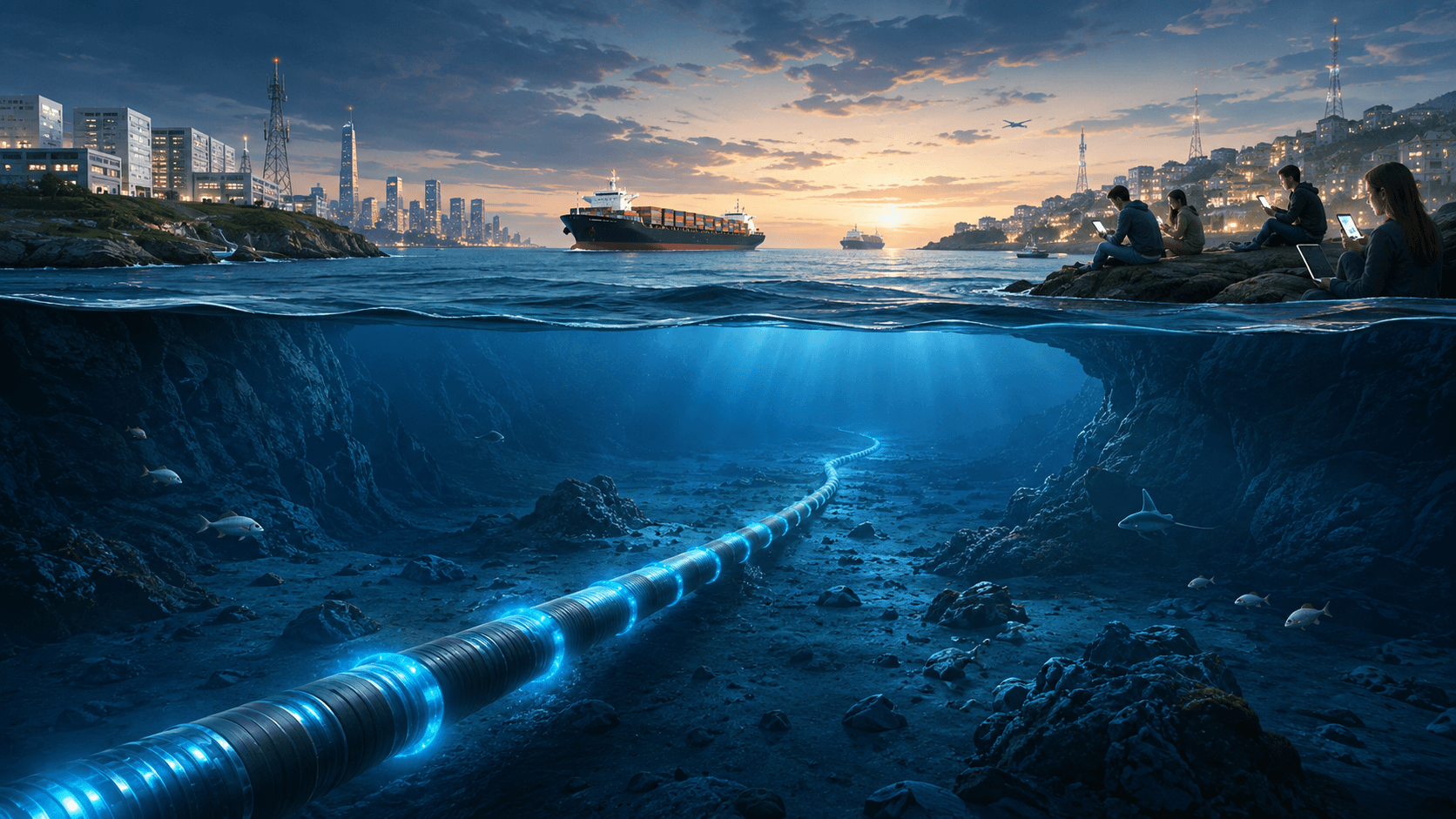
Every time you send a WhatsApp message, join a Zoom meeting, watch Netflix, or ask ChatGPT a question, your data embarks on an incredible journey. Contrary to popular belief, it doesn't usually travel through satellites. Instead, it races through a vast network of submarine fiber-optic cables stretching across the world's oceans.
These undersea cables are among humanity's greatest engineering achievements and one of its least visible. They power global communication, international banking, cloud computing, and the modern digital economy. Yet most people don't even know they exist.
Let's dive beneath the waves and discover the hidden infrastructure that keeps the internet alive.
Imagine the Internet Suddenly Stopped
Imagine waking up tomorrow and discovering that:
- International video calls won't connect.
- Online payments keep failing.
- Global stock markets slow down.
- Cloud services become unreliable.
- Your favorite streaming platform refuses to load.
It sounds like the plot of a science-fiction movie.
Yet something surprisingly small could trigger all of it.
Not a cyberattack.
Not a power failure.
Just a damaged cable lying quietly on the ocean floor.
The modern internet feels invisible.
We call it "the cloud."
Cloud storage.
Cloud computing.
Cloud gaming.
The name makes it sound like our data floats somewhere above us.
But here's the surprising truth:
The internet is one of the most physical systems humans have ever built.
And much of it lies beneath the sea.
Your Message Takes an Unexpected Journey
Let's follow something simple.
You send a WhatsApp message from Japan to your friend living in London.
What happens next?
Most people imagine one of these:
🛰️The message goes to a satellite.
📡 It flies wirelessly through the air.
☁️ It disappears into "the cloud."
The real journey looks very different.
Your phone first connects to a nearby cellular tower or Wi-Fi router.
From there, the data travels through fiber-optic cables across cities until it reaches a major data center.
If the destination is another country, the journey continues into one of the world's submarine cable landing stations.
Then something remarkable happens.
Your message enters a glass fiber no thicker than a human hair and begins racing beneath the ocean at nearly the speed of light.
Within milliseconds, it reaches another continent before traveling through local networks to your friend's phone.
All of this happens so quickly that neither of you notices.
 #### Did You Know?
Although satellites receive most of the attention, the vast majority of international internet traffic travels through submarine fiber-optic cables, not through space. Satellites remain valuable for remote locations and backup communications, but undersea cables form the primary backbone of global connectivity.
Why Not Just Use Satellites?
It's a fair question.
After all, satellites already orbit Earth.
Wouldn't they be easier?
Imagine trying to deliver every Amazon package in the world using helicopters.
Technically possible?
Yes.
Practical?
Not really.
Helicopters are expensive.
They carry limited cargo.
They're affected by weather.
Now replace helicopters with satellites.
The same idea applies.
Satellites are excellent for reaching remote islands, ships at sea, aircraft, and places where laying cables isn't practical.
But for moving enormous amounts of data between continents, submarine cables are faster, cheaper, and capable of carrying far more information.
Think of it this way:
- Satellites are regional airports.
- Submarine cables are eight-lane superhighways.
Both matter.
But one carries far more traffic.
The World's Longest Invisible Highway
If someone could drain the oceans for just one hour, the view would be astonishing.
Across the seabed, you'd see an enormous web of cables connecting nearly every continent. Refer below image to fuel your imagination.
 North America to Europe.
Europe to Africa.
Asia to Australia.
Japan to the United States.
India to the Middle East.
Together, these routes form one of the largest engineering networks ever created.
Unlike roads or railways, however, almost nobody ever sees them.
They're quietly carrying emails, financial transactions, cloud backups, online games, video calls, and billions of Google searches every single day.
Without them, the internet wouldn't disappear completely.
It would simply become dramatically slower, less reliable, and far more expensive.
What's Inside an Internet Cable?
When people hear the word "cable," they often imagine a thick copper wire.
A submarine cable is far more sophisticated.
Imagine slicing one open.
Inside, you'd find several protective layers wrapped around an incredibly delicate core.
At the very center are tiny strands of ultra-pure glass.
Not metal.
Glass.
These fibers don't carry electricity.
They carry light.
Tiny pulses of laser light race through these fibers, representing billions of ones and zeros every second.
Around this fragile core are multiple protective layers designed to survive one of the harshest environments on Earth.
The cable includes:
- Protective coatings that absorb mechanical stress
- Metallic reinforcement for strength
- Water-blocking materials that prevent leaks
- Durable outer armor to resist corrosion, abrasion, and underwater hazards
It's a bit like dressing a fragile glass straw in a suit of armor.
The glass carries the information.
Everything else exists to protect it.
 A submarine cable is often about as thick as a garden hose, yet it can carry an extraordinary volume of international internet traffic using pulses of light traveling through its glass fibers.
Laying the Internet Across Oceans
You can't simply throw a cable into the sea.
Before a single meter is installed, engineers spend months studying the ocean floor.
They avoid:
- Underwater volcanoes
- Earthquake-prone regions
- Busy fishing zones
- Steep underwater cliffs
- Areas with unstable geology
Once the safest route is selected, specialized cable-laying ships slowly deploy the cable across the seabed with remarkable precision.
Near coastlines, the cables are often buried beneath the seabed to protect them from fishing nets and ship anchors.
In deeper oceans, they simply rest on the seafloor, where human activity is far less common.
These systems are designed to operate reliably for decades while carrying the world's growing appetite for digital communication.
Who or What Breaks an Undersea Cable?
It might surprise you to learn that cybercriminals aren't the biggest threat.
Nature and everyday human activity are.
Some of the most common causes include:
⚓ Ship anchors accidentally dragging across cable routes.
🎣 Fishing trawlers snagging cables with heavy nets.
🌍 Earthquakes shifting the seabed.
🏔 Underwater landslides burying or snapping cables.
🚧 Marine construction projects damaging cables during coastal work.
Contrary to popular belief, deep-sea shark attacks on internet cables are extremely rare. While there have been isolated incidents in the past, modern cable protection has made them largely a curiosity rather than a significant operational risk.
When one submarine cable fails, network operators immediately reroute traffic through other available cables.
In regions with many redundant connections, users may never notice.
But countries or islands that depend on only one or two international links can experience noticeable slowdowns or disruptions until repairs are completed.
The internet was intentionally designed to survive failures.
Rather than relying on a single route, data can often travel through multiple alternative paths one of the reasons the internet is considered one of the world's most resilient communication systems.
Repairing the Internet Isn't Like Repairing a Wire
When a submarine cable breaks, engineers first locate the fault before a specialized repair ship lifts the damaged cable from the seabed.
Technicians then replace the broken section and precisely splice the glass fibers together. After thorough testing, the cable is carefully lowered back into the ocean. Depending on the location and weather, the entire repair can take days or even weeks.
This version is concise, flows well, and pairs nicely with a repair process infographic, allowing the image to explain the steps while the text provides the context.
Who Owns the Internet Under the Sea?
Most people assume governments own these cables.
The reality is far more interesting.
Submarine cable systems are typically funded by:
- Telecommunications companies
- Cloud service providers
- Technology companies
- International investment groups
- Consortiums of multiple organizations
Building a modern submarine cable costs hundreds of millions of dollars.
Because of that enormous investment, companies often share ownership while jointly maintaining the infrastructure.
This hidden industry rarely makes headlines.
Yet it quietly supports trillions of dollars in global digital activity every year.
When Cables Become Geopolitical Assets
Submarine cables aren't just engineering projects.
They're strategic infrastructure.
Think about what travels through them every second:
- Government communications
- International banking
- Financial markets
- Cloud computing
- Scientific research
- Military communications
- Everyday internet traffic
In other words...
Much of the world's digital economy depends on these underwater connections.
That's why governments closely monitor where cables are built, who owns them, and where they come ashore.
In today's world, submarine cables are increasingly viewed not only as communication networks but also as critical national infrastructure with economic and security implications.
Why This Matters to You
It's easy to think submarine cables are only important for engineers.
They're not.
Every time you:
📞 Make an international video call
💳 Complete an online payment
🎬 Watch Netflix
📁 Upload files to the cloud
🤖 Use ChatGPT
📧 Send an overseas email
You're relying on infrastructure hidden beneath the ocean.
Even if you never see it.
The internet feels wireless.
But wireless only describes the first few meters of the journey—from your phone to the nearest tower or Wi-Fi router.
The rest of the journey is surprisingly physical.
The Bigger Lesson
Submarine cables reveal something fascinating about modern technology.
The digital world isn't separate from the physical world.
It's built upon it.
Every cloud service depends on data centers.
Every video call depends on fiber optics.
Every AI model depends on servers.
And much of that global infrastructure is connected by glass fibers quietly resting on the ocean floor.
The next time someone says
"It's all in the cloud,"
remember...
The cloud has roots.
Many of those roots stretch beneath the sea.
Knowlegic Perspective
The cloud may be one of the most successful metaphors in modern technology but it's also one of the most misleading.
It makes the internet feel weightless, effortless, and almost magical.
The truth is far more remarkable.
Behind every email, every online payment, every AI conversation, and every video stream lies an immense network of engineers, ships, data centers, and fiber-optic cables stretching across the planet.
The internet isn't floating above us.
It's woven through the Earth itself.
Understanding that changes how we see the digital world.
Tonight, millions of people will send messages across oceans. Businesses will move billions of dollars.
Doctors will consult specialists in other countries. Students will attend online classes hosted thousands of kilometers away.
Most of us will never think about how any of it happens.
We'll simply tap Send.
Within milliseconds, tiny pulses of light will begin racing through strands of glass hidden beneath the ocean floor, crossing mountains, trenches, and entire continents before reaching their destination.
That's the quiet brilliance of submarine cables.
They don't just connect countries.
They connect modern civilization.
And perhaps the most remarkable thing about them is this:
The world's most important digital highway is one that almost nobody ever sees.
Enjoyed this?
Get notified when a new Knowlegic story worth knowing is published.


