

Sodium-Ion Batteries: Why the Lithium Alternative Is Finally Reaching Scale
A battery that swaps lithium for sodium just landed the largest order of its kind, and the real story is about where it fits, not whether it wins.
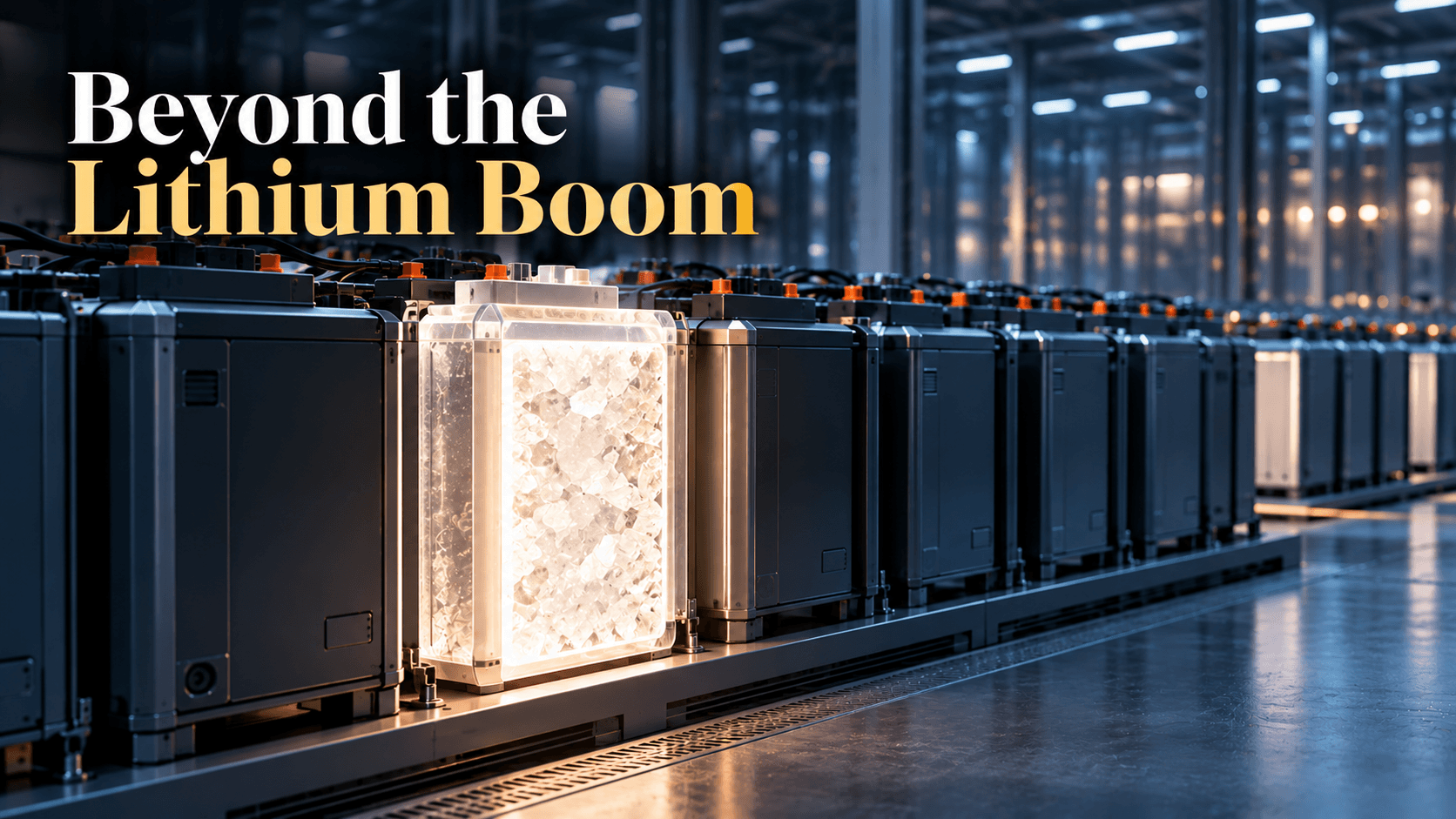
Picture a warehouse-sized hall of batteries, quietly soaking up spare electricity from the grid, with no lithium in any of them.
That is no longer a lab sketch. On 27 April 2026, CATL agreed to supply 60 gigawatt-hours of sodium-ion batteries to the energy storage company HyperStrong over three years.
The deal does not prove sodium has beaten lithium. It shows something quieter and more useful: a battery does not have to beat lithium everywhere to matter, only somewhere.
The Swap Hidden Inside a Familiar Battery
A sodium-ion battery works much like the lithium-ion batteries in phones and cars. Charged particles shuttle between two electrodes as the battery charges and discharges. The change is in the passenger. As Interesting Engineering puts it, sodium-ion batteries "replace lithium as the main charge carrier with sodium."
The appeal starts with supply. New Mobility reports that the Earth's crust holds roughly a thousand times more sodium than lithium. It adds that sodium avoids the geopolitical bottlenecks that shape the supply of lithium, cobalt and nickel.
Think of it as a restaurant that can cook the same dish with salt from any shop instead of a rare spice from one distant supplier. The meal is not automatically better. The kitchen is just much harder to disrupt.
The Order That Changed the Conversation
The CATL deal is large by any measure. New Mobility describes it as the largest sodium-ion order in history. Interesting Engineering reports that it follows a November 2025 agreement in which HyperStrong pledged to purchase 200 gigawatt-hours of CATL cells over the decade from 2026 to 2035.
The grid cell at the centre of the deal has an energy density of about 160 watt-hours per kilogram, according to Interesting Engineering. It is rated for more than 15,000 charge cycles while keeping 80 percent of its capacity. Both outlets report the cycle figure.
It also works across a wide temperature range. Interesting Engineering says the battery operates from minus 40 to 70 degrees Celsius, which it describes as wider than most lithium-ion systems.
CATL said the deal demonstrates that it has solved the hurdles along its whole sodium-ion manufacturing chain. That is the company's own claim, but the size of the order suggests a customer willing to bet on it.
Did You Know?
CnEVPost reports that, according to CATL, a sodium-ion cell discharges at minus 30 degrees Celsius with nearly triple the power of an equivalent-capacity lithium iron phosphate cell. Winter performance is one of the places the new chemistry is making its case.
The Catch: Less Energy per Kilogram
Energy density is the measure of how much energy a battery stores for its weight. It is where sodium has traditionally lagged, and it matters most for things that move.
CATL's newer Naxtra cell narrows the gap. CnEVPost reports an energy density of up to 175 watt-hours per kilogram, comparable to mainstream lithium iron phosphate batteries. New Mobility notes the grid cell, at around 160, sits somewhat below Naxtra.
Cars are the next test. CnEVPost reported in February 2026 that CATL and the carmaker Changan had jointly unveiled a sodium-ion powered vehicle, with plans for a mid-2026 market launch. New Mobility reports that CATL has said Naxtra will begin volume manufacturing before 2026 ends. CarNewsChina reports that CATL's Ni Jun expects somewhere between 10,000 and 20,000 EVs to carry its sodium-ion cells during 2026.
Those figures describe a first wave of cars. They do not describe a takeover.
Can Sodium Actually Win on Price?
Cheaper raw materials do not guarantee a cheaper battery. A Stanford University team assessed the economics in the journal Nature Energy, and ESS News summarised the result bluntly: in the near term, undercutting the cheaper lithium-ion types looks difficult.
Part of the reason is that sodium's anode is its costliest component, according to ESS News. A lower energy density hurts too, because each unit of stored energy ends up costing more.
The price of lithium itself matters as well. ESS News relays the study's warning, made in early 2025, that if lithium stays near record-low prices, fewer sodium-ion designs have a realistic path to competing.
The team's own preprint adds the hopeful side: across more than 6,000 scenarios, many sodium-ion routes might, in the early 2030s, draw level on cost with the cheaper kinds of lithium-ion battery, but only if targeted research delivers substantial progress along the way. Raising sodium's energy density is among the changes it flags as most helpful.
The honest reading is that sodium has a case, not a victory. Its best arguments are supply security, cold-weather behaviour and long life. Its hardest test, according to the Stanford work, is price against low-cost lithium in the near term.
Did You Know?
Look inside a commercial sodium-ion cell and the metal is different too. An analysis presented at a 2024 solid-state ionics conference reported that aluminium foil is used as the current collector on both the anode and the cathode, with no copper found.
Why Grid Storage Is the Natural First Home
A stationary battery does not care how much it weighs. It sits in a hall, absorbs spare power and gives it back later, so the weakness that hurts sodium in a car costs it very little here.
What it does care about is cost, cycle life and supply. That is exactly where the arguments above point, and it explains why the biggest sodium order to date is for the grid and not for a phone.
Knowlegic Perspective
Every new battery chemistry arrives wrapped in the question of whether it will replace the last one. That is usually the wrong question. Lithium-ion did not replace every earlier battery at once; it won the places where its strengths mattered most.
Sodium-ion looks set to follow a similar path, with caveats attached. The Stanford findings are a reminder that cheap raw materials, impressive cycle counts and a giant order are not the same as winning on cost. CATL's claims about its own production chain also remain the company's claims.
What the CATL deal does show is a market willing to buy a second chemistry in volume. That alone changes how fragile the world's battery supply looks. A battery does not have to beat lithium everywhere to matter, only somewhere.
Sources & References
- CATL turns sodium-ion into a grid reality with a 60 GWh landmark deal, New Mobility (2026)
- CATL gets world's largest sodium-ion battery order with 60 GWh deal, Interesting Engineering (2026)
- CATL's sodium-ion batteries begin deployment in production-ready passenger vehicles, CnEVPost (2026)
- CATL expects up to 20,000 EVs to be euipped with sodium-ion batteries in 2026, CarNewsChina (2026)
- Sodium-ion batteries face uphill struggle to beat lithium-ion on cost, ESS News (2025)
- How quickly can sodium-ion learn? Assessing scenarios for techno-economic competitiveness against lithium-ion batteries, Yao, Benson and Chueh, arXiv preprint (2024)
- Multi-Scale Analysis of Commercially Available Sodium-Ion Cells, nanoGe, SSI24 Proceedings (2024)
Enjoyed this?
Get notified when a new Knowlegic story worth knowing is published.


