

The Science Behind Makeup: How Cosmetics Actually Work
Behind every swipe of lipstick and every drop of foundation lies a remarkable blend of chemistry, physics, and skin science.
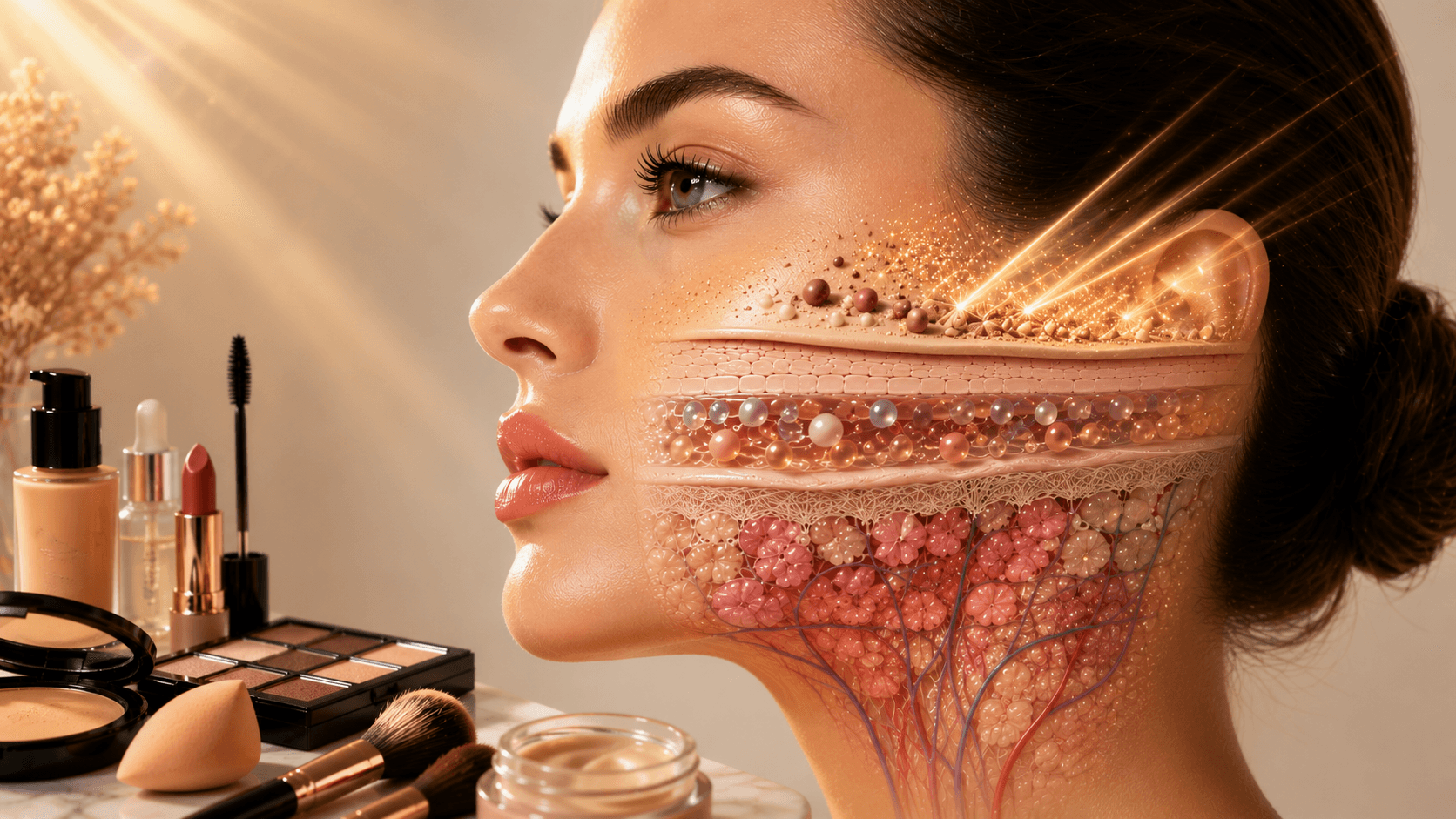
Applying makeup may feel like an everyday routine, but every product is the result of decades of scientific innovation. A foundation doesn't simply "cover" your skin. It manipulates light. A lipstick isn't just colored wax. It's a carefully engineered balance of pigments, oils, polymers, and emollients designed to glide smoothly, stay in place, and remain comfortable for hours.
Even something as simple as mascara relies on sophisticated film-forming chemistry to coat each eyelash without becoming brittle or smudging.
Understanding the science behind cosmetics changes the way you see them. Instead of bottles, tubes, and palettes, you begin to see tiny chemical systems working together to interact with one of the most complex organs in the human body - your skin.
Every Morning, Millions of Chemistry Experiments Begin
It's 8:00 a.m.
Someone picks up a foundation brush.
Across the world, millions of people are doing exactly the same thing.
Within seconds, tiny mineral particles, microscopic pigment crystals, lightweight oils, polymers, waxes, and emulsifiers begin spreading across human skin.
To most of us, it's simply makeup.
To a chemist...
it's an extraordinary engineering achievement.
Every product has to solve an almost impossible challenge.
It must spread evenly.
Match different skin tones.
Feel comfortable.
Resist sweat.
Survive humidity.
Stay stable inside its container for months—sometimes years.
And do all of this without damaging one of the body's most important protective barriers.
That tiny bottle sitting on a bathroom shelf is doing far more science than most people realize.
Knowlegic Insight
Makeup isn't designed to change your skin.
It's designed to change how light interacts with your skin.
That's an important difference.
When your complexion appears smoother after applying foundation, the product hasn't magically erased pores or fine lines.
Instead, it has altered how light reflects from the skin's surface, making imperfections less noticeable to the human eye.
In other words...
your eyes are seeing physics at work.
Your Skin Isn't a Blank Canvas
Many advertisements describe skin as though it's a perfectly smooth surface waiting to be painted.
Reality couldn't be more different.
Your skin is alive.
Every second, it is producing natural oils.
Losing tiny amounts of water.
Maintaining a slightly acidic pH.
Hosting billions of beneficial microorganisms.
Repairing microscopic damage.
Regulating temperature.
Protecting you from bacteria, chemicals, and ultraviolet radiation.
Scientists often describe skin as the body's largest organ, and for good reason.
It isn't passive.
It's constantly interacting with the environment.
That means every cosmetic product has to work with the skin rather than against it.
Imagine trying to paint a wall...
except the wall is breathing, sweating, stretching, producing oil, and constantly replacing itself.
That's the challenge cosmetic chemists face every day.
Did You Know?
Your outermost skin layer—the stratum corneum—is only about as thick as a sheet of paper.
Yet it forms one of the body's most effective protective barriers against the outside world.
Most makeup is specifically designed to remain on this outer layer rather than penetrating deeply into the skin.
Why Oil and Water Refuse to Cooperate
Try a simple experiment.
Pour a little cooking oil into a glass of water.
Shake it vigorously.
For a brief moment...
they appear perfectly mixed.
Now wait.
Within seconds, the two separate again.
Oil floats.
Water sinks.
Nature has restored order.
This creates one of the biggest challenges in cosmetic science.
Most liquid foundations contain both oil-based ingredients and water-based ingredients.
Left alone, they would separate inside the bottle.
So why don't they?
Because of one of chemistry's greatest problem-solvers:
Emulsifiers.
These remarkable molecules act like diplomats between two substances that naturally refuse to mix.
One end of an emulsifier is attracted to water.
The other is attracted to oil.
By surrounding tiny droplets of oil, emulsifiers prevent them from merging together, keeping the entire formula smooth and stable.
Without emulsifiers...
your foundation would arrive as two separate layers.
One watery.
One oily.
Not exactly the flawless finish anyone hopes for.
Think of an emulsifier as a translator at an international meeting.
Oil speaks one language.
Water speaks another.
The emulsifier understands both and keeps the conversation from falling apart.
Why Foundation Feels So Different From Powder
At first glance, foundation and face powder seem to perform the same job.
Both aim to even out skin tone.
Both reduce the appearance of imperfections.
Yet they feel completely different.
The reason lies in their architecture.
Liquid foundation behaves like a flexible coating.
It spreads across the skin using water, oils, pigments, and film-forming ingredients that create a smooth, continuous layer.
Face powder works in a completely different way.
Instead of forming a thin film, it consists of countless microscopic particles resting lightly on the skin's surface.
These particles absorb excess oil and scatter incoming light.
That's why powder often creates a soft, matte appearance without feeling heavy.
Cream products fall somewhere in between.
Their higher wax content creates richer coverage and a more moisturizing feel, making them especially popular for dry skin.
The fascinating part?
The visible color may be almost identical across all three products.
The difference comes entirely from chemistry.
The Hidden Physics Behind "Flawless Skin"
Here's something surprising.
Foundation doesn't actually hide your pores.
It changes the way light behaves.
When light strikes bare skin, tiny bumps, pores, and uneven texture create countless miniature shadows.
Those shadows make imperfections more noticeable.
High-quality cosmetic formulas contain carefully engineered particles that scatter incoming light before those shadows become obvious.
Scientists call this light diffusion.
Instead of bouncing directly back toward your eyes, light spreads in multiple directions.
The result?
Skin appears smoother.
More even.
More natural.
Nothing has physically changed.
Only the light has.
It's a beautiful example of physics creating beauty.
Some premium cosmetic formulas use combinations of mineral pigments and light-diffusing particles such as silica to create what's often called a soft-focus effect—similar to the flattering lighting photographers use in professional portraits.
Every Pigment Has a Job
Colour isn't simply added to makeup.
It's engineered.
Every pigment particle absorbs certain wavelengths of visible light while reflecting others.
That's what creates the colours our eyes perceive.
Some pigments produce rich reds.
Others create warm browns.
Some reflect white light exceptionally well.
Minerals such as titanium dioxide and zinc oxide are particularly interesting because they don't just provide color but they also scatter light efficiently, which is one reason they're widely used in cosmetics and mineral sunscreens.
Why Lipstick Doesn't Melt in Your Pocket
Have you ever wondered why a lipstick glides across your lips like butter...
...yet remains solid inside the tube?
That tiny stick is actually a remarkable feat of materials engineering.
It has to survive hot handbags, cold winters, pressure inside your makeup pouch, and countless applications, all without becoming too soft or too brittle.
The secret lies in balancing four key ingredients:
- Waxes provide structure.
- Oils create smooth application.
- Pigments deliver colour.
- Emollients keep lips feeling comfortable.
Think of lipstick as a recipe.
Too much wax?
It drags across the lips and feels dry.
Too much oil?
It becomes soft, smudges easily, and loses its shape.
Cosmetic chemists spend months adjusting these ratios until the formula feels just right.
It's less like making paint...
and more like baking the perfect cake.
A lipstick isn't simply colored wax.
It's a carefully engineered balance of ingredients that must remain stable in the tube while transforming into a smooth, even film the moment it touches your lips.
Why Does Long-Lasting Lipstick Actually Last?
If you've ever worn a long-lasting lipstick, you've probably noticed something surprising.
Hours later...
the colour is still there.
Even after coffee.
Even after lunch.
So what's happening?
The answer is film-forming polymers.
Once applied, these microscopic polymers create an ultra-thin flexible layer that locks pigments against the surface of your lips.
Imagine wrapping each colour particle inside an invisible net.
The pigments can still be seen...
but they're much harder to wipe away.
Different brands achieve this in different ways.
Some prioritise durability.
Others prioritise comfort.
That's why one lipstick can survive an entire evening while another fades after a single cup of tea.
It's not just about pigments.
It's about the invisible film holding everything together.
The Tiny Engineering Behind Every Eyelash
Mascara looks simple.
A brush.
A black liquid.
A few strokes.
But each swipe coats hundreds of individual lashes.
Every lash needs to become:
- darker,
- thicker,
- longer-looking,
- and remain flexible.
If the coating becomes too hard...
lashes feel stiff.
Too soft...
the mascara smudges.
Too dry...
it flakes.
The solution once again comes from chemistry.
Mascaras combine waxes, pigments, oils, and specialized polymers that wrap each lash in a flexible microscopic film.
Waterproof formulas take this one step further.
They contain polymers that resist water, making them difficult to wash away with ordinary water alone.
Ironically...
the same chemistry that helps mascara survive rain also explains why it needs dedicated makeup remover.
Can Makeup Protect Your Skin From the Sun?
Walk through any beauty store today and you'll see products labelled:
SPF 15
SPF 30
Broad Spectrum Protection
It sounds reassuring.
But here's an important question.
Can foundation replace sunscreen?
In most cases...
No.
Many foundations and tinted moisturizers include UV filters such as zinc oxide, titanium dioxide, or approved chemical sunscreen ingredients.
These ingredients certainly contribute to sun protection.
However, there's a catch.
The SPF printed on the bottle is measured under laboratory conditions using a specific amount of product.
In everyday life, most people apply only a fraction of that amount.
The result?
Much lower protection than the label suggests.
That's why dermatologists continue recommending dedicated sunscreen underneath makeup.
Think of makeup with SPF as an added benefit...
not your primary shield against ultraviolet radiation.
Why Creating Great Makeup Takes Years
When we pick up a bottle of foundation, we usually judge it within seconds.
Does it feel nice?
Does it match our skin tone?
Does it last?
Behind those few seconds often lie years of research.
Before a cosmetic product reaches store shelves, scientists may test:
- pigment dispersion,
- texture,
- heat stability,
- humidity resistance,
- oxidation,
- shelf life,
- microbial safety,
- packaging compatibility,
- and performance across different skin types.
A single unstable ingredient can ruin an entire formula.
Pigments may clump.
Oils may separate.
Colors may oxidize.
Textures may become grainy.
The glamorous part happens at the makeup counter.
The difficult part happens inside laboratories.
Beauty Through the Lens of Science
After exploring the chemistry behind cosmetics, one thing becomes clear.
Makeup isn't simply about appearance.
It's about controlling the interaction between:
- light,
- color,
- texture,
- chemistry,
- and human skin.
Every foundation manipulates optics.
Every lipstick demonstrates materials science.
Every mascara showcases polymer engineering.
Every successful cosmetic product represents hundreds of scientific decisions working together.
That's what makes makeup fascinating.
Not because it hides imperfections.
But because it reveals just how deeply science is woven into everyday life.
Knowlegic Perspective
When most people think about makeup, they see color.
Scientists see something entirely different.
They see emulsions that refuse to separate.
Pigments engineered to reflect light in precise ways.
Polymers forming invisible protective films.
Skin barriers interacting with carefully balanced ingredients.
Beauty products may seem ordinary because we use them every day.
But ordinary objects often hide extraordinary science.
Perhaps that's the real lesson.
The most fascinating discoveries aren't always found inside laboratories or space telescopes.
Sometimes...
they're sitting quietly inside a small tube of lipstick on your bathroom shelf.
The next time you apply foundation...
or swipe on lipstick...
or brush mascara across your lashes...
remember this:
You're not simply applying makeup.
You're witnessing chemistry, physics, materials science, and biology working together in perfect harmony.
And perhaps that's the most beautiful part of all.
Enjoyed this?
Get notified when a new Knowlegic story worth knowing is published.


