

The Science of Staying Strong as You Age
Why growing older doesn't automatically mean growing weaker and how one daily habit can change the speed of aging itself.
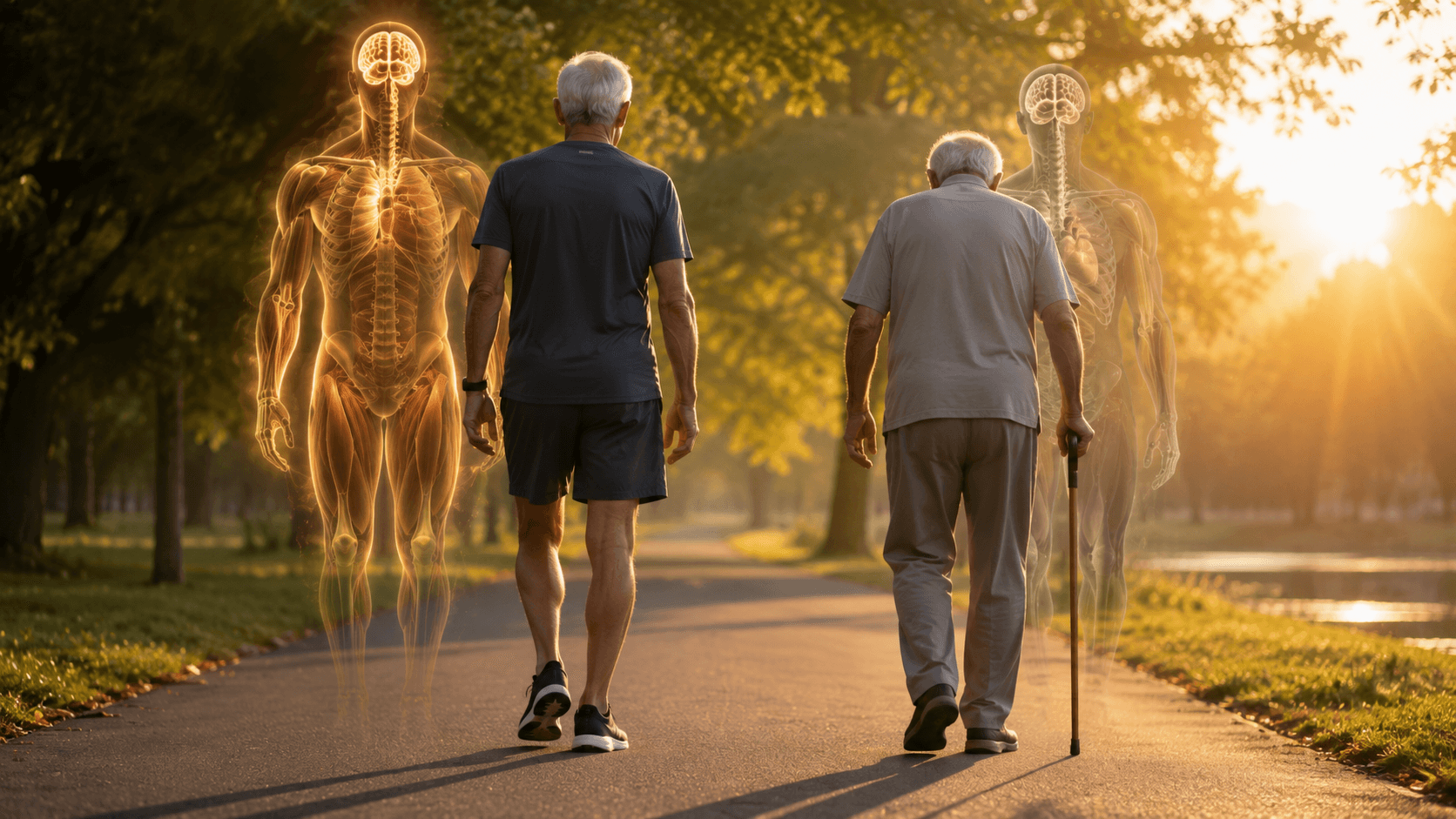
For generations, aging has been treated like a one-way journey.
Muscles weaken.
Bones become fragile.
The heart slows down.
Memory fades.
We often accept these changes as unavoidable—simply the price of growing older.
But modern science tells a far more hopeful story.
While aging itself is inevitable, how quickly the body declines is surprisingly flexible. Research across muscle biology, neuroscience, cardiovascular health, and bone physiology shows that regular physical activity doesn't merely slow deterioration, it helps the body rebuild, adapt, and remain resilient far longer than scientists once believed possible.
In many cases, the greatest threat isn't aging.
It's inactivity.
Understanding that difference changes everything.
Two People. Same Age. Different Biology.
It's just after sunrise.
A quiet park begins to fill with morning walkers.
Among them are two people, both celebrating their 72nd birthday this year.
One walks confidently, shoulders relaxed, moving with an easy rhythm that suggests years of habit.
The other takes shorter, slower steps, relying on a walking cane for support.
On paper, they're exactly the same age.
Yet if doctors measured their muscle strength, bone density, heart function, balance, and cardiovascular fitness, the results might suggest something astonishing.
One body could resemble someone in their early sixties.
The other could resemble someone much older.
How is that possible?
Didn't they both spend the same number of years on Earth?
Yes.
But their bodies spent those years very differently.
The calendar measures how long you've lived.
Your biology measures how you've lived.
And nowhere is that difference more remarkable than in the science of exercise.
Aging is inevitable.
Rapid decline isn't always.
Scientists increasingly distinguish between chronological age (the number of birthdays you've celebrated) and biological age—how well your body's systems continue to function.
While genetics play an important role, everyday movement has an extraordinary influence on biological aging.
Your Body Was Never Designed to Stay Still
Imagine buying a new bicycle.
You ride it every day for years.
The gears stay smooth.
The tyres remain strong.
Everything works as intended.
Now imagine placing that same bicycle in a garage for ten years.
Nothing dramatic happens overnight.
But slowly...
the tyres lose air.
Metal begins to rust.
The chain stiffens.
Not because the bicycle became old.
Because it stopped being used.
Human biology works in surprisingly similar ways.
Our muscles, bones, heart, and even parts of our brain evolved under one simple expectation:
Movement.
When movement disappears, the body quietly begins adapting to a less active life.
Ironically...
those adaptations often look exactly like aging.
Muscle Doesn't Just Fade, It Waits to Be Used
Most people believe muscles simply "wear out" with age.
It's an understandable assumption.
After all, many older adults notice everyday tasks becoming more difficult.
Carrying groceries.
Climbing stairs.
Getting up from a chair.
Scientists call this gradual loss of muscle mass and strength sarcopenia, and it becomes increasingly common later in life. The source document notes that muscle strength begins a slow decline from around the thirties, with the pace accelerating after about age 50 if nothing interrupts the process.
For decades, this seemed like an unavoidable consequence of aging.
Then researchers asked a different question.
What if muscles weren't failing because they were old...
but because they were underused?
The answer surprised almost everyone.
In one of the landmark studies referenced in the source material, older adults completed six months of resistance training. Not only did they become significantly stronger, but researchers also observed changes within the muscle tissue itself, with patterns of gene activity shifting toward a more youthful state.
That's an extraordinary finding.
It suggests muscles don't simply count birthdays.
They continue responding to challenge.
Even decades later.
Your muscles don't know your age.
They only know whether you've asked them to work.
Every time you lift a weight, climb a hill, or challenge your body, you're sending a biological message:
"Stay strong. You're still needed."
Strength Is More Than Bigger Muscles
When most people hear the phrase strength training, they picture bodybuilders lifting enormous weights.
But strength is much broader than appearance.
It's the ability to:
- Carry shopping bags without strain.
- Climb stairs comfortably.
- Catch yourself before a fall.
- Lift grandchildren.
- Remain independent for longer.
The science consistently shows that preserving muscle isn't about vanity.
It's about maintaining the physical capacity to live well.
And unlike many aspects of aging, muscle remains remarkably responsive to training even later in life.
Muscle tissue is one of the most adaptable tissues in the human body.
Even after years of reduced activity, it can still respond positively to progressive resistance training.
That's one reason researchers now view muscle as far more "trainable" in older adults than previously believed.
Bones Are Quietly Rebuilding Themselves Right Now
Most people imagine bones as lifeless structures.
Hard.
Solid.
Unchanging.
They're not.
At this very moment, your skeleton is carrying out millions of tiny construction projects.
Old bone is constantly being removed.
New bone is constantly being built.
Scientists call this process bone remodeling, and it's one of the body's most remarkable maintenance systems.
Here's the fascinating part.
Bones don't simply rebuild at random.
They respond to the forces placed upon them.
Walk regularly.
Climb stairs.
Lift weights.
Dance.
Your skeleton notices.
Those mechanical forces signal bone-building cells to strengthen areas experiencing repeated stress.
It's biology's version of preventive maintenance.
The source document highlights that weight-bearing exercise and resistance training can improve bone density, particularly at the hip and spine, while even walking helps slow the rate of bone loss.
Your skeleton is listening.
Every step you take tells your bones something about the world you're preparing them for.
A body that regularly carries weight builds stronger support.
A body that rarely does...
gradually decides it no longer needs as much.
A Living Blueprint
This changes how we think about osteoporosis.
Instead of viewing bones as fragile structures that inevitably weaken...
we begin seeing them as living tissues constantly responding to the demands we place upon them.
No exercise can stop aging.
But movement can influence how your skeleton experiences it.
That makes every walk, every squat, and every staircase more meaningful than it appears.
Your Heart Doesn't Have to Age This Quickly
Think about your heart for a moment.
It has been beating continuously since before you were born.
By the time you turn 70, it will have pumped blood more than two and a half billion times.
It's no surprise that cardiovascular fitness gradually declines with age.
The surprising question is:
How much of that decline is actually caused by aging?
Researchers studying lifelong endurance athletes noticed something remarkable.
People who continued exercising consistently experienced a much slower decline in cardiovascular fitness than their sedentary peers. According to the source article, long-term training reduced the rate of decline by roughly half, suggesting that much of what people attribute to "old age" is actually the result of becoming less active over time.
That's a profound shift in thinking.
Instead of asking,
"Why does my heart weaken as I age?"
Science increasingly asks,
"How much of that weakening happens because we stop asking the heart to work?"
Your heart is remarkably efficient.
But like every muscle in your body...
it adapts to the demands placed upon it.
A sedentary lifestyle teaches the heart one lesson.
Regular movement teaches it another.
Your Brain Is Still Learning New Tricks
For decades, scientists believed the adult brain was largely fixed.
Once brain cells were lost...
they were gone.
Today, that idea has changed dramatically.
One of the most fascinating discoveries involves a tiny region deep inside the brain called the hippocampus.
Think of it as your brain's memory librarian.
It helps organize experiences into lasting memories and supports learning throughout life.
Unfortunately, it also tends to shrink gradually with age.
That sounds discouraging.
Until researchers asked a simple question:
What happens if older adults start walking regularly?
In the landmark study referenced in your source document, older adults who followed a year-long brisk walking program experienced about a 2% increase in hippocampal volume, while the comparison group showed the slight shrinkage normally associated with aging. The walking group also performed better on memory measures. The researchers weren't claiming that exercise creates a younger brain overnight.
But they demonstrated something just as important.
The aging brain remains capable of adaptation.
Did You Know?
Aerobic exercise consistently increases levels of Brain-Derived Neurotrophic Factor (BDNF), often called the brain's "fertilizer" because it supports the growth, survival, and communication of neurons. Lower BDNF levels have been linked with age-related memory decline.
Balance Isn't Something You Lose
Imagine watching a toddler learning to walk.
Every step is uncertain.
The brain is constantly practicing.
Testing.
Adjusting.
Now imagine an older adult practicing balance exercises.
The process is surprisingly similar.
Balance isn't simply a consequence of age.
It's a skill.
And like most skills it improves with practice.
Research summarized in the source document found that structured activities such as Tai Chi can reduce fall rates substantially among older adults across multiple clinical trials. That finding has been influential enough that global physical activity guidelines now recommend dedicated balance training especially for people with reduced mobility.
That's a remarkable message.
Falls aren't always inevitable.
Many can be prevented by training the body's ability to stay stable.
Movement Changes More Than Muscles
Exercise is often promoted as a way to improve physical health.
But one of its most consistent effects appears somewhere less visible.
Mood.
Large analyses of older adults have found that aerobic exercise, resistance training, yoga, and Tai Chi all help reduce depressive symptoms, with no single form of movement proving overwhelmingly superior. The pattern suggests that regular movement itself is one of the key ingredients.
Scientists are still studying exactly why.
Part of the explanation likely involves brain chemistry.
Part may involve better sleep.
Improved confidence.
Greater social interaction.
Reduced inflammation.
The full picture is still emerging.
But the message remains surprisingly consistent.
Bodies that move...
often help minds feel better too.
The Science Is Still Evolving
Not every exciting discovery has reached a final answer.
One of the most intriguing examples involves telomeres.
Imagine the plastic tips protecting the ends of your shoelaces.
Without those tiny caps...
the laces begin to fray.
Telomeres play a similar protective role for chromosomes.
As cells divide over time, these protective caps gradually become shorter, making them a popular though imperfect marker of biological aging.
Researchers have repeatedly observed that physically active people often have longer telomeres than sedentary individuals.
That's exciting.
But it's important to be careful.
As your source document points out, much of this evidence comes from observational research rather than long-term experiments proving cause and effect. Scientists see a strong association, but they're still investigating exactly how exercise influences cellular aging.
Good science doesn't just celebrate discoveries.
It also recognizes uncertainty.
So... How Much Exercise Do You Actually Need?
Here's the encouraging part.
The research doesn't point toward marathon training.
Or spending hours in the gym every day.
Across study after study, a remarkably consistent recommendation appears.
Around 150 minutes of moderate aerobic activity each week, combined with strength training on at least two days, forms the foundation of healthy aging. For people who feel unsteady, adding balance exercises several times a week provides further protection.
That's roughly:
- 30 minutes of brisk walking five days a week.
- Two sessions of resistance training.
- A few short balance exercises woven into your routine.
Not extreme.
Not intimidating.
Just consistent.
Because biology rewards consistency far more than intensity.

The Real Secret to Aging Well
People often ask,
"What's the best exercise?"
Science gives an unexpectedly simple answer.
The best exercise...
is the one you'll still be doing next year.
And five years from now.
And ten years from now.
Longevity isn't built by extraordinary effort.
It's built by ordinary movement repeated consistently.
Knowlegic Perspective
For centuries, people accepted aging as a steady, unstoppable decline.
Science tells a more hopeful story.
The calendar keeps moving forward.
That part is beyond our control.
But the body doesn't simply surrender to time.
It responds to how we use it.
Every walk.
Every lift.
Every climb.
Every stretch.
Each one is a conversation with your muscles...
your bones...
your heart...
your brain.
They are all listening.
And perhaps the greatest discovery isn't that exercise can help us live longer.
It's that, throughout much of life, our bodies remain far more willing to adapt than we ever imagined.
Enjoyed this?
Get notified when a new Knowlegic story worth knowing is published.


