

The Strait of Hormuz: The 21-Mile Chokepoint That Moves the World
A narrow stretch of water between Iran and Oman carries a huge share of the world's energy trade. Here's why its geography gives it influence far beyond its size.
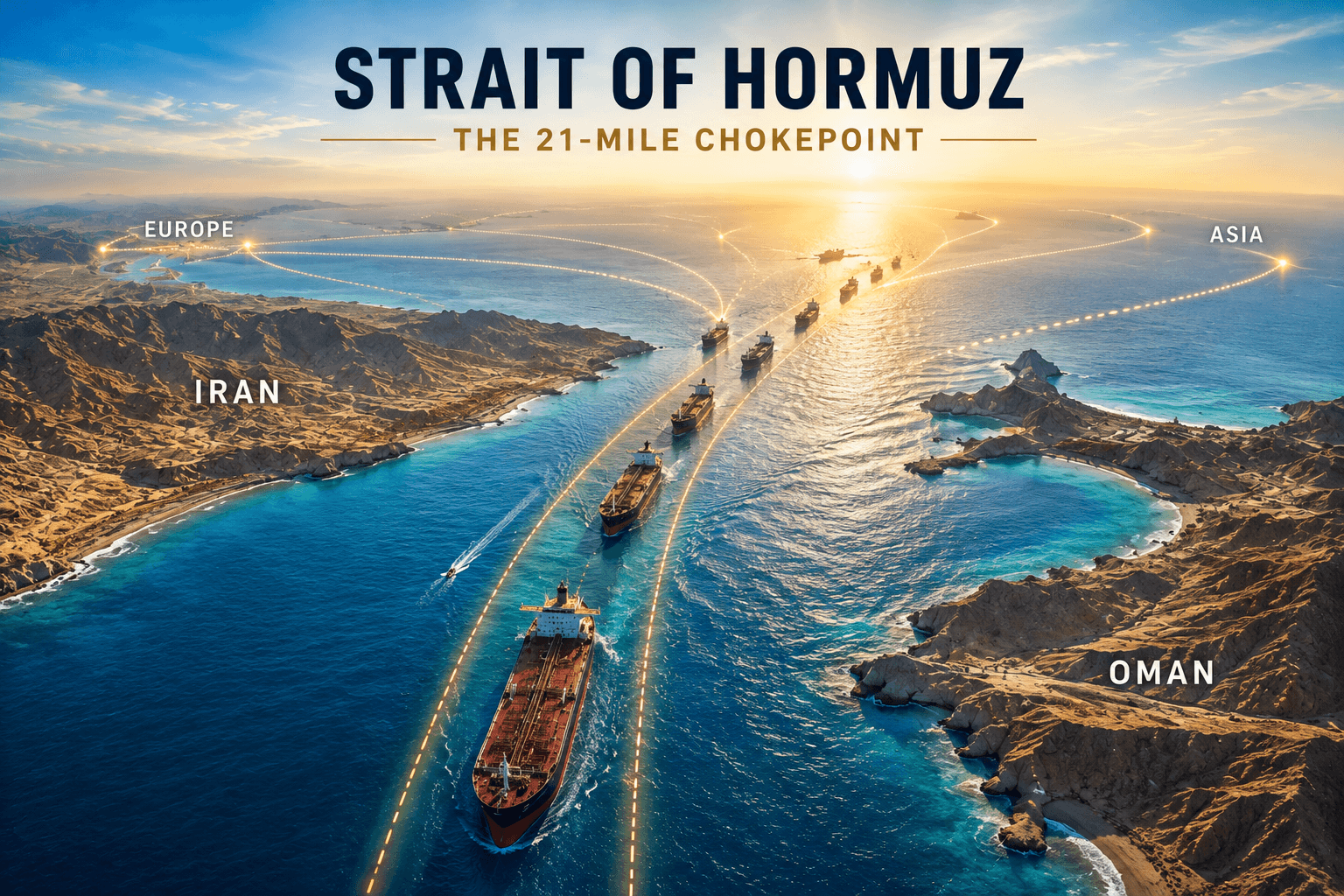
Look at a map of global energy trade and one feature stands out.
The Strait of Hormuz is only about 21 miles wide at its narrowest point, yet it sits between some of the world's largest oil and gas producers and some of its biggest energy consumers.
Before the current conflict, around 20–21 million barrels of oil and petroleum liquids per day passed through the strait, roughly one-fifth of global petroleum liquids consumption. In the first half of 2025, that represented about one-quarter of global maritime oil trade.
But 2026 has demonstrated something even more important.
The strait doesn't have to be physically sealed for the global energy system to feel its impact.
In the second quarter of 2026, average oil and petroleum-liquid flows through Hormuz fell to just 4.9 million barrels per day, compared with 21.6 million barrels per day in the final quarter of 2025.
And as of August 21, traffic remained extraordinarily low. Only seven commodity ships were recorded passing through the strait the previous day, compared with more than 130 daily vessel transits before the February conflict.
That is the power of a chokepoint.
The geography hasn't changed.
The world's dependence on it has.
A Gap Just 21 Miles Wide
The Strait of Hormuz connects the Persian Gulf with the Gulf of Oman and the Arabian Sea, separating Iran from Oman.
At its narrowest point, it is about 21 nautical miles wide.
But the navigable shipping channels are narrower still. Commercial traffic traditionally moves through two roughly 2-mile-wide lanes, one in each direction, separated by a buffer zone.
That makes Hormuz more than a geographical feature.
It makes it a chokepoint.
Before the 2026 conflict, around 20.9 million barrels per day moved through Hormuz during the first half of 2025. That's equivalent to about 20% of global petroleum liquids consumption.
And the majority of that energy doesn't stay in the Gulf.
It heads toward Asia.
China, India, Japan and South Korea are among the major destinations, with EIA estimating that about 83% of crude oil and condensate moving through Hormuz went to Asian markets in 2023.
So a narrow stretch of water between two countries connects some of the world's biggest energy producers with some of its biggest consumers.
That is what gives Hormuz its extraordinary importance.
Why the Strait of Hormuz Is So Difficult to Replace
The simplest way to understand Hormuz is to imagine a highway with millions of vehicles passing through it every day.
Now imagine that highway has almost no practical detour.
That is roughly the problem facing the global energy system.
Saudi Arabia and the UAE have built pipelines that allow some oil to bypass the strait.
Saudi Arabia operates the East-West Pipeline, which moves crude toward the Red Sea.
The UAE operates the Abu Dhabi Crude Oil Pipeline, which connects oil fields to the export terminal at Fujairah outside the Strait of Hormuz.
But the alternatives are limited.
EIA estimates that the Saudi and UAE pipelines together could provide about 4.7 million barrels per day of bypass capacity under current infrastructure.
Compare that with the roughly 21 million barrels per day that historically moved through Hormuz.
The gap is enormous.
Hormuz: ~21 million barrels/day
Bypass capacity: ~4.7 million barrels/day
Even with the alternatives operating, a major disruption would leave a large portion of normal flows without an equivalent replacement route.
And that is before considering the time, cost and infrastructure required to redirect cargoes.
2026: The Year Hormuz Became a Real-Time Experiment
The Strait of Hormuz has been strategically important for decades.
But 2026 has demonstrated its importance in unusually visible numbers.
21.6 million barrels/day
Q4 2025
↓
14.9 million barrels/day
Q1 2026
↓
4.9 million barrels/day
Q2 2026
The disruption also affected natural gas.
And the consequences spread into oil markets.
By July, renewed attacks on tankers again pushed Brent as high as $105 per barrel on July 23, according to EIA.
The important point isn't any individual oil-price number.
It is the mechanism:
Threat to shipping
↓
Fewer vessels willing or able to transit
↓
Reduced energy flows
↓
Supply uncertainty
↓
Higher risk premium in oil markets
The market doesn't need to wait for every barrel to disappear.
It prices the possibility that they might.
A Chokepoint Doesn't Need to Be Physically Closed
This is one of the most important ideas in the entire story.
When people hear “closing the Strait of Hormuz,” they may imagine a literal blockade.
But economic disruption can happen much earlier.
A tanker operator might decide that the route is too dangerous.
An insurer might increase premiums.
A shipping company might delay a voyage.
A crew might refuse to enter a high-risk area.
A government might warn commercial vessels away.
The physical waterway can remain open.
But the commercial waterway can effectively stop functioning normally.
The latest shipping data illustrate this.
On August 21, Reuters reported that only seven commodity vessels had navigated Hormuz the previous day, with no large crude carriers or LNG tankers among them. Before the conflict, more than 130 commodity vessels were passing through on some days.
That is the difference between:
a waterway being open
and
a waterway being usable at normal commercial scale.
Why Asia Watches Hormuz So Closely
The geography of energy consumption makes the story even more important.
Much of the oil moving through Hormuz ultimately heads east.
China.
India.
Japan.
South Korea.
EIA estimates that more than four-fifths of crude oil and condensate moving through the strait went to Asian markets in 2023.
That means a disruption in the Persian Gulf can eventually show up thousands of kilometres away.
The chain can look like this:
 A narrow waterway can therefore influence economies that are nowhere near the Middle East.
Did You Know?
Hormuz isn't the only major energy chokepoint.
The Strait of Malacca, Suez Canal, Bab el-Mandeb and Panama Canal can all influence global trade.
In fact, recent data show that the Strait of Malacca carried more oil than Hormuz in the first half of 2025.
So calling Hormuz simply “the world's largest oil chokepoint” is too simplistic.
Its real power comes from a combination of factors:
-
Huge energy flows
-
Limited bypass capacity
-
Concentration of major exporters around the Gulf
-
Heavy dependence of Asian consumers
That combination makes Hormuz uniquely consequential.
The Alternatives Help—but Don't Solve the Problem
Saudi Arabia and the UAE have spent years reducing their dependence on Hormuz.
That makes strategic sense.
But bypass infrastructure has limits.
Pipelines have finite capacity.
They require maintenance.
They can become congested.
And they can themselves become targets during regional conflict.
EIA notes that Saudi Arabia has used its East-West Pipeline to redirect crude toward the Red Sea, while the UAE's Fujairah pipeline provides another route around Hormuz.
But these systems were never designed to replace every barrel normally passing through the strait.
The lesson is subtle.
An alternative route doesn't have to replace everything to be useful.
It only needs to reduce the size of the shock.
That is what bypass infrastructure does.
It makes Hormuz less absolute but not irrelevant.
The Geography Is Older Than the Crisis
The political story around Hormuz changes constantly.
The geography does not.
Iran sits along the northern side.
Oman controls territory along the southern side.
The Persian Gulf opens into the Gulf of Oman through this narrow passage.
That physical arrangement existed long before modern oil markets.
The region's strategic importance also predates petroleum.
Hormuz was historically associated with major trading networks connecting the Gulf to the wider Indian Ocean world.
Merchants understood the value of controlling this gateway centuries before crude oil became the commodity that made the strait globally famous.
The commodity changed.
The map didn't.
Knowlegic Perspective
This is where the Strait of Hormuz becomes more than an oil story.
It becomes a story about geography as power.
Governments change.
Alliances change.
Technologies change.
Energy sources change.
But coastlines are much harder to negotiate with.
The Strait of Hormuz doesn't look particularly impressive on a world map.
It is just a narrow strip of water between Iran and Oman.
But through that strip, an enormous share of the world's energy trade has historically moved.
And 2026 has demonstrated what happens when that movement is interrupted.
The lesson isn't simply that Hormuz is important.
It is that modern economies can become extraordinarily dependent on places that look almost insignificant on a map.
Governments change.
Conflicts come and go.
Energy markets evolve.
But the geography remains.
Twenty-one miles can be enough to move the world.
Sources & References
• The Strait of Hormuz is the world's most important oil transit chokepoint — U.S. Energy Information Administration (EIA).
• Oil security and emergency response — International Energy Agency (IEA).
• The Strait of Hormuz: A Timeline of Tensions — HISTORY.
• The two oil pipelines helping Saudi Arabia and UAE bypass the Strait of Hormuz — CNBC (March 2026)
• How traffic through the Strait of Hormuz shrank to a trickle — a visual deep dive — CNN (April 2026)
• The Strait of Hormuz: Security Developments and Impacts on Oil, Gas, and Other Commodities
Enjoyed this?
Get notified when a new Knowlegic story worth knowing is published.


