

Counting What War Costs a Generation
Decades after the fighting stops, researchers can still measure its impact in a person's height, income and health. Here's how they do it and what can still be done to change the outcome.
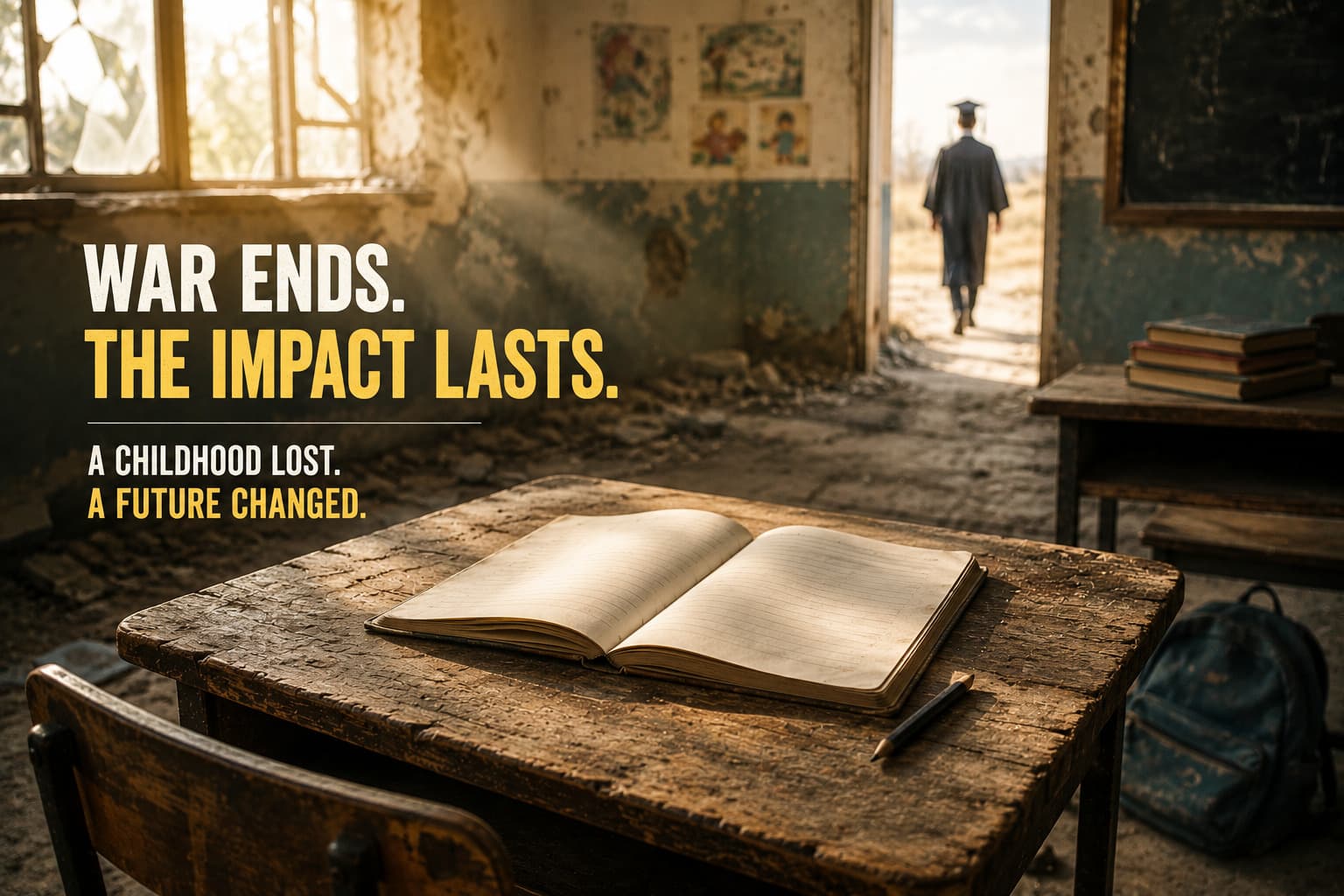
A war ends. Treaties are signed. The headlines move on.
But for the children who lived through it, the accounting can continue for the rest of their lives in adult height, school years completed, mental health, income and even cardiovascular risk.
Economists and epidemiologists have spent decades developing ways to measure exactly what conflict costs the generation that grows up inside it.
Their method is surprisingly elegant: find people who were the same age, in the same country, and compare those who were children during a period of conflict with those who narrowly missed it.
It isn't a controlled experiment. But it is one of the closest things history can provide.
And the question is no longer simply what war does to a child today.
Researchers can now ask:
What does that childhood experience look like 30, 40 or 70 years later?
That question matters now more than ever. UNICEF estimated that more than 473 million children over one in six globally were living in areas affected by conflict in 2024.
The Trick Is Finding the Right Control Group
You can't run a controlled experiment on war.
No ethics board would approve randomly assigning some children to bombing and others to safety.
So researchers had to get creative.
The method they often use is called a natural experiment.
Here's the idea.
When conflict hits a country, it rarely affects everyone in exactly the same way.
Some regions are heavily bombed. Others are barely affected.
Some children are toddlers when the fighting begins. Others are teenagers who have already completed most of their schooling.
That uneven exposure creates an opportunity for researchers.
By comparing people who were similar in age and background but experienced different levels or timing of conflict, researchers can estimate what the war itself changed.
It is, in effect, a natural comparison group created by history.
And sometimes the differences remain visible decades later.
What the Numbers Actually Show
The Dutch Hunger Winter is one of the most closely studied examples.
During the winter of 1944–45, Nazi forces cut food supplies to the western Netherlands, creating a severe famine.
Researchers subsequently followed people who had been exposed to the famine in the womb and examined their health decades later. The Dutch Famine Birth Cohort was specifically established to study the effects of maternal undernutrition during different stages of pregnancy on later cardiovascular, metabolic and mental health.
The findings have helped establish a broader principle:
What happens early in life can influence health much later.
The war's effects don't necessarily disappear when food becomes available again.
The body may carry part of the experience forward.
Vietnam Tells a Different Story
Vietnam provides another natural experiment but this time through bombing.
Researchers have combined historical information about bombing intensity with demographic and health data to examine what happened to people who experienced different levels of wartime exposure.
One study by Vu Vuong, Simon Chang and Michael Palmer found negative long-term effects on adult height and body mass index among South Vietnamese populations exposed to heavier bombing. The researchers also found much weaker effects in North Vietnam, highlighting how institutions and surrounding conditions can influence the long-term consequences of the same type of shock.
Another study published in the Journal of Development Economics found that early-life exposure to bombing during the Vietnam War was associated with substantially higher levels of severe mental distress in adulthood. The research also identified malnutrition during the war as an important mechanism.
The lesson is important:
The damage of war isn't necessarily limited to visible injuries.
It can alter health trajectories that only become measurable decades later.
The Economic Bill
Money tells the same story from another angle.
Across different postwar settings, researchers have found that people exposed to severe wartime disruption during childhood can experience lower economic outcomes later in life.
One important pathway is education.
Schools close.
Teachers disappear.
Families are displaced.
Children leave school to work or help their families survive.
And once those lost years accumulate, catching up becomes increasingly difficult.
That can eventually appear in adulthood as:
Fewer years of education → lower skills → fewer opportunities → lower lifetime earnings.
This is why the economic cost of war can continue long after physical reconstruction has begun.
The buildings may be rebuilt.
The lost years of childhood cannot simply be rebuilt in the same way.
Did You Know?
Not every long-term effect researchers find is negative in exactly the same way.
One study of Vietnam War-era bombing found that people exposed as children were more likely to become entrepreneurs as adults.
But the researchers did not interpret this as an advantage created by war.
Instead, they linked it to disruption in conventional employment opportunities pushing some people toward self-employment.
In other words:
Adaptation is not the same as benefit.
A harmful shock can sometimes produce behaviours that look positive when viewed in isolation.
The Scale Being Measured Right Now
This isn't only a history exercise.
It is happening to children today.
UNICEF reported that more than 473 million children, more than one in six globally were living in areas affected by conflict in 2024, with the share of children living in conflict zones having roughly doubled from the 1990s.
That makes the older cohort studies more than historical curiosities.
They are a warning about what today's children may experience decades from now.
A child who misses school today may not simply have a learning problem next year.
They may have:
- fewer qualifications,
- lower earnings,
- poorer health,
- greater psychological distress,
- or fewer economic opportunities decades later.
The full cost may not appear until adulthood.
What's Actually Being Done About It?
The research doesn't only document the damage.
It also points toward where interventions can matter most.
Three mechanisms appear repeatedly:
1. Interrupted education
2. Malnutrition and material deprivation
3. Chronic psychological stress
That means intervention doesn't have to wait until adulthood.
It can begin during childhood.
Cash Transfers
Humanitarian organisations increasingly use cash transfers to help displaced and conflict-affected families meet immediate needs.
The reasoning is straightforward.
Instead of deciding exactly what every family needs, provide families with resources and allow them to prioritise.
Food.
Rent.
Transport.
Medicine.
School supplies.
A recent quasi-experimental study covering Colombia, Mexico and South Africa found that each additional year of childhood exposure to cash-transfer programmes was associated with a 4% reduction in the odds of serious depressive symptoms in early adulthood. The researchers also found that the effects on education and employment were more mixed.
That last point is important.
Cash transfers appear promising, but one study does not establish a universal solution.
Keeping Children Learning
Education is the other major intervention.
Ukraine offers a stark example.
UNICEF reported that around 40% of children in Ukraine were unable to access continuous education during the war, while learning assessments showed gaps equivalent to roughly two years in reading and one year in mathematics compared with pre-war benchmarks.
In response, UNICEF and partners have supported learning and catch-up programmes designed to identify specific gaps and help children recover them rather than simply restarting an entire curriculum.
The idea is simple:
The earlier a learning loss is identified, the easier it may be to prevent it from becoming a lifetime disadvantage.
Age at exposure matters.
Research on early-life shocks consistently suggests that children exposed during particularly sensitive stages of development can experience larger long-term effects.
That makes early childhood especially important.
The same war can affect a three-year-old and a thirteen-year-old very differently.
The younger child may still be developing basic physical, cognitive and emotional systems.
The teenager may have already completed much of that developmental process.
Timing can therefore matter almost as much as exposure itself.
 ## 470 Million and Counting
The numbers can be difficult to visualise.
More than 473 million children were estimated to be living in areas affected by conflict in 2024.
That isn't simply a statistic about today's humanitarian emergency.
It represents millions of individual childhoods.
Millions of school days.
Millions of developmental years.
Millions of people who may eventually enter adulthood carrying consequences that won't be obvious when the fighting stops.
And that is exactly why researchers study previous generations.
The past becomes a warning system for the present.
Knowlegic Perspective
There's something quietly radical about treating “What does war cost a child?” as a measurable question rather than only a moral one.
It doesn't make the moral argument less urgent.
If anything, it sharpens it.
Researchers can now show how an interrupted childhood can appear decades later in a person's height, mental health, education and economic circumstances.
That specificity changes the conversation.
Instead of simply saying:
“War harms children.”
We can begin asking:
Which children are most vulnerable?
At what age?
Through which mechanism?
How long do the effects last?
And most importantly:
Where can intervention change the trajectory?
That is the real shift.
The research turns an enormous humanitarian problem into a set of specific problems that governments and humanitarian organisations can actually target.
The accounting is grim.
But it is also actionable.
Why This Matters
War is usually measured in immediate numbers:
Deaths.
Displacement.
Destroyed buildings.
Economic losses.
But there is another number that is much harder to calculate:
the years that haven't happened yet.
A child who loses two years of education today may experience the consequences in their thirties.
A child exposed to severe malnutrition may carry health effects into old age.
A child growing up under chronic stress may experience psychological consequences long after the threat has disappeared.
That means the true cost of war is partly invisible.
It is hidden inside the future.
War's bill for a childhood doesn't necessarily come due when the fighting stops.
It can arrive decades later in a blood-pressure reading, a paycheck, a missed qualification, a mental-health assessment or a health condition that researchers can trace back to the earliest years of life.
That is what makes this research so powerful.
It gives us a way to see something that was previously almost impossible to measure:
The future cost of a childhood interrupted by war.
And once that cost becomes measurable, something else changes.
It becomes possible to intervene.
Enjoyed this?
Get notified when a new Knowlegic story worth knowing is published.


