

Why Repeating a Choice Can Make It Feel Like the Better One
A 2025 study of more than 700 people suggests that simply choosing an option again and again can change how much we prefer it, even when better options exist.
Imagine ordering the same lunch from the same counter for a year. One day a friend asks why, and you hear yourself say that it is simply the best option on the menu.
Maybe it is. But a study from TU Dresden raises a less flattering possibility: the more often you pick something, the better it may seem to you.
A choice repeated often enough can start to look like a good choice, whether or not it ever was.
Seven Hundred People, One Quiet Pattern
The work comes from Ben Wagner, H.B. Wolf and Stefan Kiebel, who published it in the journal Communications Psychology. Europe PMC's record lists its first publication as 26 November 2025.
The team ran nine new value-based decision tasks with 351 participants. They also re-analysed six previously published datasets, covering another 350 people.
TU Dresden's announcement puts the total at over 700 participants.
Why "Irrational" Choices Need an Explanation
The paper starts from a familiar puzzle. People show decision biases that make their behaviour look irrational, and one important cause, the authors write, is that the context of a decision can later shape what we prefer in new situations.
In other words, where you first met an option can leave a mark. Later, in a different setting, that option may still pull on you.
Existing computer models of this, such as relative value learning or range normalization, often need extensive knowledge of the environment to explain it, according to the authors. They wanted a simpler account.
The Simple Suspect: Doing It Again
Their hypothesis was that most of these biases come from a habit of redoing whatever one did before in the same kind of situation. You acted once, so you tend to act the same way again.
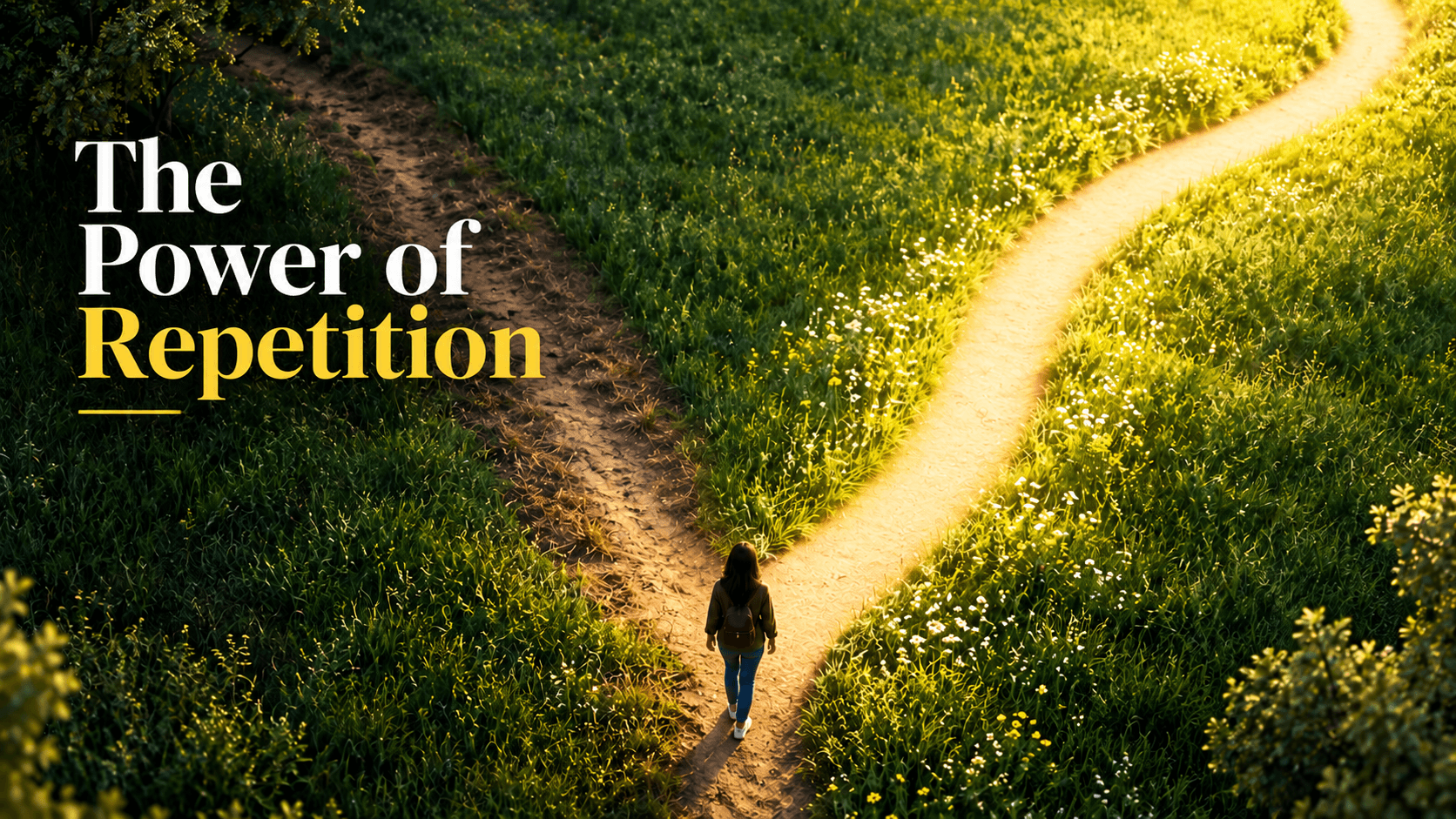
Think of a footpath across a field. Nobody planned it. It exists because people kept walking where others had already walked, and the path then looks like the obvious way across.
The results fit that picture. According to the abstract, options repeated more often within a context went with biased choices: people valued the repeated option more and felt less unsure about it.
Chosen More, Rated Higher
Wagner put the pattern plainly. "Options that were chosen more frequently were not only preferred, but also rated as better."
That detail matters. If repetition only made people stick with a pick, it would look like laziness. Repetition also changed how good the pick seemed.
Wagner also described the strength of the effect as surprising. In his words, "The surprising thing was how strongly repetition alone can change preferences."
Did You Know?
The researchers' model needed only two ingredients, learning from reward and repeating actions, to explain biased choices in stable environments. The authors say it outperformed every alternative they tested, including implementations of value normalization and a goal-centric account.
A Shortcut Rather Than a Calculation
TU Dresden's announcement says people tend to repeat decisions they have already made, whether or not those decisions still make sense in the new moment. It describes the memory of past actions as a kind of mental shortcut that shapes the next choice.
The announcement adds, in words it attributes to Wagner, that repetition can keep an option preferred in a new setting even when equally good or better alternatives exist. It points to purchasing decisions, habits and recurring routines as places where behaviour that looks illogical becomes easier to understand.
This echoes older work on habits. A 2019 paper in Psychological Review by Miller, Shenhav and Ludvig argued that habits develop through "the direct strengthening of recently taken actions rather than through the encoding of outcomes."
The abstract adds that the model "also explains the prevalent observation of perseveration in repeated-choice tasks." The Dresden authors themselves suggest their findings offer a way of understanding "habit-like choice tendencies."
If you want a related look at how everyday buying can run on autopilot, the psychology behind why we keep buying things we don't need is a good companion read.
What the Study Does Not Say
The authors report that learning from reward plus action repetition is enough to explain biased choices in stable environments. That qualifier is worth keeping, and the abstract does not claim more than that.
These were laboratory decision tasks, not lunch orders or shopping trips. The link to everyday life is the authors' suggestion and the press release's framing, not something the tasks measured directly.
It also does not say that repeating a choice is bad. Often the thing you keep choosing really is good. The finding is that repetition can add a sense of "better" on its own, which makes it harder to tell the two cases apart from the inside.
Knowlegic Perspective
It is tempting to treat a preference as a verdict: we like something because we weighed it and it won. This study offers a quieter account, in which a lot of what we prefer is a record of what we have already done.
That is not a reason to distrust every habit. Repetition is often efficient, and the study does not test any advice about changing habits. But it does suggest a question worth asking about a long-standing favourite: did I pick this because it is good, or does it feel good because I keep picking it?
A choice repeated often enough can start to look like a good choice, whether or not it ever was.
Sources & References
- Psychologie: Wiederholung beeinflusst Entscheidungen stärker als gedacht, TU Dresden (2026)
- Habit-like repetition influences decisions more than previously thought, Bernstein Network Computational Neuroscience (2026)
- Why your brain keeps making the same decisions, even when better options exist, ScienceDaily (2026)
- Habits without values, Psychological Review via Warwick Research Archive Portal (2019)
Enjoyed this?
Get notified when a new Knowlegic story worth knowing is published.


