

The Psychology Behind Why We Keep Buying Things We Don't Need
Why the itch to buy comes back the moment it's scratched and what your brain is actually chasing when you shop.
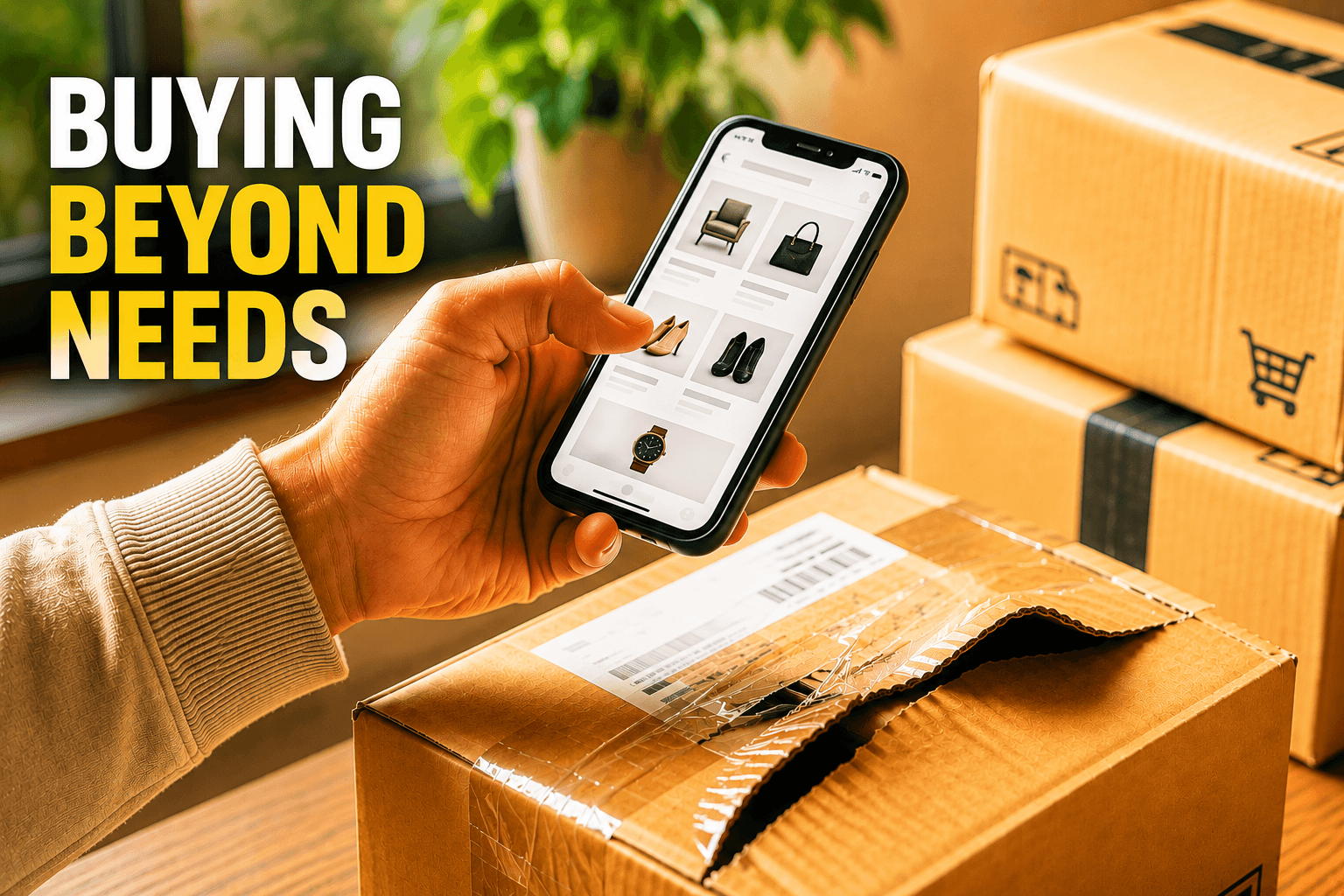
The box is still taped shut on the kitchen table, and it's already the best part of the day.
Not because of what's inside, you're not entirely sure you remember what you ordered. It's the ten minutes before this moment, refreshing the tracking page, picturing the thing in your life, that felt like the actual reward. By the time the tape comes off, some of that feeling is already gone. In a week, you'll barely register the object is there.
This isn't a willpower problem, and it isn't really about the object at all. It's a wiring problem: the brain's reward system pays out before the purchase, not after, which means the satisfaction you're shopping for was never in the box to begin with.
The Reward Fires Before You Pay
In 2007, researchers at Stanford put people in a brain scanner and had them shop.
They weren't tracking what happened after a purchase. They were watching what happened in the seconds before one, while a product was on screen, before any price appeared, and then again once a price did. The region that lit up hardest wasn't triggered by owning the item. It fired while people were still deciding whether to want it.
This tracks with something neuroscientists have shown separately: wanting and liking run on different circuits in the brain, and the dopamine system is the one that drives the wanting, the anticipatory pull toward a reward not the pleasure of actually having it.
That's the twist most people miss about shopping. The craving isn't a means to an end. The craving is the event. Once the item ships, the brain has already collected on the deal it cared about, and what's left over the thing itself is almost an afterthought.
Think of it like flipping through a restaurant menu when you're already full from the bread basket. The photos still make your mouth water. Ordering the meal doesn't add much on top of the wanting.
Did You Know?
Online shoppers report getting more excited waiting for a package in the mail than they do buying something in a physical store on the spot, the delay itself seems to stretch out the anticipation, and the anticipation is the part the brain rewards most.
When the Purchase Is Actually a Bandage
Stress, boredom, a bad meeting, a breakup a wide range of unrelated bad days end the same way: something new in the cart.
Researchers call this retail therapy, and it isn't just a euphemism. One well-cited study that tracked people's moods before and after a purchase decision found that choosing to buy something measurably softened lingering sadness more than simply browsing the same items without buying. The decision itself, not the delivery, is doing the emotional work.
That's a useful bandage. It's also why it doesn't hold. A national survey of thousands of adults found most people admit their emotions steer their spending, and the majority of people who do this say it's pushed them to spend more than they meant to (LendingTree, 2024). The mood lifts for an afternoon. The receipt doesn't go anywhere.
Here's the part that makes this a loop instead of a one-off: relief is a hunger that comes back. This is the same mechanic behind why the money you're spending on the internal comfort of a purchase rarely settles the underlying feeling for good — it treats the symptom, and the symptom returns on its own schedule, not yours.
The Feeling You Bought Has an Expiration Date
Even when a purchase genuinely delivers a nicer coffee mug, a faster phone, a jacket that actually fits well- the boost has a short shelf life.
Psychologists call this hedonic adaptation: humans are remarkably good at normalizing to whatever they have, good or bad, and treating it as the new baseline within weeks. One well-studied strategy for slowing this down is variety, spreading purchases across different kinds of experiences rather than repeating the same category of splurge, which appears to meaningfully extend the enjoyment compared to routine repeat buying. But the adaptation itself doesn't stop. It just resets the clock.
Picture a thermostat that quietly recalibrates itself to whatever temperature the room happens to be. Buy the nicer thing, and the thermostat doesn't register "warmer" for long, it just relabels this as normal and starts measuring from there. The next purchase has to clear a slightly higher bar to register as an upgrade at all.
This is also, not coincidentally, a genuinely good deal for anyone selling things. A little scarcity, a little story, a price that signals status rather than material cost — the reasons certain goods can charge far more than their materials would suggest rest on this same instinct: the brain keeps recalibrating what "enough" looks like, and industries that understand this design around it deliberately.
The Products Were Built to Wear Out
None of this happened by accident, and some of it was engineered on purpose, decades before anyone had a shopping cart icon to click.
In 1924, the world's major lightbulb manufacturers formed a cartel and agreed to cap bulb life at 1,000 hours, down from the 1,500 to 2,000 hours bulbs had commonly lasted before. They fined member factories whose bulbs lasted too long. It's widely regarded as the first documented case of an industry deliberately shortening a product's life to keep customers coming back.
The instinct that cartel banked on that a slightly-worse product sells more units over time than a great one, never went away. It shows up any time a company keeps a devoted audience returning to buy variations on the same thing long after the original reason to care has faded, the same dynamic behind why merchandise built around a franchise keeps selling for decades after the movie leaves theaters. The object changes. The mechanism pulling you back rarely does.
The person credited with coining the phrase "planned obsolescence" wasn't a manufacturer at all. It was a real-estate broker named Bernard London, who proposed it in a self-published 1932 pamphlet as a way to fight the Great Depression by legally forcing consumers to keep replacing goods.
What All of This Adds Up To
None of these forces are conspiracies against any one shopper. They're a set of ordinary human wires anticipation, mood repair, adaptation that happen to line up neatly with what keeps a store profitable.
The debt is the receipt for how well that alignment works. U.S. credit card balances hit $1.28 trillion by the end of 2025, the highest figure recorded since the New York Fed started tracking the data in 1999. That number is not proof that anyone is buying recklessly. It is proof that a lot of ordinary, forgivable little purchases add up to something enormous when the underlying itch never actually gets resolved.
Knowlegic Perspective
It's tempting to read all of this as a story about weak willpower, but the research points somewhere else. The system is doing exactly what it evolved to do: chase novelty, repair mood, and adapt to whatever it's given so it can keep noticing what's new. The problem isn't that the wiring is broken. It's that an entire industry has spent a century learning to play it like an instrument.
Knowing where the reward actually lives - in the anticipation, not the object, doesn't kill the pleasure of shopping. But it does change what you're allowed to expect from the box on the table. It was never going to fix the bad day. That was never really its job.
The box is still taped shut on the kitchen table, and it was already the best part of the day because the reward was never really in the box. It was in the ten minutes before, and that feeling was always going to fade the moment the tape came off.
Sources & References
• Neural Predictors of Purchases — Neuron / Stanford University, Knutson et al. (2007)
• The Benefits of Retail Therapy: Making Purchase Decisions Reduces Residual Sadness — Journal of Consumer Psychology
• Happiness and Thrift: When (Spending) Less Is (Hedonically) More — Journal of Consumer Psychology, Lyubomirsky et al. (2011)
• The Great Lightbulb Conspiracy — IEEE Spectrum, Krajewski (2014)
• Household Debt and Credit Report, 2025:Q4 — Federal Reserve Bank of New York (2025)
• Most Americans Admit to Emotional Spending — LendingTree (2024)
Enjoyed this?
Get notified when a new Knowlegic story worth knowing is published.


