

Why Tech Giants Are Betting Big on Nuclear Power?
Microsoft, Amazon, Google and Meta are making long-term nuclear bets as AI turns electricity into one of technology's most important bottlenecks.
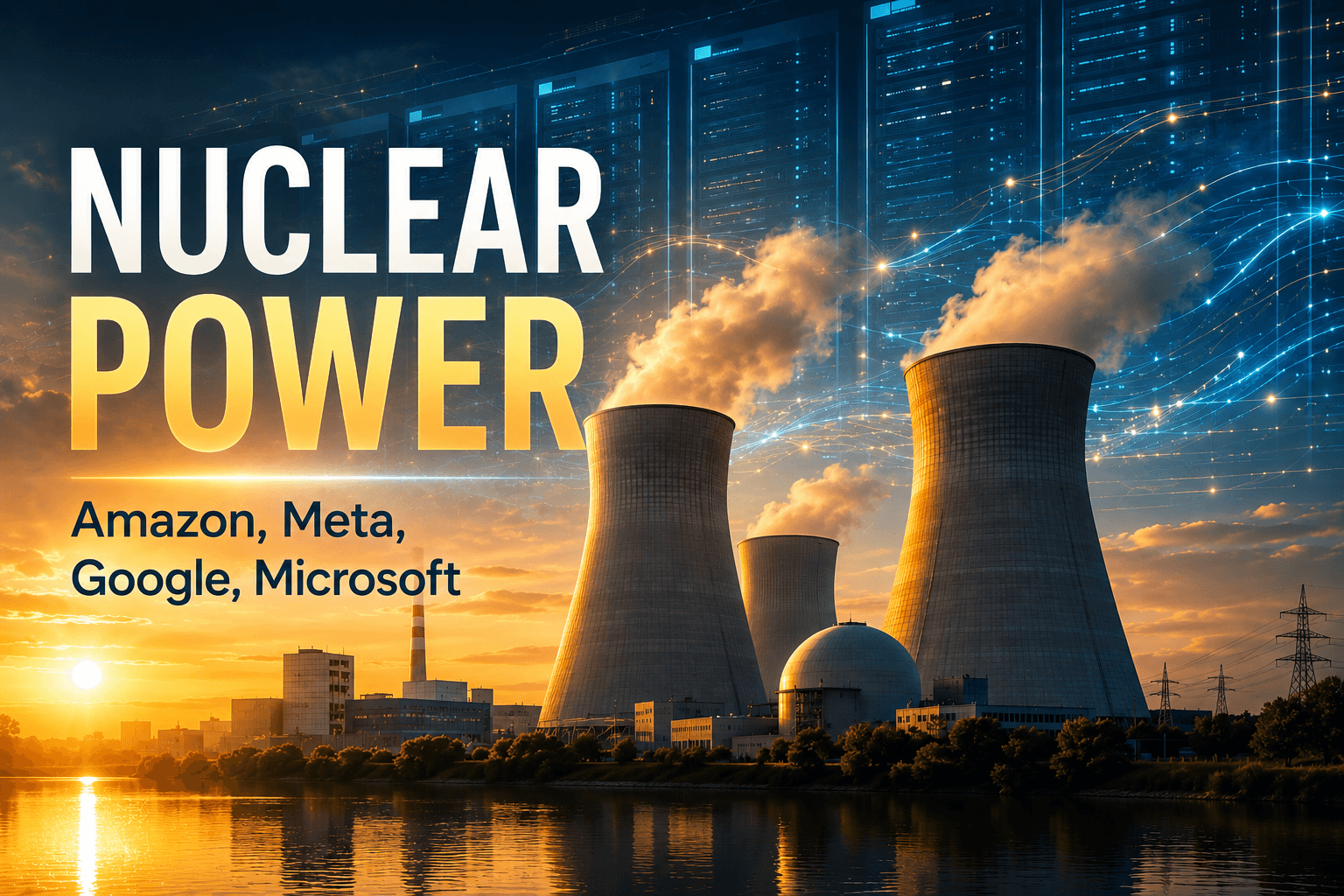
For decades, nuclear power was often discussed as an energy story.
Now it is becoming a technology story.
Microsoft agreed in 2024 to buy the output of a nuclear reactor at Three Mile Island that had been shut down since 2019. Amazon expanded its relationship with Pennsylvania's Susquehanna nuclear plant to as much as 1.92 GW. Google signed a deal for 500 MW from a future fleet of advanced reactors. Meta signed a 20-year agreement tied to Illinois' Clinton nuclear plant.
Together, these four commitments represent roughly 4.4 GW of nuclear capacity.
Why are technology companies suddenly interested in reactors?
Because AI needs something that sounds surprisingly ordinary:
Electricity. Lots of it. And it needs to be available around the clock.
The International Energy Agency expects global data-center electricity consumption to more than double to around 945 TWh by 2030, with AI identified as the most important driver of that growth.
The interesting question isn't whether Big Tech has discovered nuclear power.
It's why AI has made nuclear power strategically interesting again.
The Reactor Nobody Wanted, Suddenly Everyone's Prize
In 2019, Three Mile Island Unit 1 shut down.
The reactor wasn't destroyed.
It wasn't technically obsolete.
It had simply become difficult to operate profitably in a market where inexpensive natural gas was putting pressure on electricity prices.
Then AI changed the conversation.
In September 2024, Microsoft signed a 20-year power purchase agreement with Constellation Energy to buy the reactor's output after its planned restart.
The facility was renamed the Crane Clean Energy Center.
The agreement covers approximately 835 MW of carbon-free electricity.
It is an extraordinary reversal.
A plant that had become uneconomic suddenly became strategically valuable because a technology company wanted predictable electricity for its growing data-center footprint.
The reactor had spent years looking like an old piece of infrastructure.
Suddenly, it looked like an energy asset for the AI era.
But there is a catch.
The reactor still needs to complete the regulatory and technical process required for a restart. The U.S. Nuclear Regulatory Commission says Constellation must restore the plant's operational licensing basis and satisfy safety, inspection and environmental requirements before operations can resume.
So Microsoft's bet isn't simply:
"We bought electricity."
It's also:
"We believe this reactor can come back safely, economically and on a timeline that matches our demand."
That is a much bigger bet.
Did You Know?
The reactor Microsoft is backing is Unit 1, which operated for more than 40 years before shutting down in 2019.
The infamous Three Mile Island accident in 1979 involved Unit 2, a separate reactor at the same site. Unit 1 was not involved in that accident.
Amazon Took a Different Route
Amazon's nuclear strategy is less about restarting an old reactor.
It's about getting closer to one that is already operating.
In Pennsylvania, Amazon Web Services acquired a data-center campus connected to Talen Energy's Susquehanna nuclear plant.
In 2025, Amazon and Talen expanded their relationship with a long-term agreement for up to 1,920 MW of electricity, with the full volume expected to be reached by around 2032 and the agreement running through 2042.
That's an enormous amount of power.
But Amazon's nuclear ambitions don't stop there.
The company is also pursuing advanced nuclear technologies, including a project with Energy Northwest in Washington state and investments connected to X-energy's small modular reactor technology. Amazon says its Energy Northwest project is expected to generate roughly 320 MW initially, with potential expansion.
So Amazon is effectively pursuing two strategies at once:
Use existing nuclear power now.
Help create new nuclear capacity for later.
That combination is important because building new nuclear plants takes years.
Existing reactors offer something much more valuable in the short term:
Power that already exists.
Why Not Just Build More Solar and Wind?
This is where the story becomes more interesting.
Solar and wind remain central to Big Tech's clean-energy strategy.
They are often cheaper to build, and technology companies continue to invest heavily in renewable projects.
But there is a difference between generating clean electricity and guaranteeing that electricity is available when you need it.
A solar farm doesn't produce electricity at midnight.
A wind farm's output changes with the wind.
A nuclear plant can operate continuously for long periods.
For a data center running AI workloads around the clock, that distinction matters.
Think of it this way:
Solar and wind are like rain.
Firm power is like a tap.
Rain can be abundant, but you need storage and infrastructure to make it available exactly when you want it.
A tap gives you a predictable supply.
That's why the nuclear deals shouldn't be interpreted as Big Tech abandoning renewables.
They're better understood as a hedge against the hours when renewable generation alone may not match demand.
And the IEA expects renewables to meet a large share of the additional electricity demand from data centers through 2030, alongside natural gas and nuclear.
The future energy mix is therefore unlikely to be:
Nuclear instead of renewables.
It is more likely to be:
Nuclear + renewables + storage + an expanded grid.
Google Is Betting on Reactors That Don't Exist Yet
If Microsoft's bet is about restarting an existing reactor and Amazon's is partly about using an operating one, Google's strategy is more futuristic.
In October 2024, Google announced a partnership with Kairos Power to deploy a fleet of advanced reactors capable of producing 500 MW of clean electricity by 2035.
The first deployment is targeted for 2030.
These aren't conventional large nuclear plants.
Kairos is developing an advanced reactor design intended to be smaller and potentially more modular than traditional reactors.
The attraction is obvious.
If AI data centers keep expanding, companies don't just need today's electricity.
They need a pipeline of new electricity capacity.
But this is where the risk increases.
The technology is still being developed and commercial deployment at this scale has not yet been demonstrated in the United States.
Google is therefore betting not just on nuclear power.
It's betting on the commercialization of a new generation of nuclear technology.
Meta Chose the More Conservative Bet
Meta's nuclear strategy looks closer to Microsoft's.
In June 2025, Meta and Constellation signed a 20-year power purchase agreement covering the output of the Clinton Clean Energy Center in Illinois.
The agreement covers approximately 1,121 MW of nuclear generation and supports the plant's continued operation and relicensing.
The contrast between the companies is revealing.
Microsoft is backing a restart.
Google is backing new advanced reactors.
Amazon is combining existing nuclear power with future SMR development.
Meta is extending the life of an existing reactor.
Four companies.
Four variations on the same underlying problem:
Where will all the electricity for AI come from?
Did You Know?
The four deals highlighted here amount to roughly 4.4 GW of nuclear capacity, a useful illustration of how quickly nuclear has moved from a peripheral topic in Big Tech's energy strategy to a major infrastructure consideration.
Four Companies, Four Nuclear Bets: Powering the AI Boom
The numbers are important.
But the strategy is even more important.
These companies are trying to secure something that is becoming increasingly scarce:
predictable electricity at enormous scale.
 ## The Part the Press Releases Don't Emphasize
The demand for electricity is real.
The nuclear technology is the harder part.
Existing reactors can potentially provide large quantities of reliable electricity, but restarting or extending their lives involves licensing, engineering work, maintenance and significant capital.
New reactors face an even bigger challenge.
They must be designed, licensed, financed, constructed and connected to the grid.
And history has shown that nuclear projects can suffer from delays and cost overruns.
That's particularly relevant for small modular reactors.
The promise is compelling:
Smaller reactors.
Factory-based manufacturing.
Potentially easier deployment.
More flexible siting.
But the commercial track record is still developing.
That makes Google's and Amazon's advanced-reactor bets fundamentally different from buying electricity from an existing plant.
They are long-term infrastructure bets whose payoff depends on technology and construction schedules going according to plan.
AI Has Changed the Electricity Equation
This is the part that matters most.
The AI boom isn't simply adding more servers.
It's changing the scale of computing infrastructure being built.
The IEA estimates that global data-center electricity consumption will rise from about 460 TWh in 2024 to around 945 TWh by 2030 in its base case. Electricity use by accelerated servers, largely driven by AI, is projected to grow especially quickly.
And there is another problem.
Building a data center can happen relatively quickly compared with building major energy infrastructure.
The IEA notes that data centers can become operational in roughly two to three years, while energy infrastructure often requires much longer planning and construction timelines.
That creates a mismatch.
AI infrastructure can scale faster than the electricity infrastructure needed to support it.
This may be one of the most important physical constraints on the next phase of AI.
Not chips.
Not models.
Power.
The Nuclear Bet Is Also a Bet on Time
There's an irony here.
AI companies are among the fastest-moving businesses in the world.
Nuclear energy is one of the slowest.
A new AI model can be developed in months.
A nuclear project can take years.
A data center can be planned and constructed on a relatively compressed schedule.
A major energy project has regulatory, construction and grid milestones that cannot simply be accelerated by throwing more engineers at them.
That's why today's nuclear agreements are really bets on the timing of future electricity demand.
If AI demand grows as expected, securing long-term power could become a competitive advantage.
If demand grows more slowly, some of these commitments could look expensive.
And if advanced reactor projects are delayed, companies may still need other sources of electricity in the meantime.
That uncertainty is the part worth watching.
Knowlegic Perspective
It is tempting to describe these deals as evidence of a nuclear renaissance.
There is some truth in that.
But the more interesting story is what caused it.
The renewed interest in nuclear arrived alongside an extraordinary expansion in AI computing.
Technology companies that once thought primarily about chips, cloud capacity and software are now thinking about power plants.
That is a profound change.
Microsoft isn't just a software company negotiating for electricity from a nuclear reactor.
Amazon isn't simply a cloud company investing around a nuclear plant.
Google isn't merely experimenting with AI models while separately watching the energy sector.
Tech giants aren't betting on nuclear because they suddenly became nuclear companies.
They're betting on it because AI has created a problem that software alone cannot solve.
The machines need electricity.
A lot of it.
They need it at night.
They need it when the wind isn't blowing.
They need it when the sun isn't shining.
And they need it reliably enough that a power shortage doesn't become a technology bottleneck.
Nuclear offers one answer: large-scale, low-carbon electricity that can operate continuously.
But the bet isn't risk-free.
Restarting old reactors takes time.
Extending existing ones requires investment.
Building new reactors requires patience.
And advanced reactors remain a technological and commercial work in progress.
So the real story isn't:
"Big Tech has gone nuclear."
It's more interesting than that.
AI has made electricity part of the technology stack.
And the companies that control the next generation of computing may increasingly be the companies willing to help build the power system behind it.
Sources & References
- Constellation — Microsoft and Crane Clean Energy Center
- U.S. Nuclear Regulatory Commission — Crane Clean Energy Center
- Amazon — Nuclear Energy Strategy
- World Nuclear News — Talen-Amazon 1.92 GW Agreement
- Kairos Power — Google 500 MW Advanced Nuclear Partnership
- Constellation — Meta 20-Year Nuclear Agreement
- International Energy Agency — Energy and AI
- International Energy Agency — Energy Supply for AI
Enjoyed this?
Get notified when a new Knowlegic story worth knowing is published.


