

Why Van Gogh Became Rich After Death, While Picasso Didn't Have to Wait
One became famous only after his death. The other was already celebrated, collected and commercially successful while he was alive. The difference reveals something fascinating about how the art world creates value.
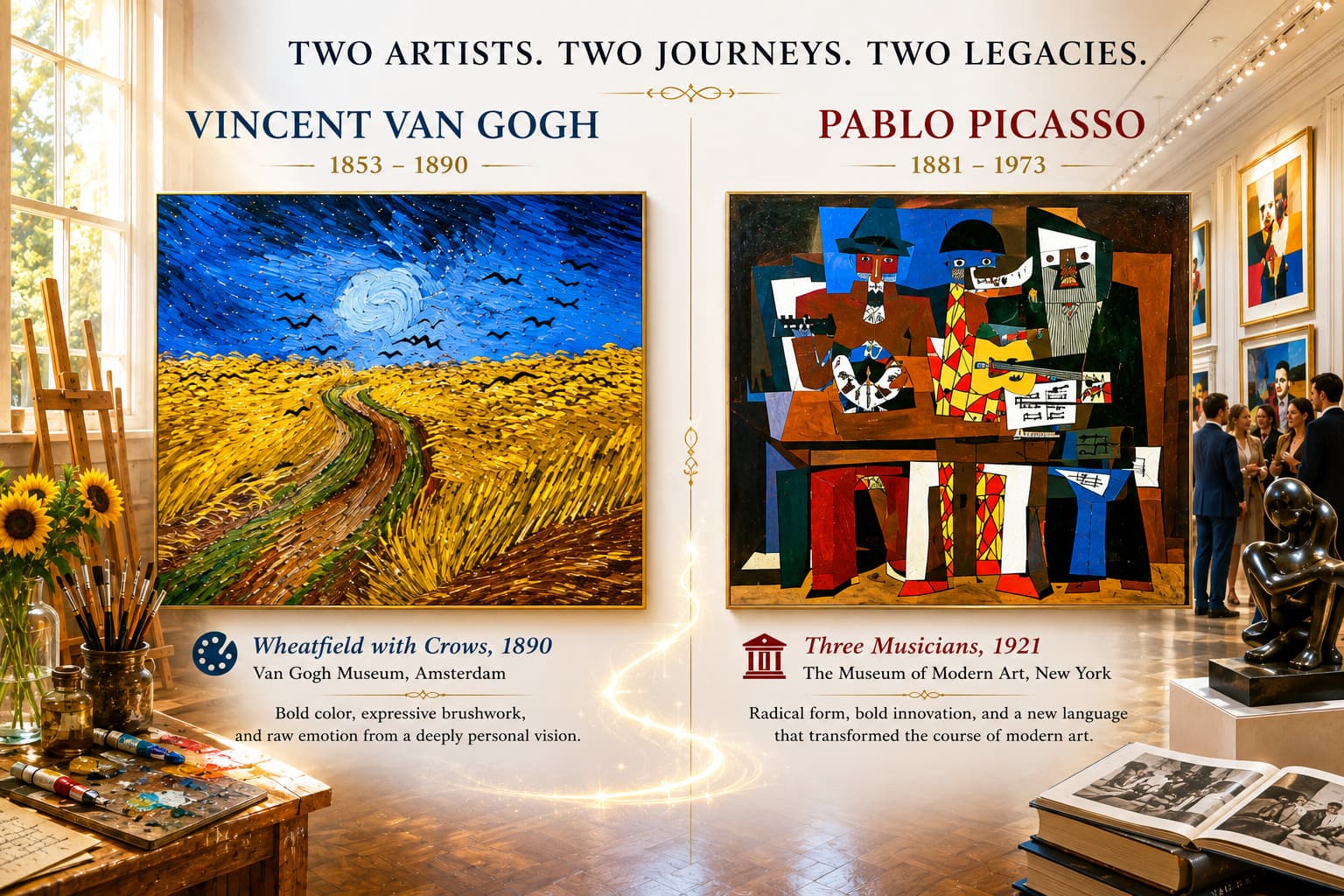
Vincent van Gogh died in 1890 at just 37, having received little commercial recognition during his lifetime. His The Red Vineyard is the only painting conclusively documented as sold while he was alive, for 400 francs to Belgian painter and collector Anna Boch.
Pablo Picasso's story could hardly be more different.
By the time Picasso died in 1973, he had spent decades as an internationally recognised artist. His work was exhibited, collected, discussed and actively traded while he was still alive. The Musée Picasso Paris documents major exhibitions and public recognition during his later decades, including a major Louvre exhibition for his 90th birthday.
So why did one artist's financial and cultural value explode after death while the other didn't need death to validate him?
The answer isn't simply talent.
It's about recognition, networks, reputation, scarcity and the people who build an artist's legacy.
Van Gogh: A Genius the Market Hadn't Understood
Vincent van Gogh produced an extraordinary body of work in a remarkably short career.
But artistic productivity and commercial success are not the same thing.
During his lifetime, Van Gogh struggled to establish a sustainable market for his paintings. His brother Theo van Gogh, an art dealer, provided crucial financial and emotional support while also trying to promote Vincent's work.
Then came the sale that became legendary.
In 1890, The Red Vineyard was purchased by Anna Boch for 400 francs. Theo's account book records the payment.
The painting is now in the Pushkin State Museum of Fine Arts in Moscow.
And its story exposes an important misconception.
Van Gogh's famous "one painting sold" story is useful shorthand, but historians have pointed out that he may have sold or exchanged other works. What is unusually well documented is that The Red Vineyard is the only known painting with a clearly established lifetime sale.
That's a more interesting story than the myth.
Because the real question isn't:
“Why did nobody buy Van Gogh?”
It is:
“Why did the market fail to recognise what later generations considered extraordinary?”
The Person Who Changed Van Gogh's Fate
Van Gogh's posthumous fame wasn't automatic.
Someone had to build it.
That person was Jo van Gogh-Bonger, Theo's widow.
After Vincent died in 1890, Theo himself died only months later. Jo was left with a young child and a substantial collection of Vincent's work.
Instead of allowing the paintings to disappear into private collections, she actively promoted them.
She lent works to exhibitions.
She sold paintings strategically.
She published Vincent's correspondence.
And she helped create the documentary record through which later audiences could understand the artist and his ideas.
In 1905, Jo organised a major Van Gogh exhibition at Amsterdam's Stedelijk Museum, displaying 472 works.
That is an extraordinary number considering how little commercial success Vincent had experienced while alive.
His reputation didn't simply appear after death.
Someone built it.
How Reputation Creates Value
This is where the story becomes bigger than Van Gogh.
Art doesn't have a universal price tag.
A painting's value depends on what people believe it is worth.
And that belief is influenced by:
- Museums
- Collectors
- Dealers
- Critics
- Exhibitions
- Provenance
- Art historians
- Auction houses
- Cultural reputation
Van Gogh's case demonstrates how those forces can change over time.
Once museums and collectors began treating his work as historically significant, the perception of scarcity and importance changed.
The paintings hadn't suddenly become technically different.
The market's understanding of them had changed.
Picasso Played a Different Game
Now consider Pablo Picasso.
Picasso didn't need someone to discover his genius after his death.
He had already built an extraordinary reputation during his lifetime.
His early supporters included collectors Gertrude and Leo Stein, whose collection documented Picasso's transition toward Cubism. The Metropolitan Museum of Art notes that the Steins acquired Picasso's early works and later purchased Cubist works directly from him.
Picasso also developed relationships with influential dealers and fellow artists.
His career wasn't operating in isolation.
He was connected to a growing network of:
Artists → Dealers → Collectors → Critics → Galleries → Museums
That network helped convert artistic innovation into recognition and demand.
And once demand appeared, it reinforced itself.
More collectors wanted Picasso.
More institutions exhibited Picasso.
More attention increased his reputation.
Greater reputation increased demand.
And greater demand supported higher prices.
Picasso's value was already being established while he was alive.
Picasso's Reputation Had Become Institutional
One of the clearest differences between the two artists is what happened during their later lives.
Picasso continued to receive major institutional recognition.
For his 90th birthday in 1971, a major exhibition of his work was held at the Louvre. The Musée Picasso Paris also documents his donations to museums, exhibitions of his recent work and his continued artistic production during his final years.
He died in 1973 at the age of 91.
But by then, his place in art history was already firmly established.
His death didn't need to introduce Picasso to the world.
The world already knew who Picasso was.
So Does Death Make Art More Valuable?
Here's where the story gets really interesting.
There is evidence that an artist's death can influence prices.
A 2025 study published in the Journal of Cultural Economics examined more than 30,000 auction transactions and over 22,000 exhibitions involving a large sample of artists. It found that auction prices tended to rise after an artist's death, consistent with the idea that death permanently limits the future supply of new works.
But the study found something even more interesting.
The “death effect” isn't the same for everyone.
The effect varies depending on an artist's age and reputation at the time of death.
Younger, lower-reputation artists can experience larger posthumous price increases because buyers may anticipate that their reputation could grow in the future.
This helps explain why the Van Gogh story is so compelling.
His death didn't magically create talent.
Instead, his death permanently closed the supply of new Van Gogh paintings while his reputation was still capable of expanding dramatically.
Scarcity Matters — But It Isn't Enough
Death creates a simple economic constraint.
An artist who dies cannot create another original painting.
The future supply becomes finite.
But scarcity alone doesn't make something valuable.
There are countless objects that are scarce but worthless.
What matters is the combination:
Scarcity + Demand + Reputation
A dead unknown artist may have a finite supply of paintings.
But if nobody wants them, scarcity doesn't help much.
A famous artist has something different.
There is already demand.
Death simply ensures that the supply can never increase again.
The recent cultural-economics research supports this distinction: the postmortem price effect varies substantially according to the artist's reputation and age at death.
The Strange Economics of Legacy
Van Gogh's story also reveals an unusual feature of creative industries.
The creator doesn't always control the value of the creation.
After an artist dies, other people become responsible for:
- Managing the estate
- Protecting authenticity
- Maintaining provenance
- Lending works to museums
- Organising exhibitions
- Managing reproduction rights
- Deciding when and where works are sold
This can have enormous economic consequences.
The Van Gogh Museum describes Jo van Gogh-Bonger as crucial to promoting Vincent's work, selling paintings and lending them to exhibitions.
Picasso's legacy was different again.
His estate was so significant that the French state acquired a substantial part of his collection through the dation system, works transferred in lieu of estate taxes and the Musée Picasso Paris was subsequently established around this extraordinary body of material.
The artist's death didn't end the economic story.
It began a new phase of it.
Knowlegic Perspective
The romantic version of Van Gogh's story is:
A misunderstood genius died poor, and the world eventually realised how brilliant he was.
It's beautiful.
But it isn't quite enough.
The more revealing story is that recognition is not distributed purely according to talent.
It depends on timing.
It depends on networks.
It depends on people willing to take a chance.
It depends on institutions deciding what deserves attention.
And sometimes it depends on someone like Jo van Gogh-Bonger refusing to let an artist's work disappear.
Picasso demonstrates the opposite pathway.
He found influential collectors.
He developed relationships with dealers.
His work entered important collections.
Museums recognised him.
His reputation compounded while he was still alive.
So when he died, the market didn't have to discover Picasso.
It already knew his value.
And this is perhaps the most important insight:
Death doesn't create artistic value.
It can amplify scarcity.
It can trigger a reassessment.
It can accelerate prices.
But the market still needs a reason to care.
Van Gogh didn't become valuable because he died.
Picasso didn't remain valuable because he lived.
The difference was when the world recognised their value and who helped make that recognition happen.
Van Gogh needed Theo's support and, later, Jo's extraordinary determination to bring his work to a wider public.
Picasso found collectors, dealers, institutions and audiences while he was still alive.
One artist's reputation had to be rebuilt after death.
The other's was already firmly established.
And perhaps that leaves us with a more useful lesson than the familiar myth of the starving genius:
Talent creates possibility. Recognition creates value. And sometimes, the people who recognise you early matter almost as much as the talent itself.
Enjoyed this?
Get notified when a new Knowlegic story worth knowing is published.


