

How India Designed Its National Identity: The Story Behind the Flag and Anthem
The tricolour and “Jana Gana Mana” feel timeless today. But neither became a national symbol without debate, redesign and compromise.
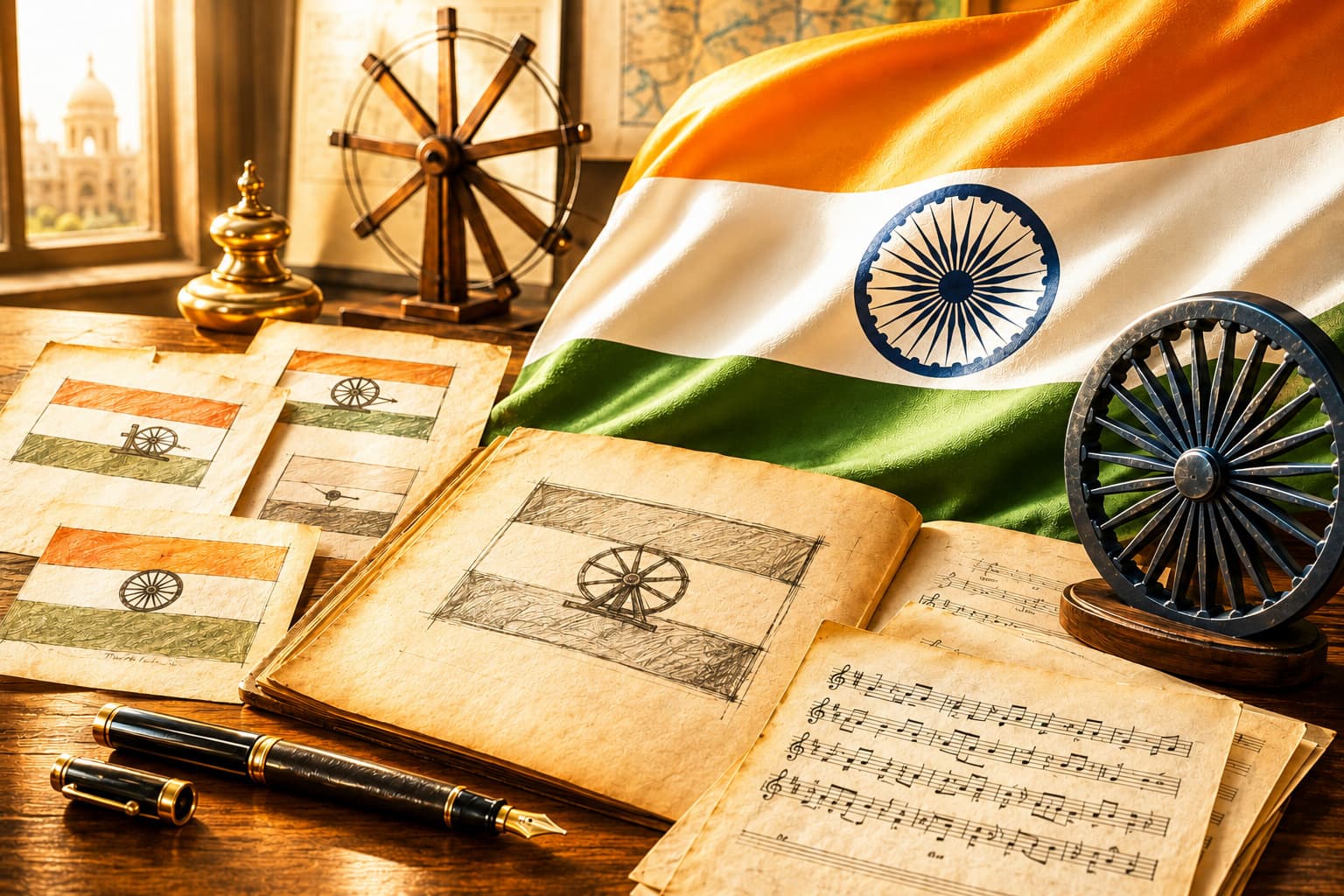
Every August 15, the same flag rises and the same anthem plays.
The colors feel permanent. The symbols feel inevitable. The words sound as though they were always destined to represent India.
But they weren't.
India's national flag went through multiple designs before independence, including a major change just 24 days before August 15, 1947.
And the national anthem question was even more complicated.
Two songs, “Jana Gana Mana” and “Vande Mataram”, carried enormous cultural and political significance. One eventually became the national anthem; the other became the national song.
Neither story was simply about choosing a winner.
Both were about answering a much harder question:
How do you create a symbol that can represent a country this diverse?
The answer, in both cases, was compromise.
Before the Tricolour We Know Today
The Indian flag did not appear fully formed in 1947.
One of the most important figures in its evolution was Pingali Venkayya, a former soldier who had met Mahatma Gandhi in South Africa and spent years experimenting with possible flag designs.
He reportedly produced around 30 variations in a monograph.
At a Congress session in 1921, Gandhi asked Venkayya to develop a design incorporating the charkha, or spinning wheel a powerful symbol of self-reliance and the independence movement.
Venkayya's early version used red and green, representing two major religious communities of the time. Gandhi later advocated adding white, representing other communities and peace.
The flag was already becoming more than a piece of fabric.
It was becoming a visual argument about what India was.
1931: The Tricolour Takes Shape
Another major redesign came in 1931.
A Congress Flag Committee replaced red with saffron and settled on a horizontal saffron-white-green arrangement.
The charkha remained at the centre of the white band.
This version became closely associated with the independence movement and was flown at Congress rallies for the next sixteen years.
It looked remarkably close to today's flag.
But one important element was still missing.
The Ashoka Chakra.
And that would change just weeks before independence.
The Symbol That Changed 24 Days Before Independence
On June 23, 1947, as Britain prepared to transfer power, the Constituent Assembly created an ad hoc committee under Rajendra Prasad to settle the national flag question.
The committee included figures such as:
- Maulana Abul Kalam Azad
- Sarojini Naidu
- C. Rajagopalachari
- K. M. Munshi
- B. R. Ambedkar
The basic tricolour layout survived.
But the centre changed.
The charkha was removed.
In its place came the Ashoka Chakra, based on the wheel from the Lion Capital of Ashoka at Sarnath.
The change was partly about design.
The charkha had a practical problem: its asymmetry did not work equally well when viewed from both sides of a flag.
But there was a bigger issue.
The charkha had become strongly associated with the Congress movement.
India was about to become an independent country not a political party.
The Ashoka Chakra offered something different.
It connected the new republic to an older historical legacy rather than a particular twentieth-century political organisation.
On July 22, 1947, the Constituent Assembly adopted the redesigned flag.
India would become independent only 24 days later.
Think about that for a moment.
The flag that today feels like one of the most permanent symbols of India was finalised less than a month before independence.
Even the Meaning of the Colors Changed
There's another fascinating layer.
The colors did not always carry exactly the meanings commonly associated with them today.
The early design explicitly connected the colors to religious communities.
After independence, that interpretation was set aside.
The Flag Code instead assigned broader meanings:
Saffron → courage and renunciation
White → truth and peace
Green → faith and the land
The symbolism had effectively been rewritten to make the flag more universal and less tied to communal divisions.
The design stayed familiar.
But its meaning evolved.
Then Came the Bigger Fight: Which Song Represents India?
The flag debate was relatively short.
The anthem debate lasted much longer.
Two compositions dominated the discussion:
Jana Gana Mana
by Rabindranath Tagore
Vande Mataram
by Bankim Chandra Chattopadhyay
Both already had powerful associations with India's national movement.
Vande Mataram came from Chattopadhyay's 1882 novel Anandamath and had become an important song of the freedom struggle.
Jana Gana Mana had its own long public history after being first performed in 1911.
So the question wasn't:
Which song is good enough?
It was:
Which song can represent an independent India?
The “King George” Controversy
One of the most persistent arguments against Jana Gana Mana was the claim that Tagore had written it to praise King George V.
The argument appeared plausible to some because of the timing.
But the chronology creates a problem.
Tagore wrote the poem on December 11, 1911.
The Delhi Durbar associated with King George V took place on December 12.
In other words:
The poem was written before the event it was supposedly created to honour.
The song was first performed on December 28, 1911, at a Congress session in Calcutta.
A separate Hindi song, written specifically for the King by another author, was also performed around the same event.
Contemporary Anglo-Indian press coverage appears to have confused the two.
Tagore himself later rejected the accusation.
Yet the claim survived.
And this is an interesting reminder of how historical myths can outlive the evidence that created them.
Why Wasn't “Vande Mataram” Chosen?
Vande Mataram had something Jana Gana Mana didn't:
an enormous emotional connection with the independence movement.
It had been sung during protests and associated with sacrifice and resistance.
But its later verses presented another problem.
They included explicit Hindu goddess imagery, reflecting the poem's origins within Anandamath.
By the 1930s, some Muslim leaders had raised concerns that those passages could make the song feel exclusionary.
So even before independence, an adjustment had already begun.
In 1937, the Congress Working Committee restricted official ceremonial use of Vande Mataram to its first two stanzas.
Those opening verses were more universal and nature focused.
The later, more controversial verses were left out of public ceremony.
The compromise had started before the final decision was even made.
1950: India Didn't Really Pick a Winner
On January 24, 1950, the decision was finally announced.
“Jana Gana Mana” became India's national anthem.
But Vande Mataram was not discarded.
Instead, it was honoured for its historic contribution to the freedom movement and given the status of national song.
It was essentially a split verdict.
One song became the anthem.
The other retained an honoured national status.
And both remained part of India's national story
Knowlegic Perspective
This is where the story becomes more interesting than a simple history lesson.
India did not create its national identity by achieving perfect agreement.
It created national symbols by negotiating disagreement.
The charkha wasn't necessarily rejected because it was meaningless.
Quite the opposite.
It was incredibly meaningful, but perhaps too closely tied to one political movement to become the permanent symbol of an entire country.
The Ashoka Chakra solved that problem by reaching further back into India's history.
The same principle appears in the anthem debate.
Vande Mataram was too historically important to simply discard.
But some of its later imagery made it difficult to use universally.
So the compromise was to preserve its national significance while choosing Jana Gana Mana as the anthem.
This reveals something important about nation-building:
A shared symbol doesn't always emerge because everyone agrees. Sometimes it emerges because people agree on what they can live with.
That isn't necessarily weakness.
For a country as diverse as India, it can be a form of political design.
The final symbols are simple.
The process that created them wasn't.
We often encounter national symbols at their final stage.
The flag is already flying.
The anthem is already playing.
The meaning feels obvious.
But every symbol has a history.
And sometimes that history contains disagreement, redesign and things that were deliberately left out.
India's flag is not simply a tricolour.
It is the result of a design journey from Venkayya's early experiments to the charkha and finally the Ashoka Chakra.
And the anthem isn't simply a song.
It represents a decision to give different parts of India's freedom struggle a place in the national story.
The most interesting thing about India's national symbols may be that neither was ever as inevitable as it looks today.
The flag changed.
The centre symbol changed.
The meaning of its colors evolved.
The anthem was debated.
Another song was too important to ignore.
And in the end, neither story produced a clean victory for one side.
Instead, India built symbols that could survive the argument.
Perhaps that is the real design lesson.
The strongest national symbols aren't always the ones everyone agreed on from the beginning. They're the ones that became big enough to belong to everyone.
Today, the debates that shaped them are mostly invisible.
The flag simply rises.
The anthem simply plays.
And perhaps that is the clearest sign that the compromises worked.
Enjoyed this?
Get notified when a new Knowlegic story worth knowing is published.


