

Pompeii Wasn't Destroyed in One Day - It Happened in Two Terrifying Acts
The eruption of Mount Vesuvius gave Pompeii's residents hours to escape. Then, in a matter of minutes, the nature of the disaster changed completely.
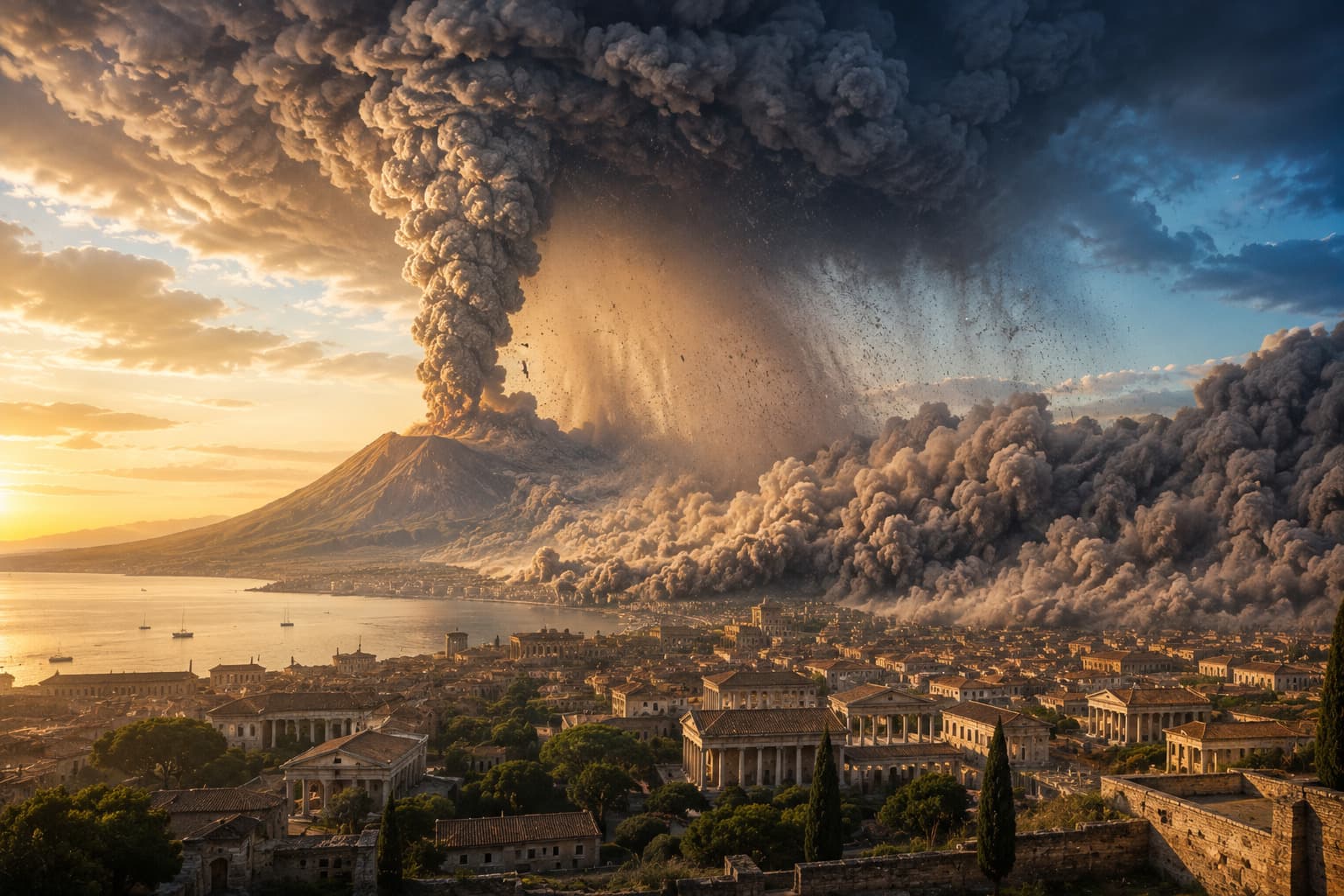
Pompeii was an ancient Roman city in southern Italy, near the Bay of Naples and at the foot of Mount Vesuvius.
Today, its archaeological remains are located near the modern city of Naples, making it one of the world's most famous archaeological sites.
Nearly 2,000 years ago, Pompeii was a thriving Roman city filled with homes, shops, temples, streets and public spaces.
Then, in AD 79, Mount Vesuvius erupted.
What happened next is not quite the simple story most of us remember.
Ask someone what happened to Pompeii, and you will probably hear a familiar story:
Mount Vesuvius erupted. Pompeii was buried. Everyone died.
It makes for a powerful image- a Roman city suddenly frozen beneath volcanic ash, with people caught exactly where they stood.
But the real story is more complicated.
The eruption unfolded in two very different phases.
First came approximately 18 hours of pumice and ash, gradually accumulating over the city. It was dangerous, destructive and frightening, but it also gave many residents time to leave.
Then came the second phase.
Fast-moving, superheated currents of volcanic gas and debris swept through the region. For those still in their path, there was almost no time left.
Pompeii wasn't simply destroyed in one sudden moment.
Act One: The Eruption That Gave People Time
The beginning of Vesuvius's eruption wasn't the instant catastrophe that movies often suggest.
Instead, the volcano entered what volcanologists call a Plinian phase, named after Pliny the Younger, whose account remains one of the key eyewitness sources.
A huge column of ash and pumice rose into the sky.
Then the material began falling.
And it kept falling.
For roughly 18 hours, Pompeii was gradually covered by volcanic debris. In some areas, the accumulated material eventually reached several meters in depth.
This was hardly safe.
Roofs began collapsing under the weight.
The streets became increasingly difficult to navigate.
Breathing became harder.
But there was one crucial difference between this phase and what came later:
People could still escape.
A large portion of Pompeii's population appears to have left during this prolonged first phase.
That means the famous image of an entire city dying simultaneously is misleading.
Many people got out.
Act Two: When the Disaster Changed Character
After hours of falling pumice, the eruption entered a much more lethal phase.
The volcano began producing pyroclastic density currents, rapid flows and surges containing hot volcanic gases and debris.
These weren't slow rivers of lava.
They moved with terrifying speed.
Some estimates put their speeds at up to roughly 300 kilometers per hour, with temperatures reaching several hundred degrees Celsius.
Anyone still in Pompeii when these currents arrived had essentially no realistic chance of outrunning them.
And this is the detail that changes the entire story.
The first phase was a warning.
The second phase was the deadline.
The people who remained weren't necessarily unaware of the danger.
They simply had far less time once the eruption entered its most destructive stage.

Herculaneum Had a Very Different Experience
Pompeii wasn't the only settlement caught in the eruption.
Nearby Herculaneum experienced a very different sequence.
Because it was closer to Vesuvius, pyroclastic surges reached the town earlier, before the thick pumice accumulation that defined Pompeii's experience had developed.
For decades, archaeologists assumed relatively few people had died there because comparatively few remains were found within the excavated town.
Then archaeology changed the picture.
In the 1980s, excavations near the ancient shoreline uncovered roughly 300 skeletons inside boat-storage chambers.
These were people who appear to have fled toward the sea, gathering near the waterfront while waiting for boats that never arrived in time.
It is a sobering reminder that having somewhere to escape to doesn't necessarily mean having a way out.
Another Thing Most People Get Wrong
Pliny the Elder didn't die because he got too close to Vesuvius out of scientific curiosity.
According to his nephew's account, he sailed toward the disaster because he wanted to help rescue people.
He reached Stabiae but eventually collapsed and died, likely from a combination of toxic gases and physical strain.
His death has a name and a timeline because his nephew happened to survive and document the events.
Thousands of others were not so fortunate.
What If We've Been Getting the Date Wrong?
Now comes one of the most fascinating pieces of the Pompeii story.
For centuries, the eruption was traditionally dated to:
August 24, AD 79
That date came largely from interpretations of Pliny the Younger's letters.
But archaeology has introduced serious complications.
In 2018, researchers discovered a charcoal inscription in Pompeii containing the date October 17.
Charcoal is relatively short-lived when exposed, making it difficult to explain why such an inscription would have survived for months before being sealed by the eruption.
Then other clues began lining up.
Researchers found evidence associated with:
- Autumn produce
- Coins reflecting an imperial title granted after August
- People wearing heavier clothing
- Other seasonal indicators
Together, these findings have led many researchers to favor a date around October 24, AD 79, roughly two months later than the traditional date.
So the date itself is now part of the mystery.
And that's a useful reminder:
History isn't always a finished story.
Sometimes archaeology finds one small piece of evidence that forces us to rethink what we thought we already knew.
Why the Two-Phase Timeline Matters
The distinction between the two phases isn't just an interesting historical detail.
It helps explain one of the biggest questions surrounding Pompeii:
If the eruption lasted so long, why did so many people die?
Approximately 2,000 bodies have been recovered from Pompeii.
Yet the city may have had a population many times larger.
That suggests something important:
A large portion of the population likely escaped.
The people who died were not necessarily those who had no warning.
Some may have misjudged how much time they had.
Others may have been unable to escape.
And once the pyroclastic currents arrived, the opportunity to make a decision disappeared almost instantly.
The Strange Power of One Piece of Evidence
The date debate offers another fascinating lesson.
Imagine knowing for centuries that an event happened on August 24.
Then someone finds a simple piece of charcoal with a date written on a wall.
Suddenly, the entire timeline has to be reconsidered.
That is the power of archaeology.
It doesn't always uncover spectacular treasures.
Sometimes the most important discovery is something incredibly ordinary:
a piece of writing on a wall.
That small piece of evidence, combined with coins, food remains and clothing, can challenge a story that survived for nearly two thousand years.
Knowlegic Perspective
The popular version of Pompeii is dramatic:
A volcano erupted. A city was buried. People were caught by surprise.
But the real story is more interesting.
Pompeii experienced something that resembles many disasters throughout history:
a warning phase followed by a rapidly closing window of opportunity.
The first phase was dangerous but survivable.
The second phase was fast and devastating.
That distinction matters far beyond archaeology.
In many real-world crises, disaster isn't a single moment.
It is a sequence.
There can be warning signs.
There can be time to react.
There can be decisions that make the difference between escape and catastrophe.
And sometimes the greatest danger isn't failing to notice the warning.
It's misjudging how much time remains after you notice it.
Pompeii wasn't buried in a single moment.
It was destroyed in two acts.
The first lasted long enough for many people to escape.
The second arrived quickly enough to make escape almost impossible.
And somewhere between those two phases lies the most important part of the story:
the window.
The people who survived weren't necessarily the ones who knew everything about Vesuvius.
They were the ones who had enough time and used it.
Perhaps that is why Pompeii remains so powerful nearly two thousand years later.
History doesn't just preserve what happened.
Sometimes, it preserves the moment when there was still time to do something about it.
Enjoyed this?
Get notified when a new Knowlegic story worth knowing is published.


