

China's Rise Explained: 10 Innovations That Changed a Nation
In just a few decades, China has transformed from a manufacturing hub into a leader in infrastructure, technology, clean energy, and space. Here are ten innovations that help explain one of the most remarkable transformations in modern history.
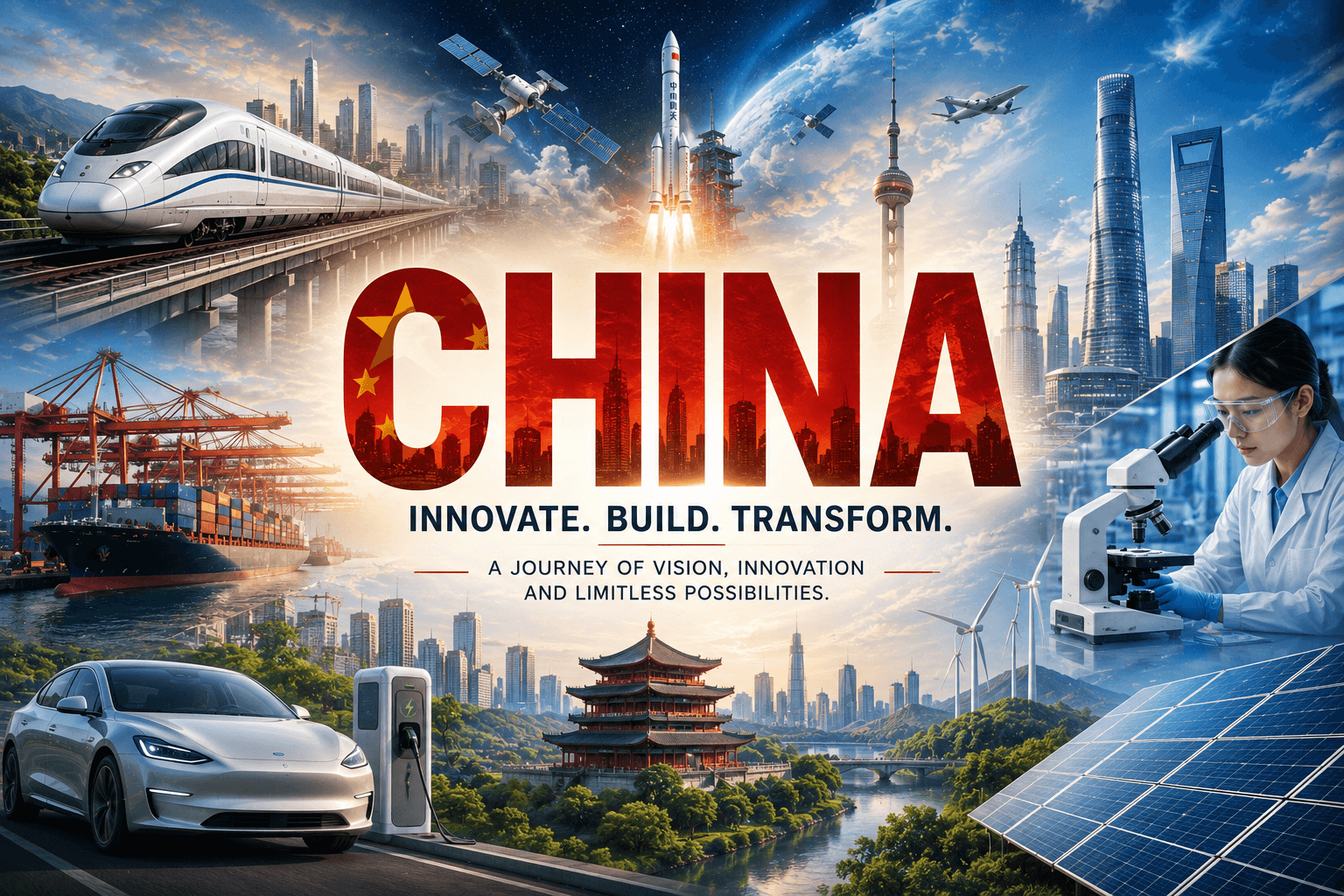
How do you reinvent a nation?
Imagine leaving your hometown in 1980 and returning four decades later.
The narrow roads have become expressways. Villages have grown into glittering skylines. Cash has almost disappeared from everyday life. Trains travel faster than many cars on a highway. Electric vehicles quietly fill the streets, while drones, robots, and AI-powered services are becoming increasingly common.
It sounds like a scene from science fiction.
For millions of people in China, it's simply everyday life.
Few countries have transformed as dramatically or as quickly as China. In the space of a single generation, it evolved from a largely agrarian economy into one of the world's biggest manufacturing centers, a leader in clean energy, and a major player in emerging technologies.
This transformation wasn't driven by one groundbreaking invention. It was built through a series of innovations, long-term investments, and ambitious infrastructure projects that reshaped not only China but also influenced economies around the world.
Here are ten innovations that help explain that extraordinary journey.
1. The Factory That Changed the World
Walk into almost any home and play a simple game.
Pick up ten everyday objects, a phone charger, a pair of headphones, a kitchen appliance, or a toy. Chances are, several of them carry the familiar words:
Made in China.
That label represents decades of investment in manufacturing, supply chains, and industrial expertise.
Beginning in the late 1970s, China opened its economy to foreign investment and rapidly expanded its manufacturing sector. Factories that once produced simple consumer goods gradually moved into electronics, machinery, medical equipment, renewable energy technologies, and advanced industrial products.
Today, manufacturing remains one of the foundations of China's economy, connecting thousands of suppliers into highly efficient production networks that serve markets around the globe.
Did You Know?
China manufactures a significant share of the world's industrial goods, from consumer electronics and household appliances to solar panels and high-speed trains, making it one of the most important links in global supply chains.
2. The Rail Network That Redefined Distance
Imagine finishing breakfast in Beijing and attending a business meeting hundreds of kilometres away before lunch.
That's possible thanks to China's high-speed rail network.
Over the past two decades, China has built the world's largest network of high-speed rail, connecting major cities with trains capable of travelling at around 350 km/h (217 mph).
The impact extends far beyond faster travel.
Businesses can reach new markets more easily. Tourism has expanded. Smaller cities have become better connected to economic centres. For many domestic journeys, rail has become a practical alternative to flying.
Building this network required massive investments in engineering, bridges, tunnels, signalling systems, and long-term planning, making it one of the largest infrastructure projects in modern history.
Did You Know?
China's high-speed rail network is the largest in the world, stretching over 48,000 kilometers, longer than the combined high-speed rail networks of all other countries.
3. When Your Wallet Became a Smartphone
Not long ago, forgetting your wallet could ruin your day.
Today, in many Chinese cities, forgetting your phone is the bigger problem.
Buying coffee, paying for groceries, booking a taxi, or purchasing vegetables at a local market often involves nothing more than scanning a QR code.
The widespread adoption of mobile payments transformed everyday commerce, making digital transactions faster and more convenient for consumers and small businesses alike.
It also helped fuel rapid growth in online shopping, food delivery, and digital services, creating one of the world's most connected consumer ecosystems.
Did You Know?
In many Chinese cities, even small street vendors accept QR code payments, making cash transactions increasingly uncommon in everyday life.
4. Driving the Electric Future
A decade ago, electric cars were still considered a niche product in many parts of the world.
Today, China is the world's largest market for electric vehicles.
Government incentives, expanding charging infrastructure, and intense competition among manufacturers have accelerated EV adoption. Companies such as BYD have become global names, while Chinese battery manufacturers supply many of the world's leading automakers.
The shift has also encouraged advances in battery technology, helping reduce costs and improve driving range.
China's influence in the EV industry now extends well beyond its borders.
Did You Know?
China is the world's largest electric vehicle market, and companies like BYD and CATL have become global leaders in EV manufacturing and battery technology.
5. Powering Tomorrow with Clean Energy
China's energy story isn't only about coal or industry.
It is also one of the world's largest investors in renewable energy.
Across the country, enormous solar farms stretch across deserts, wind turbines line coastlines and mountain ranges, and hydroelectric projects generate electricity for millions of homes.
These investments are helping expand renewable energy capacity while supporting the growing demand for electricity from homes, businesses, and electric vehicles.
The scale is remarkable and increasingly influential in the global clean energy transition.
Did You Know?
China installs more renewable energy capacity each year than most countries produce in total, making it one of the world's largest investors in solar and wind power.
6. Where Artificial Intelligence Meets Everyday Life
Artificial intelligence is often imagined as something futuristic.
In China, many AI applications are already woven into everyday life.
AI helps improve manufacturing efficiency, supports medical image analysis, powers language translation, optimises logistics, and assists customer service.
While many countries are investing heavily in AI, China's large digital ecosystem has created opportunities to deploy AI technologies at significant scale.
The race to lead in artificial intelligence is global, and China has become one of its major participants.
Did You Know?
Artificial intelligence in China is already helping optimize factory production, improve medical diagnostics, translate languages, and streamline logistics for millions of daily deliveries.
7. The Ports That Keep the World Moving
Every day, thousands of ships carry products across oceans.
Many of them pass through Chinese ports.
Ports such as Shanghai and Ningbo-Zhoushan rank among the busiest in the world, handling enormous volumes of cargo each year.
Automation, advanced logistics systems, and modern infrastructure help move goods quickly from factories to international markets.
These ports play a critical role in keeping global supply chains moving.
Did You Know?
The Port of Shanghai has ranked among the world's busiest container ports for years, handling tens of millions of shipping containers annually.
8. Reaching Beyond the Sky
China's ambitions don't stop at Earth's surface.
Its space programme has expanded rapidly over the past two decades, including satellite launches, lunar exploration, Mars missions, and the development of the Tiangong space station.
These achievements reflect growing investments in science, engineering, and aerospace technology.
Space exploration has become another area where China is contributing to global technological progress while pursuing its own long-term ambitions.
Did You Know?
China became the third country to independently send humans into space and now operates its own permanently inhabited space station, Tiangong.
9. Transforming Healthcare Through Innovation
When people think about China's rise, they often picture factories, bullet trains, or electric cars.
Healthcare rarely comes to mind.
Yet over the past decade, China has invested heavily in medical research, biotechnology, digital health, and healthcare infrastructure.
Today, Chinese researchers are contributing to advances in areas such as cancer treatment, gene editing research, AI-assisted diagnostics, vaccine development, and medical imaging. The country has also expanded the use of telemedicine, helping patients in remote regions connect with specialists through digital platforms.
Artificial intelligence is increasingly used to analyse medical images, assist doctors with diagnosis, and improve hospital workflows. Meanwhile, biotechnology companies are developing innovative therapies, including cell and gene therapies that are attracting global attention.
While challenges remain—including ensuring equal access to high-quality healthcare across urban and rural areas, China's growing investment in medical science is making it an increasingly important player in global healthcare innovation.
Did You Know?
China is among the world's largest contributors to biomedical research publications and has become a major hub for clinical trials, biotechnology startups, and pharmaceutical innovation.
10. Building the Cities of Tomorrow
Perhaps the most visible symbol of China's transformation is its cities.
Modern skylines, extensive metro systems, smart infrastructure, and large-scale urban development projects have reshaped how millions of people live and work.
Urbanization has supported economic growth while also presenting new challenges, including housing affordability, environmental sustainability, and balancing development across different regions.
China's next chapter may be less about building more and more about building smarter.
Did You Know?
China has built more than 200 urban metro systems and continues to invest in smart-city technologies that help manage transportation, energy, and public services more efficiently.
More Than a Story of Growth
China's rise is often measured in numbers: GDP, exports, rail networks, or skyscrapers but behind those numbers is a broader story about how long-term investment, industrial capability, education, technology, and infrastructure combined to transform a nation within a single generation.
China’s transformation wasn't driven by one invention or one policy. It was built through decades of innovation, infrastructure, education, and an extraordinary ability to scale ideas.
At the same time, China's future will be shaped by important challenges, including an ageing population, changing global trade dynamics, environmental pressures, and the need for sustainable economic growth.
Its story is still unfolding.
Whatever the future holds, one thing is clear: few countries have changed the modern world as profoundly or as quickly, as China.
Whether other nations choose similar paths or different ones, China's journey offers an enduring lesson:
Innovation creates opportunities. Scale changes the world.
Key Takeaways
- China's transformation was driven by multiple innovations working together rather than a single breakthrough.
- Manufacturing, infrastructure, and technology became the foundation of its economic rise.
- China now plays a significant role in electric vehicles, renewable energy, AI, and global trade.
- The country continues to face important challenges, including demographics, sustainability, and economic transition.
- Understanding China's rise helps explain many of the technologies and products that shape our daily lives.
Explore Further:
For readers who'd like to explore the data and research behind China's transformation, these trusted resources provide in-depth analysis:
- World Bank – China Overview – Economic indicators, development progress, poverty reduction, and country insights.
- International Energy Agency (IEA) – Global EV Outlook 2026 – Comprehensive analysis of global electric vehicle trends, battery manufacturing, and charging infrastructure.
- World Intellectual Property Organization (WIPO) – Statistics & Global Innovation Index – Innovation rankings, patent data, and intellectual property trends.
- UN Trade and Development (UNCTAD) – Research on international trade, investment, global supply chains, and sustainable development.
- OECD – China Economic Surveys – Independent assessments of China's economy, policy reforms, and long-term growth prospects.
Enjoyed this?
Get notified when a new Knowlegic story worth knowing is published.


