

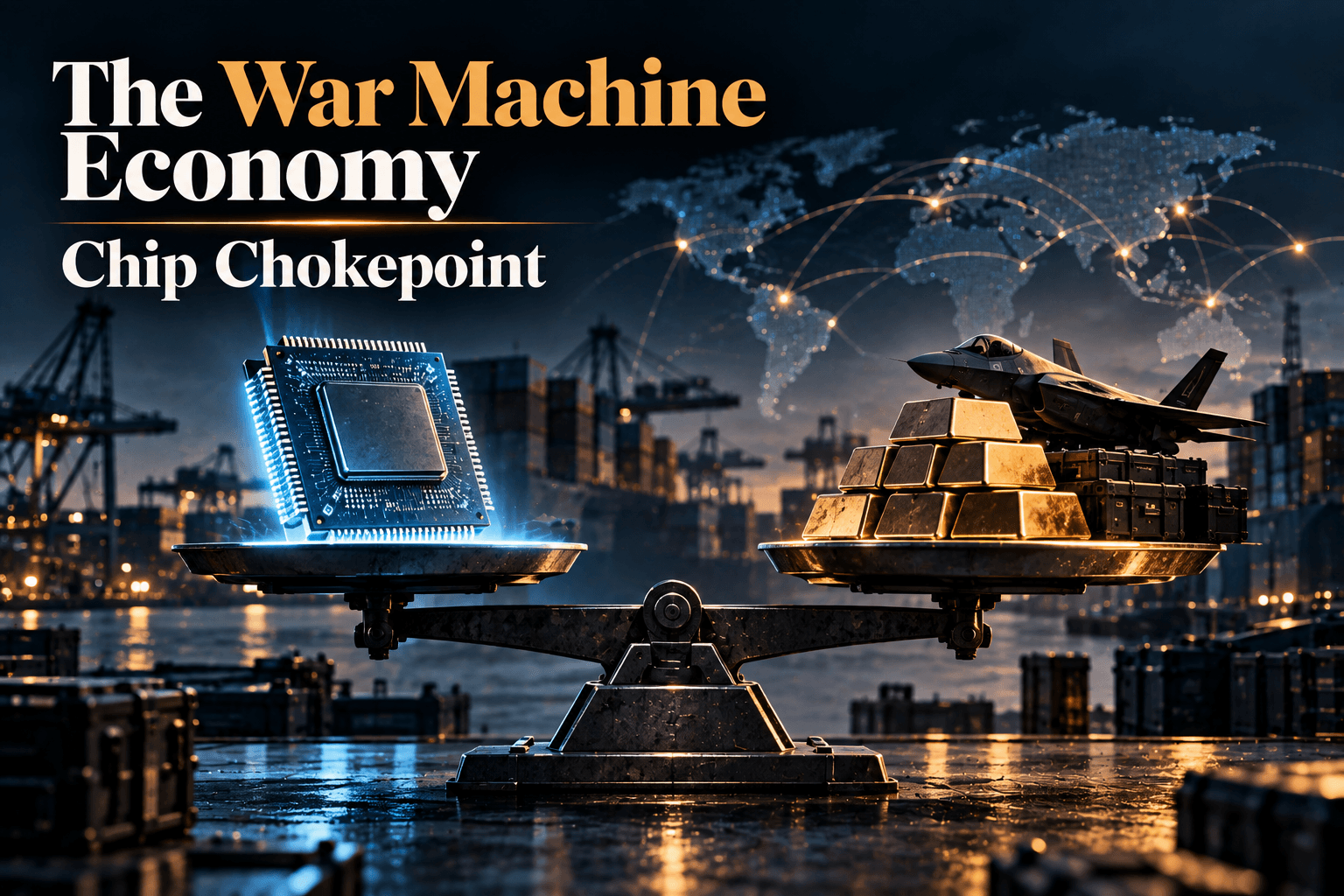
The War Machine Economy, Part 4: The Chip Chokepoint
A trade rule written to slow down a handful of Chinese supercomputers has turned into Washington's single most powerful lever over the AI race, costing one company eight billion dollars in a single quarter and spawning a smuggling economy that runs through Singapore warehouses.
In April 2025, a short letter from the US Commerce Department arrived at Nvidia's headquarters. It said the company would now need a license to keep selling its H20 chip, a version of its AI processor built specifically to stay just inside the limits of earlier export rules, to customers in China.
Nvidia had already sold roughly a million of those chips into China the year before. By the end of that one quarter, the company had absorbed a $4.5 billion inventory charge, lost another $2.5 billion in sales it couldn't ship, and warned investors the total hit would run closer to $8 billion. A single piece of paper had done more damage to Nvidia's China business than any tariff, lawsuit, or competitor ever had.
What that letter revealed, and what Washington spent the rest of 2025 and 2026 discovering in both directions, is that the chip itself, not the finished AI model, not the data center around it, has become the real battlefield in the contest over who controls artificial intelligence. Controlling the flow of advanced compute has turned into a form of power as consequential as controlling weapons, and just as hard to fully enforce.
A Chip Engineered to Thread a Needle
The H20 didn't exist by accident. After the Biden administration's October 2022 rule first cut off China's access to Nvidia's most advanced chips, the H100 among them, and the equipment used to make them, Nvidia designed a downgraded version of its hardware specifically calibrated to fall just under the new technical thresholds, legal to export, usable for AI work, but deliberately less capable than what American companies could buy.
That's the quiet detail most coverage of the "chip war" skips past: these restrictions were never really about banning chips. They were about drawing a line through a chip's internal specifications, memory bandwidth, interconnect speed, raw computing throughput, and letting companies design products that sat precisely on one side of it. For nearly three years, that worked. Then the line moved.
Chinese buyers didn't treat the H20 as a consolation prize either. The roughly one million units they bought in 2024 dwarfed the few hundred thousand comparable chips Huawei could get out of its own factories that same year. A deliberately weakened American chip still beat the best fully domestic alternative on offer.
The Day a Memo Cost More Than a Product Recall
When the April 2025 licensing requirement hit, it didn't just block future sales. Nvidia had already built H20 chips for customers it could no longer legally serve, leaving it holding inventory nobody else wanted at that price. The $4.5 billion charge covered that stranded stock and the supply contracts behind it.
Three months later, the policy reversed again. The Trump administration lifted the licensing block, and Nvidia prepared to resume shipments, only to find the terms had changed a second time: Washington would now take fifteen percent of whatever revenue Nvidia, and separately AMD, earned selling these specific chips into China, as the price of a license to sell them at all.
Did You Know?
Nobody in Washington has fully explained what legal authority allows the government to simply take a cut of a private company's foreign sales revenue as a condition of an export license. As of late 2026, the arrangement still hadn't been written into a published regulation. It existed mostly as a public understanding between Nvidia's leadership and the White House, which is itself a sign of how improvised this entire policy area has become.
Washington Keeps Moving the Line
The H20 saga wasn't the end of it. Nvidia's newest and most powerful chip family, Blackwell, remains fully blocked from Chinese customers altogether, full stop, no license path. On December 8, 2025, Trump announced that the administration would instead open a narrower door for the previous-generation H200 chip, allowing sales to approved Chinese customers under a 25% surcharge, the first real loosening since the original 2022 rules, though still a chip far short of what American buyers can get.
Each adjustment reflects the same underlying tension: block too little, and American chips accelerate a geopolitical rival's AI and military research. Block too much, and the lost revenue funds China's push to build an alternative supply chain that doesn't need American chips at all. There's no setting on that dial that fully avoids one of those two outcomes.
The Chips That Take the Long Way to Beijing
While regulators argued over license terms, a separate economy formed around getting restricted chips into China anyway. Singapore and Malaysia, major legitimate trade and logistics hubs in their own right, became the preferred route for shipments that quietly changed destination mid-journey.
US prosecutors charged two men in 2025 over one such scheme: a California front company that, from late 2022 through mid-2025, allegedly shipped Nvidia H100 and other restricted chips to Singapore- and Malaysia-listed buyers while collecting payment from separate firms in Hong Kong and mainland China. One invoice in that case, worth more than $28 million, declared a Singapore customer that investigators later found didn't exist at the address listed.
In 2026, Singaporean police separately arrested three men on fraud charges tied to Dell and Supermicro servers whose paperwork claimed Malaysia as the final stop. That same year, US officials opened an investigation into a logistics firm suspected of helping move restricted Nvidia-powered systems toward Chinese buyers.
None of this requires inventing new technology. It requires a falsified form and a willing middleman, which is a far easier problem to solve than redesigning a chip.
Chip smuggling in this trade doesn't typically involve anyone hiding a processor in a suitcase. The restricted hardware usually travels as part of an entire pre-assembled server, legally manufactured and shipped by a legitimate company, with only the paperwork about its final buyer and destination falsified somewhere along the route.
Beijing's Answer: Build Around the Chokepoint
China's government response has run on two tracks at once. One is money: Beijing's state-backed semiconductor fund committed another $47.5 billion in 2024 alone, its third and largest round yet, on top of estimates of China's cumulative state-directed chip investment since 2014 that range from roughly $100 billion to well over $140 billion depending on how it's counted. Much of it is aimed at Huawei, SMIC, and memory makers building a homegrown alternative to Nvidia.
The other track is mandate. According to multiple reports on draft planning documents, China is weighing a roughly $295 billion national AI data-center buildout, the kind of large-scale computing infrastructure that drains enormous amounts of power and water just to operate, requiring at least 80% of the hardware inside it to be domestically made by 2028.
Huawei's Ascend chip family, now in its third generation, is real and shipping in meaningful volume. But Chinese AI developers still overwhelmingly prefer Nvidia hardware, even the deliberately weakened kind, because the software and performance gap hasn't closed. That gap, not patriotism, is what keeps the smuggling routes in business.
Knowlegic Perspective
For most of modern trade history, the things governments fought hardest to control were either weapons themselves or the raw materials that went into building them, oil, uranium, rare earth metals. The advanced AI chip now sits in that same category, not because of what it looks like, but because of what it makes possible: the computing power behind military planning systems, surveillance tools, and the next generation of autonomous weapons all runs through the same narrow set of chip designs and the handful of factories capable of making them.
That's why an export license can move markets the way a tariff or a sanction usually does, and why a smuggling network built around falsified shipping paperwork is treated with the same seriousness as one built around actual munitions. The chip isn't a proxy for the weapon anymore. In a meaningful sense, it has become one.
What the last two years have shown is that this kind of control is porous by nature. Money moves across a border through false paperwork far more easily than enriched uranium does, and a government strong enough to build Nvidia's $12 billion bet on AI infrastructure into the backbone of a trillion-dollar industry isn't strong enough to fully decide who gets to use it. Controlling compute has become as strategically important as controlling weapons themselves, and just as difficult to actually enforce.
Sources & References
- NVIDIA Announces Financial Results for First Quarter Fiscal 2026, NVIDIA Corporation (2025)
- Under new, unusual agreement, U.S. will get a 15% cut of Nvidia and AMD chip sales to China, PBS NewsHour (2025)
- Nvidia and AMD to pay 15% of China chip sales revenues to the U.S. government, FT reports, CNBC (2025)
- US charges Chinese nationals with illegally shipping Nvidia chips to China, Al Jazeera (2025)
- China Creates $47.5 Billion Chip Fund to Back Nation's Firms, Bloomberg (2024)
- How China's 'Big Fund' is helping the country catch up in the global semiconductor race, South China Morning Post (2024, updated)
- China drafts $295 billion plan to build a national AI data center grid running on 80% domestic chips, Tom's Hardware (2026)
Enjoyed this?
Get notified when a new Knowlegic story worth knowing is published.


