

Movie Theaters Aren’t Dying. They’re Becoming Something Else
Streaming was supposed to finish off the multiplex. Instead, 2026 is turning into one of the strongest theatrical years since the pandemic and the growth reveals something streaming still can't quite reproduce.
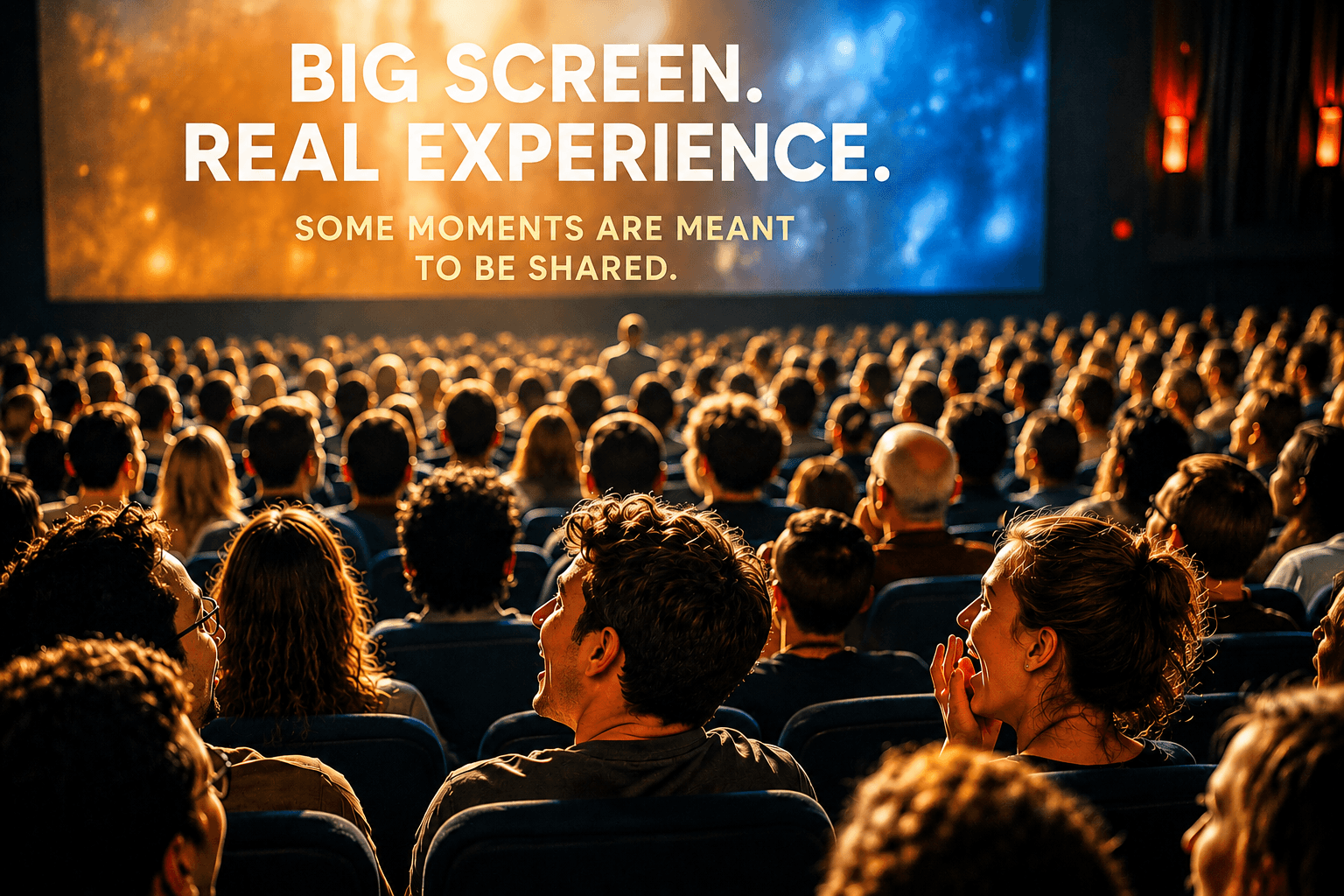
For years, the prediction seemed obvious: streaming would keep eating into movie theaters until going to the cinema became an occasional novelty.
That hasn't quite happened.
The U.S. and Canadian theatrical market is still well below its pre-pandemic attendance levels. In 2025, about 769 million tickets were sold, compared with more than 1.2 billion in 2019.
And yet, 2026 is telling a different story.
The summer box office has been running close to pre-pandemic levels, while premium formats such as IMAX are taking an increasingly important share of major releases. IMAX itself finished 2025 with a record $1.28 billion in global box office, up 40% year over year. Demand at that end of the market has been strong enough to change the hardware itself, with one production pushing IMAX to rebuild its film cameras.
So the story isn't really “movie theaters are back.”
It's more interesting than that.
Moviegoing is becoming more selective.
The ordinary trip to the cinema has become easier to replace with a stream at home.
The big-screen event has become harder to replace.
The Comeback That Isn't What It Looks Like
The easiest way to understand what's happening is to look at IMAX.
IMAX generated a record $1.28 billion in worldwide box office in 2025, 40% more than in 2024 and 13% above its previous record from 2019. The company says its network represented about 3.8% of global box office from just over 1,800 locations.
And 2026 has continued that momentum.
Consider Michael, the Michael Jackson biopic.
The film opened to roughly $97 million domestically, with IMAX contributing $13.8 million in North America and $24.5 million worldwide. That was the biggest IMAX opening ever for a musical biopic.
That's remarkable because IMAX screens represent only a small fraction of the world's total screens.
The point isn't that everyone suddenly wants to go to the movies again.
It's that when audiences decide a film is worth seeing theatrically, they're increasingly willing to pay for the best version of the experience.
A premium ticket costs more.
The screen is bigger.
The sound is better.
The film feels like an occasion.
The theater doesn't necessarily need every Tuesday night to be busy.
It needs the right Friday night to feel impossible to miss.
Did You Know?
Pew Research Center found that 53% of U.S. adults said they had visited a movie theater in the previous year. Among adults aged 18–29, the figure was 67%, compared with 39% among those 65 and older.
But attendance has not returned to its old levels.
In 2019, U.S. and Canadian theaters sold about 1.23 billion tickets.
In 2025, they sold about 769 million.
So the theatrical audience hasn't simply returned to its old habits.
It's choosing its moments.
Why the Couch Can't Fully Compete
The obvious advantage of a theater is technology.
A giant screen.
Powerful sound.
Darkness.
A carefully designed room.
But there may be another ingredient that doesn't fit neatly into a technology specification:
other people.
Researchers have started studying what happens to us when we experience films together.
In a 2019 study published in PLOS ONE, Laura Kaltwasser and colleagues compared people's responses to emotionally charged film clips when they watched alone and when they watched with others in a cinema setting. They found that the presence of others influenced physiological and emotional responses, including measures related to vagal activity and emotional engagement.
Another study led by Tsz Yan So, Man Yi Erica Li and Hakwan Lau found that audience members' heart-rate variability showed measurable synchrony while watching films. Their work also found that segments associated with greater physiological synchrony were subsequently judged as more engaging.
But there is an important caveat.
This research is still relatively small and doesn't prove that “watching in a theater is always better than watching at home.”
The studies are exploring physiological and emotional responses under particular conditions.
What they do suggest is more modest and perhaps more interesting:
Watching something together can change the experience of watching it.
Think about watching a football match alone.
Now imagine the same goal being scored in a stadium surrounded by 50,000 people.
The event itself hasn't changed.
But your experience of it has.
Cinema can work in much the same way.
The Part Streaming Can't Easily Copy
Streaming has perfected convenience.
You don't have to drive anywhere.
You don't have to find parking.
You don't have to sit beside strangers.
You can pause the film.
You can watch in your pajamas.
And if the movie isn't interesting after 20 minutes, there's always another one.
For ordinary moviegoing, that's an incredibly powerful proposition.
But convenience isn't the only reason people leave home.
People go to concerts.
They attend sporting events.
They visit restaurants.
They travel to festivals.
None of these experiences are particularly convenient.
That's not the point.
The point is that you're participating in something rather than simply consuming it.
A packed theater can create the same feeling.
A comedy becomes funnier when a room erupts with laughter.
A horror movie becomes more intense when everyone screams at once.
A musical can become almost communal when hundreds of people recognize the same song.
And a Christopher Nolan film on a giant screen can feel like an event rather than another item in a streaming menu.
The product is no longer simply:
“Watch this movie.”
It's:
“Come experience this movie with us.”
Theatrical windows, the period between a film's cinema release and its arrival on streaming, have also proved more resilient than many expected.
Studios experimented with much shorter windows during and after the pandemic.
But the strongest theatrical releases have reinforced the value of giving cinemas time to turn a movie into an event.
The window isn't just about protecting ticket sales.
It's about protecting the sense that a film is somewhere you go before it becomes something you stream.
The Business Is Getting Narrower, Not Smaller
This may be the most important distinction.
The movie theater of the future probably won't look like the movie theater of 2005.
Back then, theaters benefited from a steady stream of releases: comedies, dramas, action movies, thrillers, family films and everything in between.
Streaming has absorbed much of the middle.
A movie that costs a lot to see, takes two hours and requires a drive has a harder time competing with an endless library sitting on your television.
But something spectacular has a different equation.
If a film has enormous visual scale, famous actors, devoted fans, spectacular sound, or a cultural moment around it, the theater suddenly becomes part of the product.
That's why premium formats matter.
The industry isn't necessarily trying to make every movie a theatrical event.
It's increasingly trying to make the right movies impossible to ignore.
Knowlegic Perspective
It's tempting to look at the strong 2026 box office and declare that streaming lost.
That's not what happened.
Streaming won a huge part of the convenience battle.
The casual Tuesday-night movie has become much easier to watch at home.
The theater is responding by becoming something different.
Less routine. More occasion.
Less convenience. More experience.
Less “What should we watch?” More “We have to see this.”
That's a subtle but important shift.
The theatrical business may be getting smaller in terms of frequency while becoming more valuable in terms of experience.
And that pattern isn't unique to cinema.
When technology makes something easier to consume at home, physical experiences don't necessarily disappear.
Sometimes they become more specialized.
More social.
More premium.
More memorable.
Streaming didn't finish off movie theaters.
It simply forced them to answer a harder question:
Why should anyone leave the house to watch a movie anymore?
For an ordinary film, the answer may increasingly be:
You probably don't have to.
For the right film, the answer is different:
Because this is better when everyone is in the room.
The lights go down.
The screen gets enormous.
The sound hits.
Someone laughs three seats away.
Someone gasps.
A crowd goes silent.
And for two hours, hundreds of strangers are watching the same thing at exactly the same time.
That's something your television can reproduce visually.
But it can't reproduce socially.
Movie theaters aren't returning to the old world.
They're finding their place in the new one.
One Last Thing…
If you've made it this far, congratulations, you've survived another article without needing to pause it for a snack.
Now imagine doing that in a packed theater.
Enjoyed this?
Get notified when a new Knowlegic story worth knowing is published.


