

Digital Clutter Is the Version Nobody Is Cleaning
We learned to treat a messy room as a tax on the mind. The same research points straight at the inbox and the browser, and almost no one is tidying those.
Picture a friend's kitchen table buried under mail, chargers, school forms, and a stack of things that do not have a home. You would probably feel a small pull to clear it, and if you lived there you might feel a low hum of stress every time you walked past.
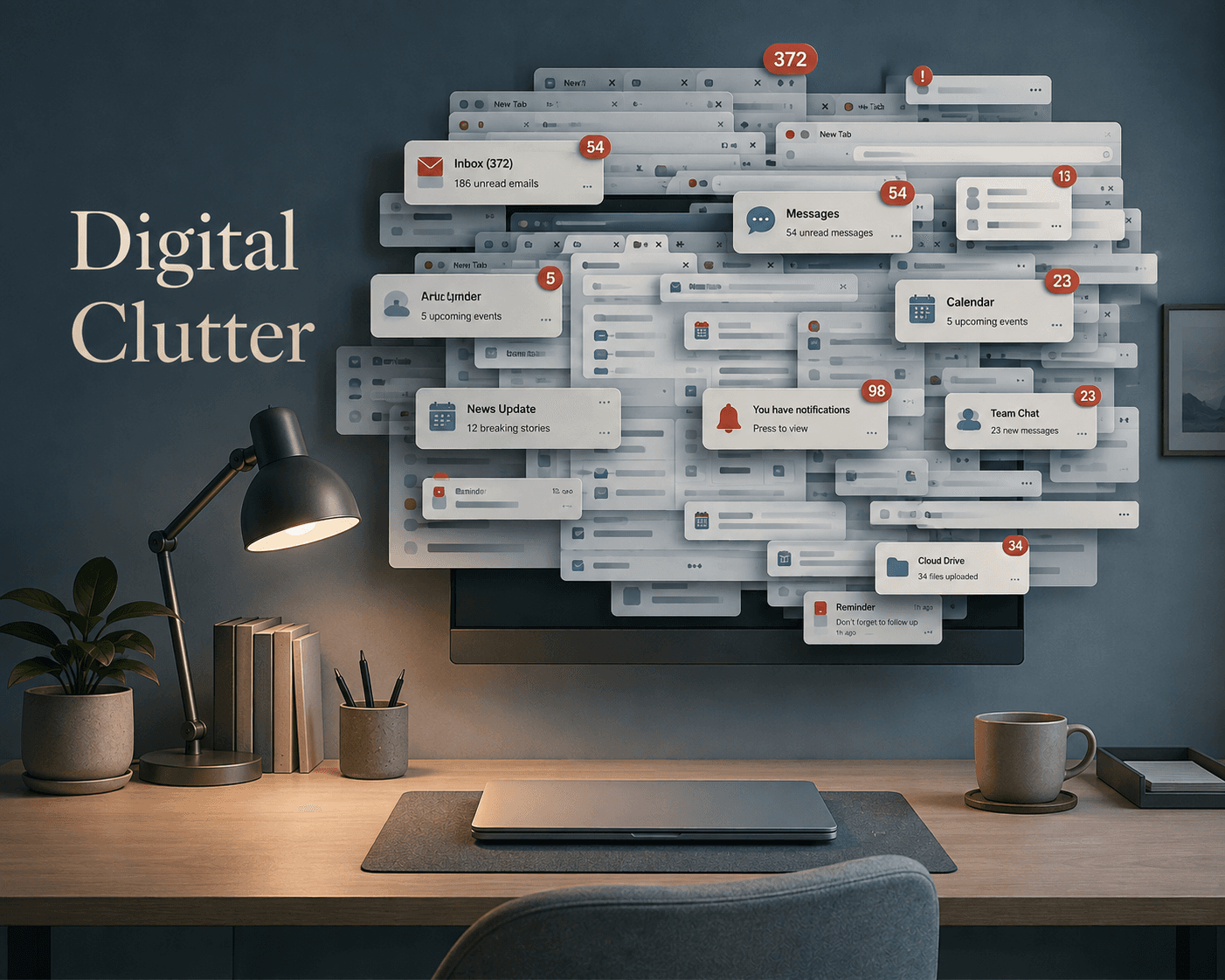
Now picture the same person's laptop: 6,000 unread emails, forty browser tabs, a desktop wallpapered in screenshots, a phone that lights up every few minutes. Nobody walks past that and thinks, this is a mess I should deal with. It is just Tuesday.
We spent years learning that physical clutter is a cost the mind pays. The digital version does the same work on the same attention, and almost no one is treating it as clutter at all.
Why a Messy Room Tires You Out
The reason clutter feels draining is not aesthetic fussiness. It is how vision works.
When several objects sit in your field of view at once, they do not get processed in parallel for free. Researchers at Princeton's neuroscience institute showed that multiple things competing for attention actually suppress each other's signal in the visual system, so the brain has to spend effort picking a winner. A clear surface asks nothing of you. A pile of twelve unrelated items quietly runs an auction every time your eyes pass over it.
There is a second cost on top of that. Psychologists talk about "attention residue," the finding that when you switch away from a task, especially an unfinished one, part of your mind stays stuck on it and the next task suffers. A cluttered space is a room full of unfinished tasks. The unpaid bill, the thing to return, the project in a heap all tug at you at once, and the tug does not stop just because you have looked away. This is the same drag that makes it hard to do focused work in a room full of notifications.
Did You Know?
The phrase "inbox zero" was coined by the writer Merlin Mann around 2006, and he has spent years insisting people misread it. The "zero," he said, was never the number of messages in your inbox. It was meant to be the amount of your attention the inbox is allowed to occupy while you are trying to do something else.
The Study Everyone Half-Remembers
The research people usually reach for is a UCLA project from the 2000s that sent anthropologists into the homes of dual-income Los Angeles families and, among many other things, measured the residents' cortisol.
Its most cited result is narrower and stranger than the headlines suggest. When people gave recorded tours of their own homes, the women who used more language about clutter and unfinished projects tended to show a flatter daily cortisol rhythm, a pattern linked in other work to worse health. Women who described their homes as restful showed the healthier shape. The effect was clearest in the wives, not the husbands, the sample was small, and it is a correlation, not proof that the clutter caused the stress. But it put a physiological fingerprint on something people already felt: living inside visible disorder wears on you.
The Pile Moved to the Screen
Here is what happened next. A huge share of everyday clutter migrated onto devices, and shed its appearance as clutter on the way.
The average office worker sends and receives somewhere north of a hundred emails on a working day, by widely cited industry tallies from the Radicati Group and others. Adults in the United States get on the order of several dozen phone notifications a day, by recent estimates that range from roughly 45 to 70 depending on how a notification is counted; for teenagers, one large survey put the median in the hundreds. Photo libraries hold tens of thousands of images almost nobody revisits. None of it forms a visible heap, so none of it triggers the instinct to tidy.
Attention does not care about the difference. A phone screen with nine notification badges is nine objects competing for processing, exactly like nine items on a counter. An inbox with 4,000 unread messages is a wall of unfinished business, and the mind treats unfinished business the way it always has, by circling back to it. Researchers studying "digital hoarding," a genuinely new area, found in one small sample that the average inbox held around a hundred unread and several hundred read messages, and that people who struggled to delete files reported more stress and anxiety about it. It is the same accumulation reflex that fills physical homes with things people do not need, pointed at data that weighs nothing and is never in the way.
Gloria Mark, who has tracked computer use at the University of California, Irvine for two decades, found that the average stretch of attention on a single screen fell from about two and a half minutes in 2004 to roughly 47 seconds by the late 2010s. She is careful that this measures screen-switching in workplace settings, not a new biological limit, but in one experiment, cutting off workers' email for a week lengthened their attention and lowered their stress.
Why the Digital Version Is Harder to Clean
Physical clutter has a natural enemy: it takes up space you want back. The counter has to be cleared to cook. The chair has to be emptied to sit.
Digital clutter has no such pressure. Storage is effectively unlimited and nearly free, so nothing forces a reckoning. Search is good enough that you can usually find the one file you need without deleting the 900 you do not. And every design incentive runs the other way, since the services holding your mail and photos benefit from you keeping and returning, not clearing and leaving.
So the mess grows in a way a kitchen table cannot, silently, without a moment where it visibly overflows. The cost still lands. It just arrives as a vague sense that focus is harder than it used to be, that opening the laptop is faintly tiring, that there is always something unresolved. The same feeling the messy room produced, sourced from a pile you have trained yourself not to see. It is also part of why so many people stop partway through the books they start: the attention meant for the page is still half-committed to a pile that never closes.
Knowlegic Perspective
The interesting thing about digital clutter is not that it is bad for you. It is how completely it slipped past the instinct that governs physical mess.
People renovated their whole relationship with stuff over the last fifteen years. They read the decluttering books, learned that a crowded room is a crowded mind, and got at least a little better at noticing when possessions were piling up. In the same window, the majority of that clutter turned into pixels and became invisible to the exact instinct that had just been sharpened. The inbox is not exempt from the psychology of the messy drawer. It is the messy drawer, scaled up and hidden.
None of this means inbox zero or a spotless desktop is the goal; chasing an empty inbox can burn more attention than it saves. The point is smaller and more useful. We learned to treat a messy room as a tax on the mind. The digital version does the same work on the same attention, and almost no one is treating it as clutter at all.
Sources & References
- Interactions of Top-Down and Bottom-Up Mechanisms in Human Visual Cortex, Journal of Neuroscience (2011)
- No Place Like Home: Home Tours Correlate With Daily Patterns of Mood and Cortisol, Personality and Social Psychology Bulletin (2010)
- Why Is It So Hard to Do My Work? The Challenge of Attention Residue When Switching Between Work Tasks, Organizational Behavior and Human Decision Processes (2009)
- Teens Are Bombarded with Hundreds of Notifications a Day on Their Smartphones, Common Sense Media (2023)
- Attention Span (research summary), Gloria Mark, University of California, Irvine (2023)
Enjoyed this?
Get notified when a new Knowlegic story worth knowing is published.


