

The Ancient Astronaut Theory: Why It Persists Even Though the Evidence Doesn't
Every site cited as proof of ancient alien contact the pyramids, the Nazca Lines, the Sumerian tablets already has a documented human explanation. The theory endures anyway.
In 1968, Swiss hotel manager Erich von Däniken published a book claiming that extraterrestrial visitors built the pyramids, guided ancient civilizations, and inspired the gods of early religions.
Chariots of the Gods? has sold more than 65 million copies and never gone out of print.
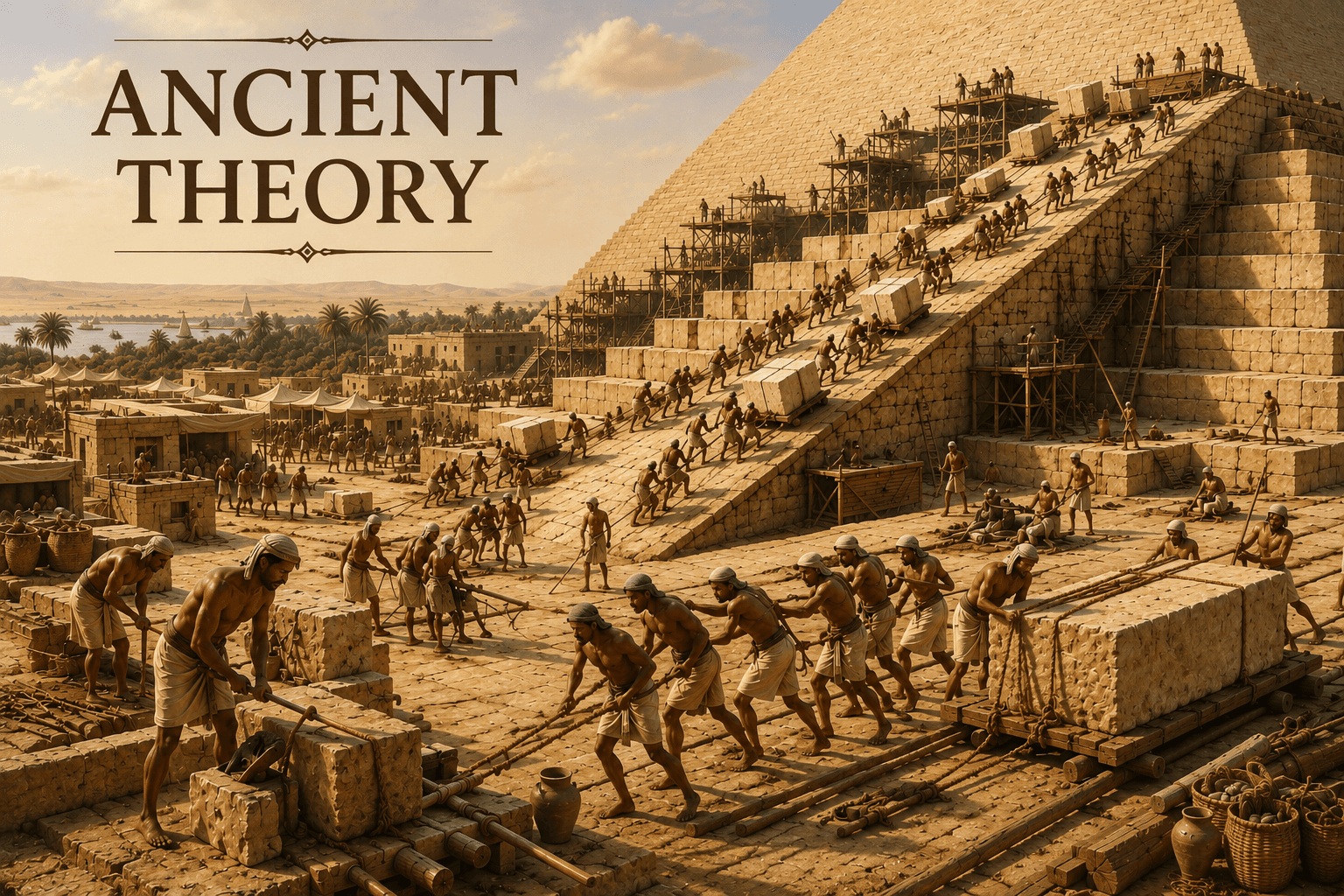
In the decades since, archaeologists have uncovered the actual pyramid builders' settlement at Giza, bakeries, worker housing, administrative buildings, and a cemetery: the ordinary infrastructure of a highly organized human construction project.
The evidence was never missing.
It's the ordinary explanation that never felt like enough.
A Book Built on Someone Else's Book
Chariots of the Gods? didn't emerge from new archaeological research.
Von Däniken drew heavily on a 1960 book by Louis Pauwels and Jacques Bergier, with the borrowing later becoming the subject of a lawsuit. But even that book wasn't the beginning.
The core idea reaches further back, through 19th-century occultism and writers such as Helena Blavatsky, then into the paranormal writing of Charles Fort and the fictional worlds of H. P. Lovecraft, where ancient non-human beings shaped human history.
Von Däniken brought these strands together into a single, confident, bestselling narrative.
The packaging not the archaeological evidence is what made it stick.
Did You Know?
The ancient astronaut idea didn't begin with archaeology.
It moved from 19th-century occultism, through pulp and paranormal writing, into a 1960 countercultural book, and finally into Chariots of the Gods?
By the time it reached a mass audience, it had already passed through several genres with little connection to archaeological excavation.
The Pyramids Have a Paper Trail
In 1988, archaeologist Mark Lehner and the Ancient Egypt Research Associates began uncovering a workers' settlement just southeast of the Giza pyramids.
What they found was not a mystery.
It was a functioning town: bakeries, breweries, administrative buildings, worker housing, and a cemetery for the people who built the monuments.
The evidence points to a skilled and organized workforce not slaves and not outside help.
Copper tools, timber, and stone were moved through a logistics network connected to the Nile. Ramps made from rubble and mud helped move limestone blocks into position.
Engineers, supervisors, and craftsmen worked in defined roles within an operation large enough to support thousands of workers.
None of that is glamorous.
It is, however, thoroughly documented down to the bread ovens.
Lines That Were Never Meant to Be Seen From a Spaceship
The Nazca Lines, etched into the Peruvian desert between roughly 200 BC and 650 AD, are often presented as landing strips visible only from the air.
The theory goes that they must therefore have been made for someone flying overhead.
But that framing skips a basic fact:
Many of the lines are visible from surrounding hills and nearby Andean foothills.
The Nazca people created them by clearing away a shallow layer of dark, iron-oxide-coated stones to expose lighter ground underneath.
Archaeologists studying the lines have proposed religious, astronomical, and agricultural purposes, including the possibility that some were paths meant to be walked as part of ritual activity.
They weren't necessarily runways waiting for visitors from the sky.
When Ancient Texts Become "Spacecraft"
Claims that ancient texts describe spacecraft usually come down to translation rather than archaeology.
Writer Zecharia Sitchin claimed that Sumerian tablets described twelve planets and an alien race called the Anunnaki, arriving from a world called Nibiru.
Michael Heiser, a scholar with a PhD in Hebrew and Semitic Studies, compared Sitchin's translations with ancient Mesopotamian lexical sources.
He found that words Sitchin translated as "rocket" and "planet" did not carry those meanings in the surviving sources he examined.
Sumerian astronomical records, in the conventional scholarly interpretation, recognized five planets.
Not twelve.
Professional Sumerologists, Assyriologists, and Near Eastern historians have likewise rejected Sitchin's interpretations.
The issue isn't that ancient texts are uninteresting.
It's that interesting texts still have to be translated accurately.
So Why Does the Theory Keep Coming Back?
Part of the answer may be psychological rather than archaeological.
Researchers studying conspiracy beliefs have pointed to teleological thinking, the tendency to assume that something impressive must have been deliberately designed by an outside force rather than produced gradually through ordinary processes.
It's the same instinct that can make a beautifully maintained garden feel like evidence of some extraordinary explanation, rather than the result of someone tending it consistently for years.
Conspiracy-style beliefs can also provide a sense of certainty and control.
"Aliens did it" is a remarkably tidy explanation.
The real story is messier:
Thousands of workers.
Decades of planning.
Trial and error.
Engineering problems.
Logistics.
And generations of accumulated knowledge.
There's also an element of institutional trust.
When archaeologists publish evidence contradicting the theory, believers may interpret the rejection itself as evidence of a cover-up rather than as a correction.
Add a long-running television franchise built around the premise, and a claim with little supporting evidence can continue finding a new audience.
The Real Mystery Was Never the Ruins
What's genuinely remarkable about Giza or Nazca isn't that they are unexplained.
It's almost the opposite.
They represent enormous achievements accomplished without modern machinery.
Thousands of people had to be organized.
Materials had to be sourced and transported.
Construction techniques had to be developed and refined.
Knowledge had to be passed from one generation to the next.
The ancient astronaut theory can make these achievements seem more mysterious.
But it also risks taking credit away from the people who actually did the work.
The human explanation is not the less extraordinary one.
Knowlegic Perspective
There's a difference between curiosity about the unknown and comfort with an answer that skips the evidence.
The ancient astronaut theory trades on the first to sell the second.
Real archaeology is full of genuine open questions. Ancient engineering still contains details that researchers debate in good faith.
But the sites most often presented as "unexplained" by the ancient astronaut theory are, in many cases, among the better-documented projects of the ancient world.
The instinct behind the theory isn't entirely unreasonable.
Standing in front of something built without cranes, trucks, or modern machinery, it's natural to wonder how humans accomplished it.
It just turns out the bigger explanation was human coordination all along.
It's the ordinary explanation that never felt like enough.
The pyramids have a paper trail.
The Nazca Lines weren't necessarily mysterious runways.
And ancient texts still have to survive the test of accurate translation.
What's left when the mystery is stripped away isn't a smaller story.
It's a bigger one:
What people were able to build without any help at all.
Sources & References
Chariots of the Gods? The book that inspired Ancient Aliens
How were the Pyramids of Giza built?
NBC News, "How did they feed 10,000 pyramid builders?"
The Conversation, "Why some people still believe that aliens shaped ancient civilisations"
Enjoyed this?
Get notified when a new Knowlegic story worth knowing is published.


