

The Loneliness Paradox: Why the Most Connected Generation Feels the Most Alone
Gen Z can reach almost anyone on the planet with a single tap, spends about as much time with friends in person as older generations, and still reports feeling lonelier. The explanation may not be how much contact they have, but what that contact actually feels like.
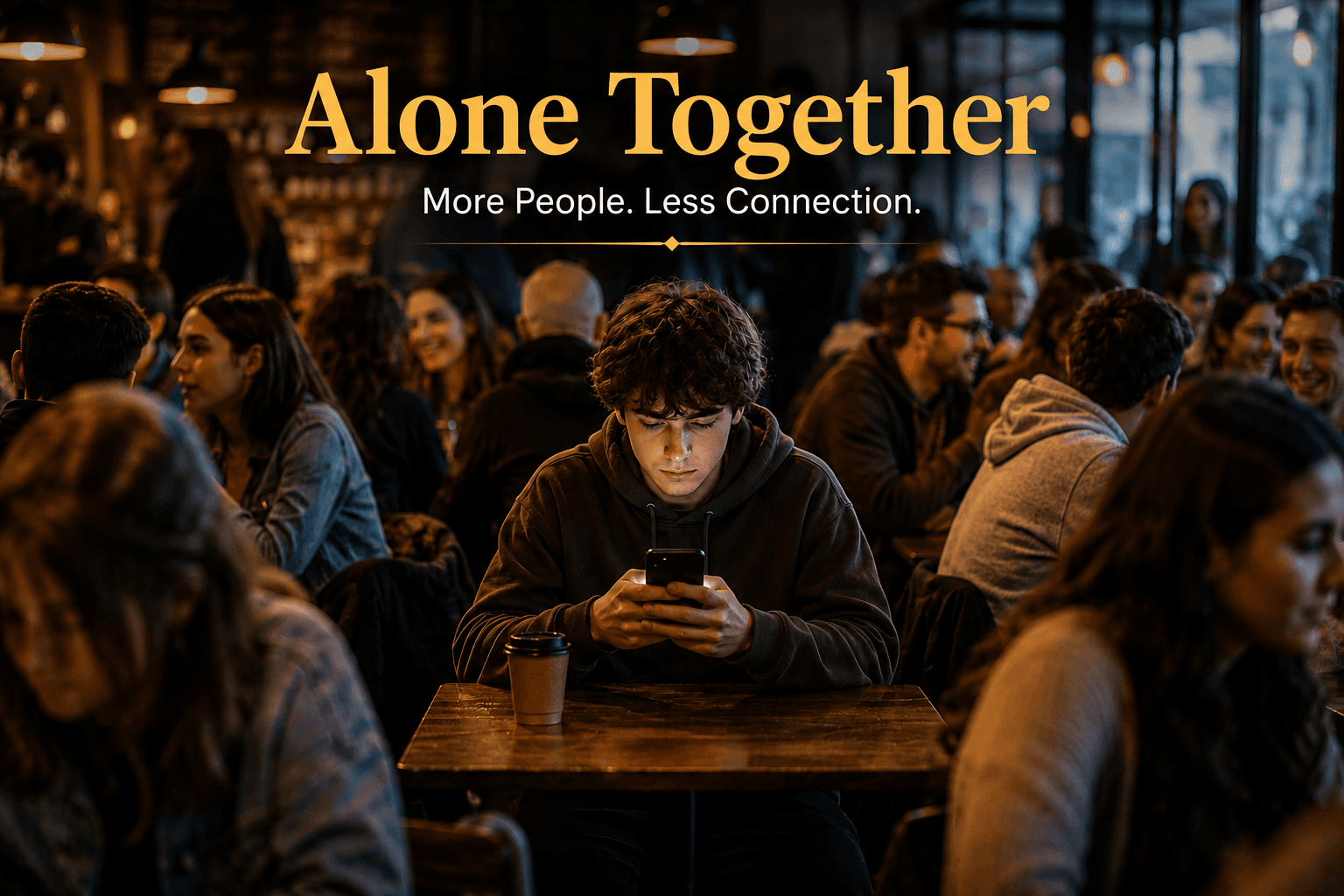
By one major 2025 survey, 67% of Gen Z adults in the U.S. qualified as lonely, more than any other generation including baby boomers, who grew up without a single social platform.
That sounds like an obvious story about phones.
Too much scrolling. Too many notifications. Online friendships replacing real ones.
Except another, more detailed survey found something that doesn't quite fit that explanation:
Gen Z spends roughly as much time with friends in person, week to week, as Gen X and millennials do.
So something is missing between being around people and feeling connected to them.
And newer research is beginning to point toward an answer.
The issue may not be the amount of contact.
It may be the quality of connection.
The Numbers That Don't Add Up
The loneliness gap itself is striking.
Cigna's 2025 report put Gen Z at 67% lonely, compared with 65% of millennials, 60% of Gen X, and 44% of baby boomers. A separate global study by GWI found that 80% of Gen Z respondents said they had felt lonely in the previous year, compared with 45% of boomers.
The obvious explanation is easy:
Too much screen time.
But then another piece of the puzzle appears.
A 2026 report from the Survey Center on American Life found that 61% of Gen Z adults had spent time with friends during the previous week, with more than a third having done so within the previous 24 hours. Those numbers were relatively close to older generations.
The same research also looked at whether social media use or gaming predicted lower sociability and found no meaningful association.
So Gen Z isn't necessarily isolated in the literal sense.
They're showing up.
They're meeting people.
They're talking.
They're hanging out.
So why do so many still feel alone?
The gap appears to be somewhere else.
Did You Know?
The Survey Center on American Life found another detail that makes the story even more complicated:
56% of Gen Z adults said they felt lonely at least once or twice a month during childhood, more than twice the 24% of baby boomers who reported the same about their own childhoods.
For a meaningful share of Gen Z, loneliness didn't begin with the smartphone.
It may have started much earlier.
Presence Isn't the Same as Connection
A 2026 study published in the International Journal of Environmental Research and Public Health looked directly at this distinction.
Researchers tracked how much time people spent alone versus with other people. But they also looked at something different:
What did those interactions actually feel like?
Were they warm?
Emotionally close?
Supportive?
Or were they tense, distant, or draining?
The result was revealing.
The quantity of social contact, how many people someone interacted with and for how long had essentially no relationship with how lonely they felt.
What tracked more closely with loneliness was the quality of those interactions.
Warmth and emotional closeness mattered.
So did the absence of conflict and strain.
The study can't prove that low-quality interactions cause loneliness. It is possible that people who already feel lonely experience ordinary interactions as more distant.
But the pattern is still important:
More contact did not necessarily mean less loneliness.
Warmth did.
Think of it like calories versus nutrition.
You can eat all day and still be malnourished if you're not getting what your body actually needs.
Social life can work in a similar way.
You can be surrounded by people and still feel emotionally unfed.
Research on strong and weak social ties offers another piece of the puzzle.
Acquaintances, group-chat members, colleagues, mutual followers and casual contacts can make our social networks look enormous.
But the strength of our closest relationships may matter much more for loneliness than the size of the overall network.
A thousand followers and no one who regularly asks “Are you actually okay?” can be a surprisingly lonely place to live.
The Part Social Media Plays-More Precisely
None of this completely clears social media.
GWI's research found that Gen Z adults spending 16 or more hours a week on social platforms showed significantly higher odds of loneliness. And 62% of Gen Z respondents directly linked their own loneliness to social media use.
But here's where we need to be careful.
These findings come from separate surveys.
They don't prove that social media is directly creating loneliness.
And the Survey Center research suggests social media use isn't simply replacing in-person friendships.
Gen Z is still showing up.
So perhaps the more interesting question isn't:
“Is social media replacing real relationships?”
It may be:
“What kind of relationship is social media giving us?”
A notification.
A like.
A story reply.
A quick reaction.
A group chat full of messages.
All of these can create the feeling of being socially active.
But they don't always provide the thing loneliness seems most sensitive to:
emotional closeness.
The volume of interaction can go up without the depth of connection increasing with it.
And that may be where the paradox lives.
When Connection Becomes a Substitute for Connection
Imagine having 200 unread messages.
You might reasonably think:
I'm definitely not alone.
Now imagine having one person you can call at midnight when something has gone badly wrong.
Those are two very different forms of connection.
The first tells you that people are around.
The second tells you that someone is there for you.
Modern technology is extraordinarily good at the first.
The second still requires something much harder:
Time.
Trust.
Vulnerability.
Attention.
And often, the willingness to put the phone down and actually stay in a conversation.
That may explain why someone can spend an entire evening interacting with people online and still go to bed feeling strangely alone.
The person wasn't missing contact.
They were missing closeness.
Knowlegic Perspective
It's tempting to file this away as another story about a generation ruined by their phones.
The data doesn't really support such a simple explanation.
Gen Z shows up.
They spend time with friends.
They communicate constantly.
They have enormous digital networks.
And yet, loneliness remains unusually high.
The research points toward a quieter and harder problem:
Modern social life has become very good at producing the appearance of connection without always producing the substance of it.
And that's not necessarily just a Gen Z problem.
It's a modern human problem.
A person can sit in a crowded café and feel invisible.
They can have hundreds of followers and nobody they trust.
They can spend an entire evening in a group chat and still wish someone would actually call.
Technology didn't invent that feeling.
But it may have made it easier to confuse being connected with feeling connected.
They can spend time with friends in person at rates that aren't dramatically different from older generations.
And still, many report feeling profoundly lonely.
Maybe the answer was never about how many connections we have.
Maybe it has always been about which ones make us feel seen.
A hundred notifications can tell you that people remember your name.
One honest conversation can make you feel that someone knows you.
And perhaps that's the part technology still hasn't figured out.
Connection can be measured in clicks.
Closeness can't.
Sources & References
• The Cigna Group, Redefining health through vitality: New insight into five years of loneliness trends
• GWI, "Understanding Gen Z's loneliness epidemic" (2025)
• The Survey Center on American Life, "The Childhood Loneliness of Generation Z" (2026)
• Social Networks (ScienceDirect), "Diversity of strong and weak ties and loneliness" (2023)
Enjoyed this?
Get notified when a new Knowlegic story worth knowing is published.


