

The Real Cost of One AI Answer
Each reply from a chatbot spends a flick of electricity and a sip of water. The amount is trivial. The number of replies is not, and the grid is where the strain shows up.
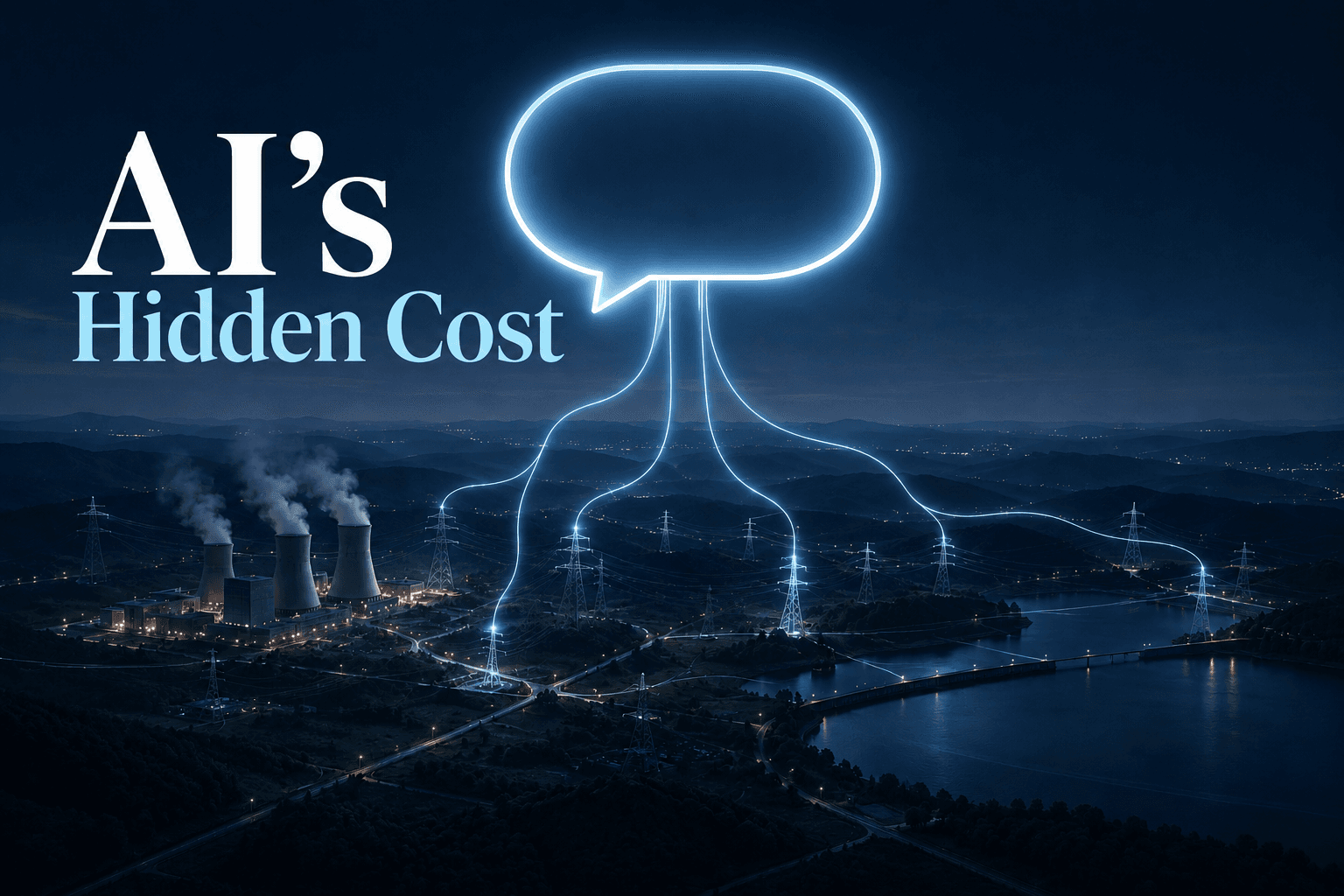
You type a question into a chatbot and the answer arrives before you have finished sitting back in your chair. It feels weightless, like pulling a book off a shelf.
It is not. Somewhere in Virginia or Oregon, a rack of processors grew warmer by a fraction of a degree, a cooling system breathed out a wisp of vapor, and an electricity meter ticked forward. The cost of your one question is real, just spread across a building you will never see.
Every AI answer has a physical body: a flick of electricity and a sip of water. One answer is nothing. A billion answers a day, every day, is enough to bend a power grid and pull hard on a city's water supply.
A Sip of Water You Never See
Start with the smallest unit: one prompt, one reply.
OpenAI's own published estimate puts an average ChatGPT query at about 0.34 watt-hours of electricity, roughly what a bright LED bulb burns in a couple of minutes, and a volume of water the company describes as one fifteenth of a teaspoon. You use more water rinsing a spoon before you put it in the dishwasher.
The electricity does the obvious work, running the chips that turn your question into a stream of text. The water does the unglamorous work: carrying heat away from those chips before they cook themselves. Most large data centers evaporate water for cooling the same way sweating cools a runner, and that vapor mostly does not come back to the local river.
At the scale of your afternoon, none of this matters. The problem is that you are not the only one asking.
Nobody Agrees on the Number, and That Matters
Here is the awkward part. The per-query figures vary wildly depending on who is counting.
The research group Epoch AI, building its estimate up from chip specifications, landed near 0.3 watt-hours for a typical query, about ten times lower than a widely repeated older figure. Academic estimates of water use per answer range from a fraction of a milliliter to something closer to a small mouthful, depending on the model, the region, the season, and whether you count the water used to generate the electricity in the first place.
So treat any single number with suspicion, including the ones in this article. What the estimates agree on is the shape of the thing: the cost per answer is small, it is falling as hardware improves, and it is still growing in total because the number of answers is climbing faster than the efficiency gains. As AI shifts from single replies toward agents that take dozens of steps to finish one task, the footprint of a single request climbs with it.
Did You Know?
Training a model and running it are different bills. One peer-reviewed study estimated that training GPT-3 evaporated around 700,000 liters of clean freshwater on-site, comparable to what it takes to manufacture a few hundred cars. But training happens once. The running total that now dominates comes from inference, the everyday business of answering questions, repeated billions of times a day.
The Aggregate Is Where It Gets Loud
Stack those tiny costs up and the picture changes character.
A 2024 report prepared for the US Department of Energy by Lawrence Berkeley National Laboratory found that data centers consumed about 4.4 percent of the country's electricity in 2023, and projected that share could reach somewhere between roughly 7 and 12 percent by 2028. The wide range is itself the headline: even the government's own analysts cannot pin it down. Independent forecasts land in similar territory. Goldman Sachs Research expects data centers' share of US power demand to roughly double by 2030, and the Electric Power Research Institute's high case runs higher still.
Globally, the International Energy Agency expects data-center electricity use to roughly double to about 945 terawatt-hours by 2030, close to Japan's entire annual consumption today, with the United States accounting for the largest single slice of the growth.
Water follows the same curve. A study led by researchers at the University of California, Riverside estimates that data-center water use across North America is approaching one trillion liters a year, and that building the new pipes, treatment plants, and reservoirs to serve continued growth could cost between about 10 and 58 billion dollars. This is the same cooling problem that makes data centers such heavy users of both water and power, now scaled to the size of a national utility.
The Grid Became the Bottleneck
For a few years the scarce ingredient in AI was chips. That has quietly changed. Now the scarce ingredient is a place to plug in.
Berkeley Lab's running tally of projects waiting to connect to the US grid has hovered well above 2,000 gigawatts of proposed generation and storage, a queue so long it can take several years to clear. A data center can be built in two or three years. Getting it connected to enough firm power can take twice that.
Where the demand has arrived ahead of the supply, prices move. In the PJM region that stretches across the mid-Atlantic, the market's independent monitor attributed a large share of a sharp jump in capacity costs to data-center demand, and those costs flow through to ordinary household electricity bills. The companies racing to build this infrastructure are increasingly borrowing heavily to fund it, a sign of how fast the buildout has outrun normal cash flow.
Northern Virginia shows what this looks like on the ground. The cluster of server farms around Ashburn, known in the industry as Data Center Alley, has grown so fast that data centers now account for roughly a quarter of all the electricity used in Virginia. The local utility has at times run short of transmission capacity to connect new sites, stretching wait times by years. In late 2025, state regulators approved a separate rate class for the largest users, an attempt to keep the cost of all that new infrastructure from landing on residential bills.
Annual water averages hide the danger. Cooling systems draw the most water on the hottest afternoons, which are exactly the days the local supply is tightest and the grid is already straining. That is why the UC Riverside researchers argue operators should be required to report their peak water use, not just a tidy yearly total that smooths the spikes away.
Washington Starts Reading the Meter
Until recently, the water and power a data center used were mostly its own business. That assumption is eroding.
The FY2026 National Defense Authorization Act, signed at the end of 2025, now requires the Pentagon's computing roadmap to estimate the electricity and water each new data center on a military installation would draw, its effect on the surrounding community, and how local utility disruptions would be prevented. Separate bipartisan bills in Congress would extend similar disclosure to commercial data centers nationwide, through an annual survey of energy and water use.
The common thread is a shift in how the infrastructure is treated. Water and power are no longer background utilities assumed to be available. They are being written into law as the constraints that decide whether a project happens at all.
Knowlegic Perspective
The debate about AI's footprint often gets stuck arguing about the wrong scale. Skeptics point to the enormous national totals; defenders point to the vanishingly small per-query cost. Both are right, and talking past each other. A single answer really is close to free. The aggregate really is large enough to reshape a regional grid and a city's water plan.
What is genuinely new is not the per-query number, which keeps improving, but the speed at which demand is compounding against physical limits that move slowly. You can add a server rack in a week. You cannot add a high-voltage transmission line or a reservoir in a week. The interesting question for the next few years is not whether AI can get more efficient per answer, it clearly can, but whether efficiency and grid-building can keep pace with a demand curve that is still bending upward.
Every AI answer has a physical body: a flick of electricity and a sip of water. One answer is nothing. A billion answers a day is enough to bend a power grid and pull hard on a city's water supply, which is why the meter reading, not the model, is becoming the thing that decides how far this technology can go.
Sources & References
- DOE Releases New Report Evaluating Increase in Electricity Demand from Data Centers, U.S. Department of Energy / Lawrence Berkeley National Laboratory (2024)
- Energy and AI, Executive Summary, International Energy Agency (2025)
- Making AI Less "Thirsty": Uncovering and Addressing the Secret Water Footprint of AI Models, Communications of the ACM (2025)
- The Gentle Singularity, Sam Altman (2025)
- Queued Up: 2025 Edition, Characteristics of Power Plants Seeking Transmission Interconnection, Lawrence Berkeley National Laboratory (2025)
- Data centers were 40% of PJM capacity costs in last auction: market monitor, Utility Dive (2025)
- US Data Center Power Demand Projected to Double by 2027, Goldman Sachs Research (2025)
Enjoyed this?
Get notified when a new Knowlegic story worth knowing is published.


