

Why Data Centers Use So Much Water and Electricity?
Every AI answer has a physical cost. Behind the cloud are enormous machines that need two things to keep running: power and cooling.
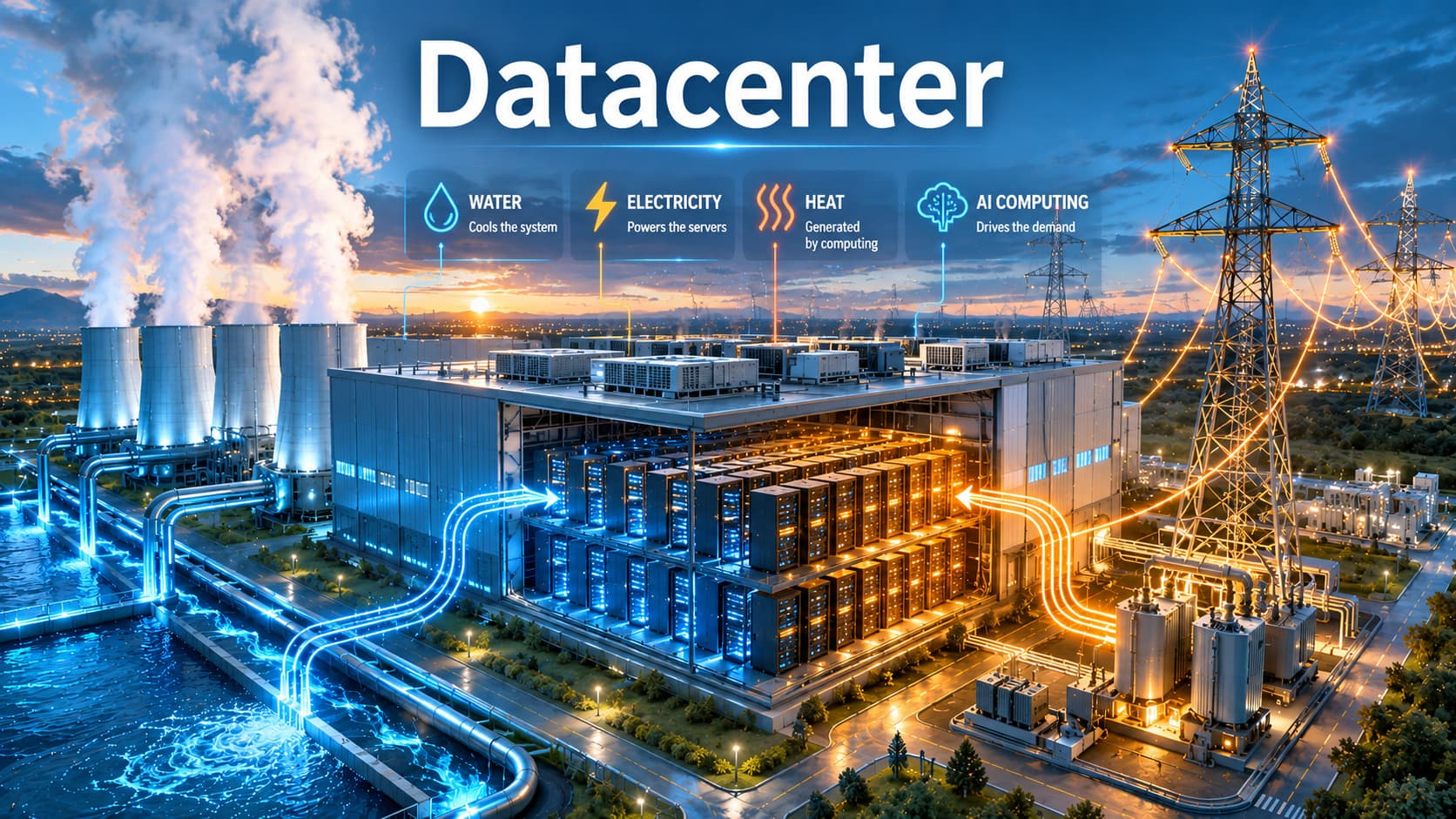
We tend to think of AI as something that happens in the cloud.
You type a question.
A response appears.
It feels almost weightless.
But behind that simple interaction, where the model is building your answer one token at a time, are thousands of powerful servers running inside enormous data centers. Those machines consume electricity and almost all of that electricity eventually becomes heat.
That creates a surprisingly simple problem:
The more computing we demand, the more heat we have to remove.
And removing that heat can require an enormous amount of water.
A typical large data center can use one to five million gallons of water a day, primarily for cooling. At the same time, global data-center electricity demand is rising rapidly, driven in part by AI workloads. That demand has grown large enough that the biggest technology companies are now buying nuclear power directly.
So the infrastructure challenge behind the AI boom isn't just about having enough chips.
It's about having enough power and water to keep those chips running.
Why Do Data Centers Need Water?
Imagine a laptop working hard for hours.
Eventually, it gets hot.
Now imagine replacing that laptop with thousands or tens of thousands of powerful servers working continuously.
The heat problem becomes enormous.
Servers generate heat whenever they process information. If that heat isn't removed efficiently, equipment can slow down, malfunction, or suffer permanent damage.
One of the most effective ways to deal with that heat is surprisingly familiar:
Evaporation.
It's the same principle your body uses when you sweat.
As sweat evaporates from your skin, it carries heat away.
Data centers can use a similar principle at industrial scale.
Water absorbs heat and is then evaporated, carrying that heat away from the facility.
It's effective.
It's relatively inexpensive.
And that's precisely why it became so widely used.
But there's a catch.
The water that evaporates doesn't come back.
Did You Know?
According to the source material, as much as 85% of the water drawn by some data centers can be lost through evaporation during cooling.
Think of it like a paper towel.
It's cheap and effective but once you've used it, it's gone.
A closed-loop cooling system is more like a reusable bottle: the coolant is continuously circulated instead of constantly consuming fresh water.
The trade-off?
It can require more electricity and more sophisticated equipment.
And that leads to a much bigger problem.
Water and Electricity Are Connected
At first, water and electricity sound like two separate data-center problems.
They're not.
They're deeply connected.
Evaporative cooling uses water, but it can reduce the amount of electricity needed for cooling.
Mechanical or air-based cooling can dramatically reduce direct water consumption, but it can require more electricity.
So operators are often balancing two resources:
Use more water → potentially use less electricity.
Use less water → potentially use more electricity.
It's almost like squeezing a balloon.
Push the problem down on one side, and it can expand somewhere else.
And there's an even more hidden connection.
A data center doesn't only have a water footprint because of the water it uses directly.
The electricity powering it can have a water footprint too.
The Water You Don't See
Suppose a data center uses electricity generated by a power plant.
That power plant may itself consume large quantities of water, particularly in systems that use water for steam generation and cooling.
The source material notes that coal-fired power plants can use close to 19,000 gallons of water per megawatt-hour of electricity generated, largely because of their steam-cycle processes.
So there are really two water footprints:
Direct water use
The water consumed by the data center itself.
Indirect water use
The water consumed elsewhere to generate the electricity that powers the data center.
It's similar to looking at the environmental footprint of a car.
You wouldn't measure only what comes out of its exhaust pipe.
You'd also consider what happens during manufacturing and energy production.
The same logic applies here.
The real water footprint of computing can extend far beyond the walls of the data center.
Then AI Arrived
Data centers were already consuming more electricity before generative AI became mainstream.
Then something changed.
AI workloads began expanding rapidly.
Training and running large AI models requires enormous amounts of computation. And unlike a traditional web search, where the system can often retrieve and rank existing information, an AI model has to perform substantial computation to generate a response.
Now multiply that by billions of interactions.
The scale becomes difficult to ignore.
The source material projects global data-center electricity demand to grow sharply, with demand in 2026 on pace to exceed 1,000 terawatt-hours.
And AI is one of the major forces behind that growth.
A useful analogy is the difference between:
Looking something up in a dictionary
and
running a small factory for several seconds to produce an answer.
The first is essentially retrieval.
The second requires computation.
And when that computation happens billions of times, the infrastructure underneath it becomes enormous.
If the world's data centers were treated as a single country, their electricity consumption would place them among the world's largest electricity consumers.
The source material estimates that 2026 demand could put data centers among the five largest electricity-consuming entities on Earth.
That's an extraordinary way to think about something most people imagine as simply "the cloud."
The AI Infrastructure Problem
Here's what makes AI different.
Traditional data centers were designed around workloads such as:
-
Websites
-
Email
-
File storage
-
Databases
-
Video streaming
-
Business applications
AI adds another category of computing that can be exceptionally demanding.
Training large models requires huge amounts of processing.
But training isn't the only challenge.
Once a model is deployed, people continuously interact with it.
Every question.
Every generated image.
Every piece of code.
Every AI-powered search.
Every automated task.
Each interaction requires computing resources.
And those resources consume electricity.
That electricity becomes heat.
And that heat has to go somewhere.
So AI creates a chain reaction:
More AI → More computing → More electricity → More heat → More cooling
And cooling brings us right back to:
Water.
The Trade-Off Nobody Really Wants
This is perhaps the most uncomfortable part of the story.
There isn't a single perfect cooling solution.
Imagine a data center located in a region where water is already scarce.
The operator could move toward waterless or mostly mechanical cooling.
That could dramatically reduce direct water consumption.
But now the facility may require more electricity to achieve the same cooling performance.
Alternatively, the operator could rely more heavily on evaporative cooling.
That may reduce cooling electricity requirements.
But it consumes more water.
So the question isn't simply:
"How do we make data centers greener?"
It becomes:
"Which resource can this location afford to spend?"
Water?
Electricity?
Or both?
The answer can vary dramatically depending on geography, climate, energy sources, and local infrastructure.
So What Are Companies Doing?
The most promising solutions try to break the water-versus-electricity trade-off.
One approach is closed-loop liquid cooling.
Instead of continually evaporating fresh water, coolant can be circulated repeatedly through the system.
Microsoft, for example, has deployed chip-level closed-loop liquid cooling and reported significant reductions in water use at some facilities.
Another approach is immersion cooling.
Instead of relying primarily on air, servers can be immersed in a specialized non-conductive liquid that transfers heat away from the hardware.
In simple terms:
Servers get hot → liquid absorbs the heat → cooling system removes the heat → cooled liquid returns → repeat.
This can dramatically change the cooling equation.
The source material cites industry reporting indicating that immersion cooling can reduce cooling energy by more than 90% compared with older systems in appropriate applications.
But there's a catch here too.
Most existing data centers weren't designed around these technologies.
Retrofitting old infrastructure can be expensive and complicated.
That means the data centers being designed today may have an important advantage:
They can be built around the cooling problem from day one.
The Data Center of the Future May Look Very Different
The next generation of data centers won't necessarily be defined only by faster chips.
They may be defined by how intelligently they handle:
Heat.
Water.
Electricity.
Location.
And efficiency.
That could mean more sophisticated liquid cooling.
More closed-loop systems.
More efficient power infrastructure.
Greater use of renewable energy.
Better placement of facilities in regions where water and electricity resources can support them.
And more efficient AI models that require less computation to accomplish the same task.
Because there's another way to reduce the environmental cost of AI:
Don't use as much computing in the first place.
If a model can produce the same result using less computation, the benefits ripple through the entire infrastructure chain.
Less computation.
Less electricity.
Less heat.
Less cooling.
Potentially less water.
Knowlegic Perspective
It's easy to think of the internet as something that exists somewhere above us, in "the cloud."
But the cloud isn't really a cloud.
It's buildings.
Inside those buildings are racks of servers.
Those servers consume electricity.
Electricity produces heat.
Heat requires cooling.
And cooling can consume water.
Suddenly, something as simple as asking an AI a question has a physical infrastructure story behind it.
That doesn't mean we should stop using AI.
It means we should understand what scaling AI actually requires.
The biggest constraint on AI's future may not be whether we can build a smarter model.
It may be whether we can build the physical infrastructure needed to run that model sustainably.
And that is a much more interesting problem.
The AI revolution is often described in terms of algorithms, chips, models, and data.
But underneath all of it is something far less glamorous:
heat.
Every powerful server generates it.
Every AI workload adds to it.
And somebody has to remove it.
Today, that can mean millions of gallons of water and enormous quantities of electricity flowing through the infrastructure behind the AI services we use every day.
The next great leap in AI may therefore not come from making models simply bigger.
It may come from making the machines that run them far more efficient.
Because the future of AI isn't limited by what we can make intelligent.
It's also limited by how much water and power we can afford to spend making it run.
Key Takeaways
-
Data centers consume electricity primarily to power computing infrastructure, and much of that energy eventually becomes heat.
-
Evaporative cooling is effective but can consume large quantities of water.
-
Water and electricity are closely connected: reducing one can sometimes increase the other.
-
The electricity supply itself can have an indirect water footprint.
-
AI workloads are accelerating data-center electricity demand.
-
Closed-loop liquid cooling can reduce direct water consumption.
-
Immersion cooling can significantly reduce cooling energy in suitable environments.
-
More efficient AI models could reduce the infrastructure required to run AI at scale.
-
The future AI challenge isn't only computational, it is increasingly physical.
Enjoyed this?
Get notified when a new Knowlegic story worth knowing is published.


