

Why Luxury Brands Stay Expensive
The price isn't just about craftsmanship. It's about psychology, scarcity, identity, and one of the oldest principles of human behavior: we desire what few can have.
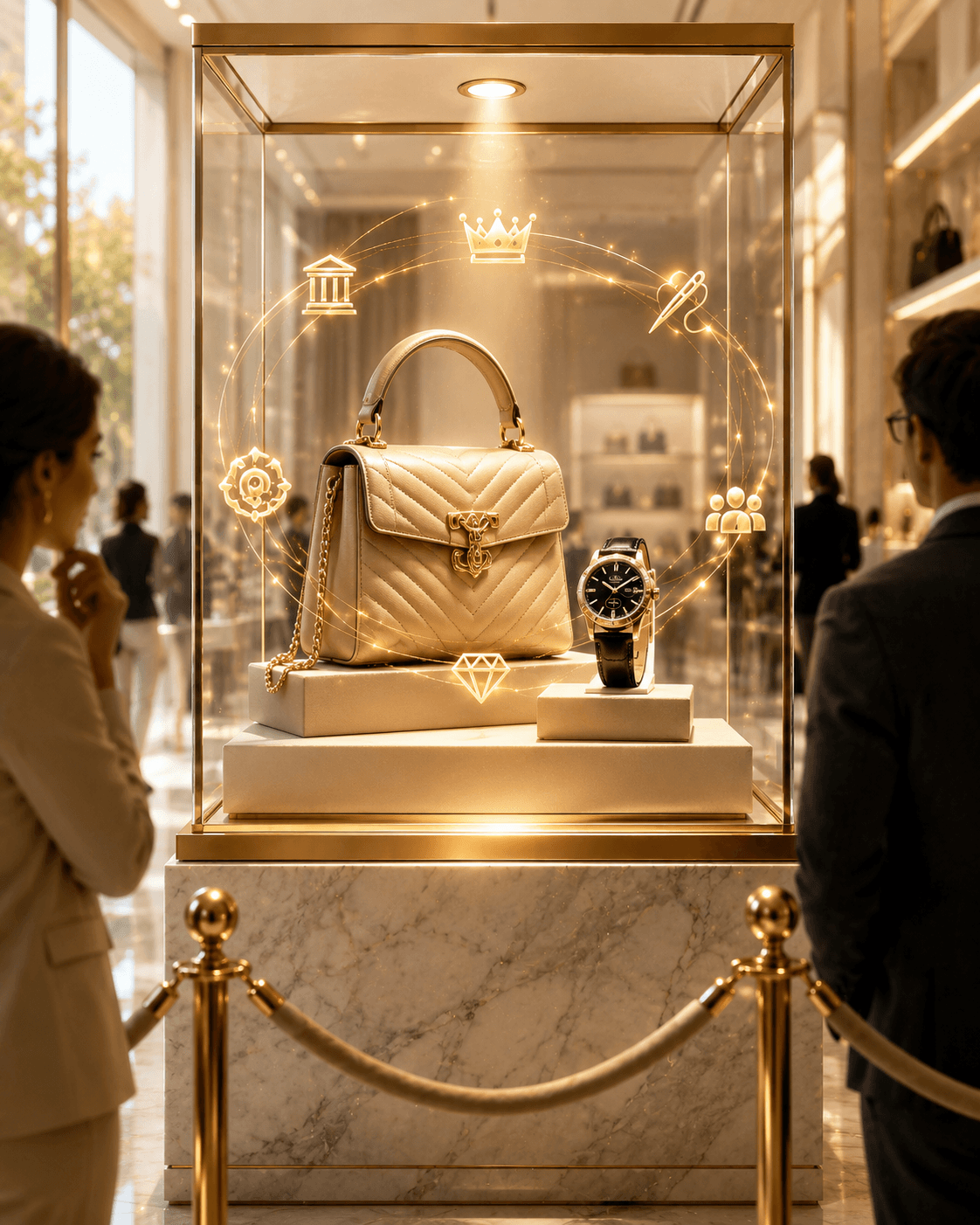
Imagine walking into two stores on the same street.
In the first, a beautifully crafted leather handbag costs ₹12,000.
A few doors away, another handbag remarkably similar in size, function, and even quality of leather carries a price tag of ₹12 lakh.
Both hold your phone.
Both carry your wallet.
Both protect your keys.
Yet one costs nearly a hundred times more than the other.
At first glance, it feels absurd.
Surely no handbag is worth that much.
And yet, every year, millions of people willingly spend extraordinary sums on luxury watches, handbags, fragrances, shoes, and cars, not because they have been tricked, but because they believe those products offer something far more valuable than utility.
So what exactly are they buying?
Leather?
Craftsmanship?
History?
Status?
Or something much deeper?
To answer that question, we first need to understand a simple truth:
Luxury isn't really about products.
It's about perception.
The World's Most Successful Illusion
Most businesses compete by trying to convince customers that they offer more.
More features.
More convenience.
More value for money.
Luxury brands play an entirely different game.
Instead of asking, "How can we sell more?", they ask,
"How can we remain desirable?"
That single difference changes everything.
A luxury brand isn't trying to reach everyone.
In fact, it actively avoids it.
Imagine if every person in your neighborhood suddenly owned the same limited-edition watch.
Would it still feel special?
Probably not.
Its usefulness wouldn't change.
It would still tell time just as accurately.
But its meaning would.
Luxury companies understand something psychologists have known for decades:
People rarely value objects in isolation.
They value what those objects represent.
That is why luxury is built on a paradox.
The fewer people who own something, the more desirable it often becomes.
Scarcity: The Oldest Marketing Strategy in Human History
Walk into most supermarkets, and shelves are overflowing.
If one product sells out, another replaces it tomorrow.
Luxury doesn't work that way.
Many of the world's most prestigious brands deliberately produce fewer products than the market is willing to buy.
Some collections are released only once a year.
Others come with waiting lists stretching months or even years.
Certain products can only be purchased after building a relationship with the brand.
At first, this seems like terrible business.
Why refuse customers who are ready to spend money?
Because luxury companies aren't trying to maximize sales.
They're trying to maximize desire.
The less available something becomes, the more valuable our brains instinctively believe it is.
Psychologist Robert Cialdini describes this as the Scarcity Principle. When opportunities become limited, people don't simply want them, they begin to assume they must be worth wanting.
Think about the last time you saw the words:
- Limited Edition
- Only 50 Pieces Worldwide
- Invitation Only
- Sold Out
Nothing about the product itself changed.
But your perception probably did.
Scarcity doesn't create quality.
It creates attention.
And attention is often the first step toward desire.
Did You Know?
Some luxury brands intentionally avoid mass discounts, even during economic slowdowns.
Why?
Because lowering prices doesn't just reduce profit.
It can reduce prestige.
For many luxury companies, protecting the perception of exclusivity is more valuable than selling a few extra products.
The Product Is Only Half of What You're Buying
Imagine receiving two identical watches.
One arrives in a plain cardboard box.
The other comes inside a handcrafted wooden case, wrapped in silk, presented in a quiet boutique where someone carefully explains its history before handing it to you.
Which one feels more valuable?
Objectively, they're identical.
Emotionally, they're worlds apart.
Luxury brands understand that value doesn't begin when you use the product.
It begins long before that.
The architecture of the store.
The lighting.
The scent.
The silence.
The packaging.
Even the way a sales associate speaks.
Every detail is carefully designed to create a feeling that you're entering a world not just making a purchase.
Because in luxury, the experience becomes part of the product.
Customers don't simply leave with a handbag or a watch.
They leave with a story they'll tell friends.
A memory they'll relive.
And perhaps most importantly, a feeling about themselves.
Luxury brands know something remarkable:
People rarely remember every feature of a product.
But they remember how owning it made them feel.
Why Stories Can Be More Valuable Than Leather
Two handbags can use similar leather.
Two watches can tell time with equal precision.
Yet one becomes a family heirloom while the other remains just another accessory.
The difference often lies in narrative.
Luxury brands rarely sell objects in isolation.
They sell centuries of craftsmanship.
They sell heritage.
They sell workshops tucked away in Italian villages.
They sell master artisans who spend hours hand-stitching details invisible to almost everyone.
Whether every customer consciously thinks about those stories is almost irrelevant.
The stories become woven into the brand itself.
Over time, they transform products into cultural artifacts rather than everyday possessions.
In other words, people aren't only buying craftsmanship.
They're buying continuity.
They're buying tradition.
They're buying the feeling that they're becoming part of something much larger than themselves.
Why Status Is One of Luxury's Most Valuable Products
Luxury has never been only about craftsmanship.
It has always been about communication.
Long before designer logos existed, humans used clothing, jewelry, architecture, and even food to signal status within their communities.
Kings wore crowns.
Warriors carried decorated weapons.
Merchants displayed rare fabrics.
These objects weren't merely useful.
They communicated identity.
Modern luxury brands do exactly the same thing.
A luxury watch doesn't simply tell time.
It quietly tells a story about the person wearing it.
Whether that story is wealth, success, taste, achievement, or appreciation for craftsmanship depends on the observer. But the object has become a language.
More than a century ago, economist Thorstein Veblen introduced the idea of conspicuous consumption, the tendency for people to purchase expensive goods not only for their usefulness, but because those goods visibly communicate status.
His insight remains surprisingly relevant today.
A luxury product often performs two functions simultaneously:
- It serves a practical purpose.
- It sends a social signal.
Neither function is inherently right or wrong.
Humans have always communicated through symbols.
Luxury simply happens to be one of the most visible ones.
Taste Isn't Born—It's Learned
Have you ever wondered why one handbag is considered timeless while another is dismissed as ordinary?
Or why a particular watch, chair, or pair of shoes suddenly becomes "iconic"?
The answer isn't always superior design.
Often, it's education.
Not classroom education.
Cultural education.
Luxury brands spend decades shaping what society considers beautiful.
They sponsor fashion shows.
Collaborate with artists.
Work with architects.
Partner with filmmakers.
Choose ambassadors carefully.
Open stores that feel more like art galleries than retail spaces.
Over time, they don't just respond to taste.
They help create it.
French sociologist Pierre Bourdieu called this cultural capital, the idea that knowledge, preferences, and taste can become a form of social advantage.
People often assume they naturally prefer certain brands.
In reality, many of those preferences have been slowly shaped by culture, media, and repeated exposure.
Luxury doesn't simply follow trends.
The most successful brands quietly influence them.
The Luxury Economy Isn't Built on Products. It's Built on Patience.
Most companies celebrate convenience.
Luxury celebrates waiting.
Waiting lists.
Exclusive appointments.
Limited releases.
Private previews.
Invitation-only events.
At first glance, these seem inconvenient.
But psychologically, they serve an important purpose.
Waiting increases anticipation.
Anticipation strengthens emotional attachment.
By the time customers finally receive the product, they've already invested weeks or sometimes years thinking about it.
Ownership begins long before purchase.
In many cases, the waiting experience becomes part of the luxury itself.
Luxury brands understand that desire grows strongest when it has room to breathe.
Why Luxury Survives Economic Uncertainty
Economic downturns change spending habits.
People postpone vacations.
Delay buying new cars.
Reduce discretionary expenses.
Yet many luxury brands continue to perform remarkably well.
Why?
Part of the answer lies in who buys luxury.
But another part lies in what luxury represents.
During uncertain times, symbols of permanence, craftsmanship, and heritage can become even more emotionally appealing.
Some customers buy luxury because it reflects success.
Others buy it because it represents stability.
A luxury watch isn't simply a watch.
For some, it's an heirloom.
A reward for years of work.
A milestone.
An object expected to outlive trends.
That's a different psychological purchase from buying something merely because it's fashionable.
Visual Thinking

Knowlegic Perspective
Luxury brands reveal something fascinating about human nature.
We often assume that value is something built into an object that a product is expensive because it's inherently better.
But luxury turns that assumption upside down.
It shows that value is also something we collectively create.
A waiting list becomes valuable because people believe it represents rarity.
A handbag becomes iconic because generations of culture, storytelling, craftsmanship, and aspiration have given it meaning.
The object matters.
But the shared belief surrounding the object matters just as much.
Once you recognize this pattern, you begin to notice it everywhere.
Universities build prestige through reputation.
Technology companies create exclusivity through early access.
Restaurants become destinations because reservations are difficult to secure.
Even social media transforms attention into perceived value.
Luxury isn't an exception to human behavior.
It's one of its clearest demonstrations.
It reminds us that people rarely buy products based on utility alone.
We buy stories.
We buy identity.
We buy belonging.
And perhaps most of all, we buy meaning.
The next time you see someone carrying an expensive handbag or wearing a luxury watch, it's worth asking a different question.
Not,
"How much did that cost?"
But,
"What does it represent?"
Because luxury has never been only about leather, gold, or precision engineering.
It is about something far more powerful.
The remarkable human ability to assign extraordinary meaning to ordinary objects.
And perhaps that's the greatest lesson luxury teaches us.
Sometimes, the most valuable thing we purchase isn't the object itself.
It's the story we choose to believe about it.
Enjoyed this?
Get notified when a new Knowlegic story worth knowing is published.


