

Why Messi Never Needed to Be the Fastest Player on the Pitch
Kylian Mbappé can outrun him by several kilometers per hour. It has never mattered. Messi built something more useful.
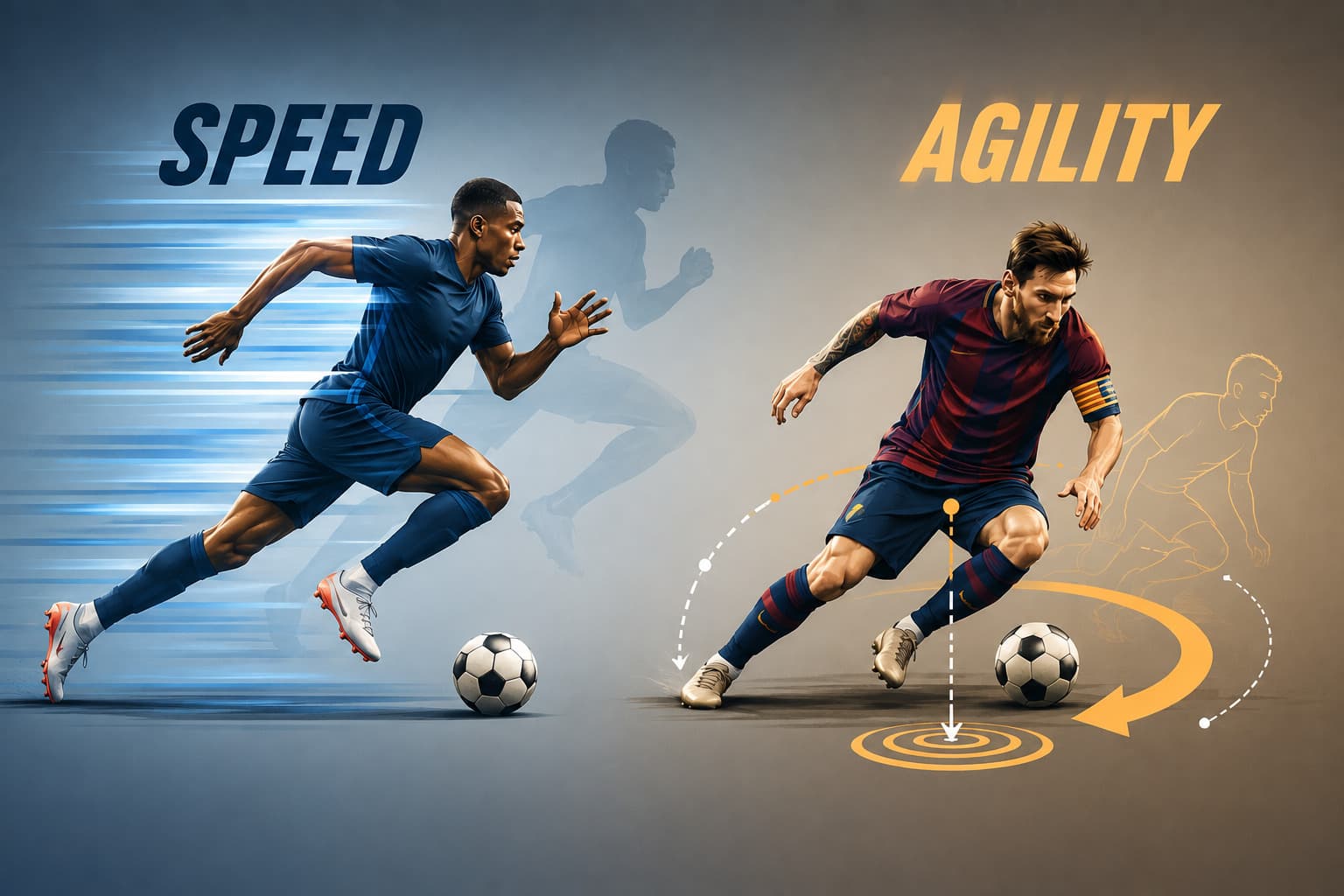
Lionel Messi has never been the fastest player on a football pitch.
Kylian Mbappé can reach speeds above 37 km/h. Cristiano Ronaldo has still reached the mid-30s well into his career. Messi's top speed is closer to 32.5 km/h.
And yet, for two decades, defenders have struggled to stop him.
The reason reveals something fascinating about athletic performance: football speed isn't always about how fast you can run.
It's about how quickly you can stop.
How suddenly you can change direction.
How fast you can take the first step.
And, perhaps most importantly, whether you can understand what is about to happen before everyone else does.
The Footrace Messi Would Lose
Imagine Mbappé, Ronaldo, and Messi standing side by side.
The whistle goes.
Mbappé accelerates.
Ronaldo follows.
Messi loses the race.
On a stopwatch, the result isn't particularly close.
But here's the strange part:
That race tells you surprisingly little about why Messi is so difficult to defend.
Football isn't a 100-meter sprint.
Most one-on-one battles don't give players enough space to reach their maximum speed. A defender isn't asking Messi to race 40 meters down an empty track.
They're trying to survive three or four meters of chaos.
And in that tiny space, a completely different kind of speed becomes important.
The Speed That Doesn't Show on a Speedometer
Imagine putting a drag racer and a go-kart on an open highway.
The drag racer wins.
Obviously.
Now put both into a cramped parking lot filled with tight turns.
Suddenly, the advantage changes.
The drag racer has extraordinary top speed.
The go-kart can stop, turn, and redirect almost instantly.
Football is much closer to the parking lot.
A player's top speed only becomes useful if there is enough space to reach it.
In a crowded penalty area or during a one-on-one encounter, there usually isn't.
Instead, the decisive movements happen over a few meters.
That makes deceleration, first-step quickness, balance, and change of direction enormously important.
Messi's compact movement style combined with his relatively short stride and low center of gravity has helped him make those rapid adjustments in tight spaces.
And that's where his version of speed begins.
Messi's Secret Weapon May Be Stopping
This sounds counterintuitive.
But think about what happens when Messi approaches a defender.
He doesn't need to outrun them.
He needs to make the defender believe he is going one way...
then stop...
then move somewhere else before the defender can react.
The critical movement may happen in less than a second.
Acceleration matters.
But deceleration creates the opportunity for the next move.
A player who can rapidly slow their body, plant a foot, shift their center of mass, and accelerate in another direction can create separation without ever reaching extraordinary top speed.
That's the difference between running fast and changing position fast.
The Numbers Back It Up
This isn't simply a visual impression.
Since Opta began tracking Europe's top five leagues in the 2006–07 season, Messi has completed more successful dribbles than any other player, with Eden Hazard behind him.
Messi also holds the record for the most successful take-ons recorded by Opta in a single match:
18.
Think about what that means.
He didn't need to win one enormous footrace.
He repeatedly won dozens of tiny battles.
One step.
One touch.
One change of direction.
Again and again.
For nearly two decades.
Then There's Something Even More Interesting
Watch Messi closely when he's dribbling.
His eyes aren't always locked on the ball.
They're scanning.
A defender's hips.
A teammate's movement.
An opening between players.
A passing lane that may exist for only a fraction of a second.
Meanwhile, his feet continue controlling the ball.
That separation between where his eyes are looking and what his feet are doing is one of the most fascinating parts of elite skill.
And it raises a bigger question:
How much of the movement has become automatic?
When the Feet Stop Needing Attention
One academic hypothesis proposed in 2016 suggested that extremely refined motor skills could reduce the amount of conscious attention required to control the ball, potentially leaving more cognitive capacity available for reading the game around the player.
It's an intriguing idea.
But it is important to be precise:
It remains a hypothesis, not a proven explanation for Messi's superiority.
Still, watch him play and the underlying concept becomes easier to appreciate.
The ball doesn't appear to consume all of his attention.
He seems to be processing the game around it.
That is a very different kind of athletic advantage.
The Body That Shaped the Toolkit
Messi's physical story adds another layer.
At around ten or eleven years old, he was diagnosed with a growth hormone deficiency.
At roughly 1.27 meters tall, he was noticeably smaller than many of his teammates and required nightly hormone treatment that his family in Argentina struggled to afford.
Barcelona's youth academy eventually took him on and covered the treatment.
Messi ultimately grew to around 1.70 meters.
That's not exceptionally short for an ordinary person.
But in elite football, where size, strength, and explosive physical ability can provide obvious advantages, it meant he couldn't simply build his game around overpowering opponents.
His most valuable tools had to be elsewhere.
Footwork.
Timing.
Balance.
Close control.
Anticipation.
Reading the game.
His body didn't determine exactly what kind of player he would become.
But it may have made certain solutions more valuable to him earlier than they were to others.
And once those solutions became strengths, he kept refining them.
The Bigger Point: Don't Confuse the Most Visible Skill With the Most Valuable One
Sport encourages us to measure what is easy to measure.
Speed.
Height.
Strength.
Jumping ability.
Distance.
Numbers are useful.
But they don't tell the entire story.
Messi's career is a remarkable counterexample.
His top speed doesn't dominate the leaderboard.
His physical size doesn't overwhelm defenders.
His advantage appears in subtler measurements:
How quickly can he decelerate?
How precisely can he redirect his body?
How early can he read an opponent's movement?
How much of the technical task can he perform automatically?
Those qualities are harder to capture with a single number.
And yet they can decide the game.
Knowlegic Insight
The most important ability isn't always the one that looks most impressive on paper.
Sometimes the real advantage is hidden in the space between two measurable skills.
In football, that space might be the fraction of a second between stopping and changing direction.
In other fields, it might be anticipation, timing, pattern recognition, or decision-making.
Messi's career is a reminder that specialization can beat raw physical advantage when the skill is matched perfectly to the environment.
So, Was Messi's Lack of Speed Actually a Disadvantage?
Yes.
And no.
He could not rely on the same physical weapon that players like Mbappé possess.
But football doesn't ask every player to solve the same problem.
Mbappé can create separation by exploding into open space.
Messi can create separation by making the defender move first.
One uses space.
The other manipulates it.
One wins the race.
The other changes where the race is happening.
That's why comparing their top speeds alone misses the point.
The Three-Meter Advantage
Here's perhaps the simplest way to understand Messi.
Don't picture a football pitch.
Picture three meters of space.
A defender is directly in front of him.
There isn't enough room for a 37 km/h sprint.
Messi takes a touch.
The defender shifts.
Messi slows.
The defender adjusts.
Then Messi changes direction.
Suddenly, the defender is moving toward the space Messi has already left.
And Messi is moving into the space the defender hasn't reached yet.
The advantage wasn't created by running faster.
It was created by understanding the geometry of the moment.
That's what makes his style so difficult to defend.
Knowlegic Perspective
It's easy to describe Messi's football as magic.
But "specialization" may be a more useful word.
He didn't simply become a slightly better version of the fastest or strongest players.
He developed a different toolkit.
A toolkit optimized for the actual geometry of football:
tight spaces,
rapid changes of direction,
tiny windows,
and decisions that need to happen before the defender realizes what is coming.
That's a lesson that extends far beyond sport.
We often admire the ability that is easiest to measure.
But the skill that changes the outcome isn't always the biggest, fastest, or loudest one.
Sometimes the decisive advantage is the one hiding between the numbers.
Mbappé will probably keep winning the footrace.
That's not the contest Messi spent his career trying to win.
His game was built around something more subtle:
getting to the right place before the race even begins.
For two decades, Messi has shown that you don't always need to run faster than everyone else.
Sometimes you simply need to understand what happens next and move before anyone else sees it coming.
Because on a football pitch, the most important distance isn't 100 meters.
It's often just three.
Enjoyed this?
Get notified when a new Knowlegic story worth knowing is published.


