

Wood Never Stopped Being Precious- We Just Stopped Noticing
It's the only major building material a living thing grows for free, using nothing but sunlight, water, and air. Somewhere between the campfire and the skyscraper, we forgot how strange that actually is.
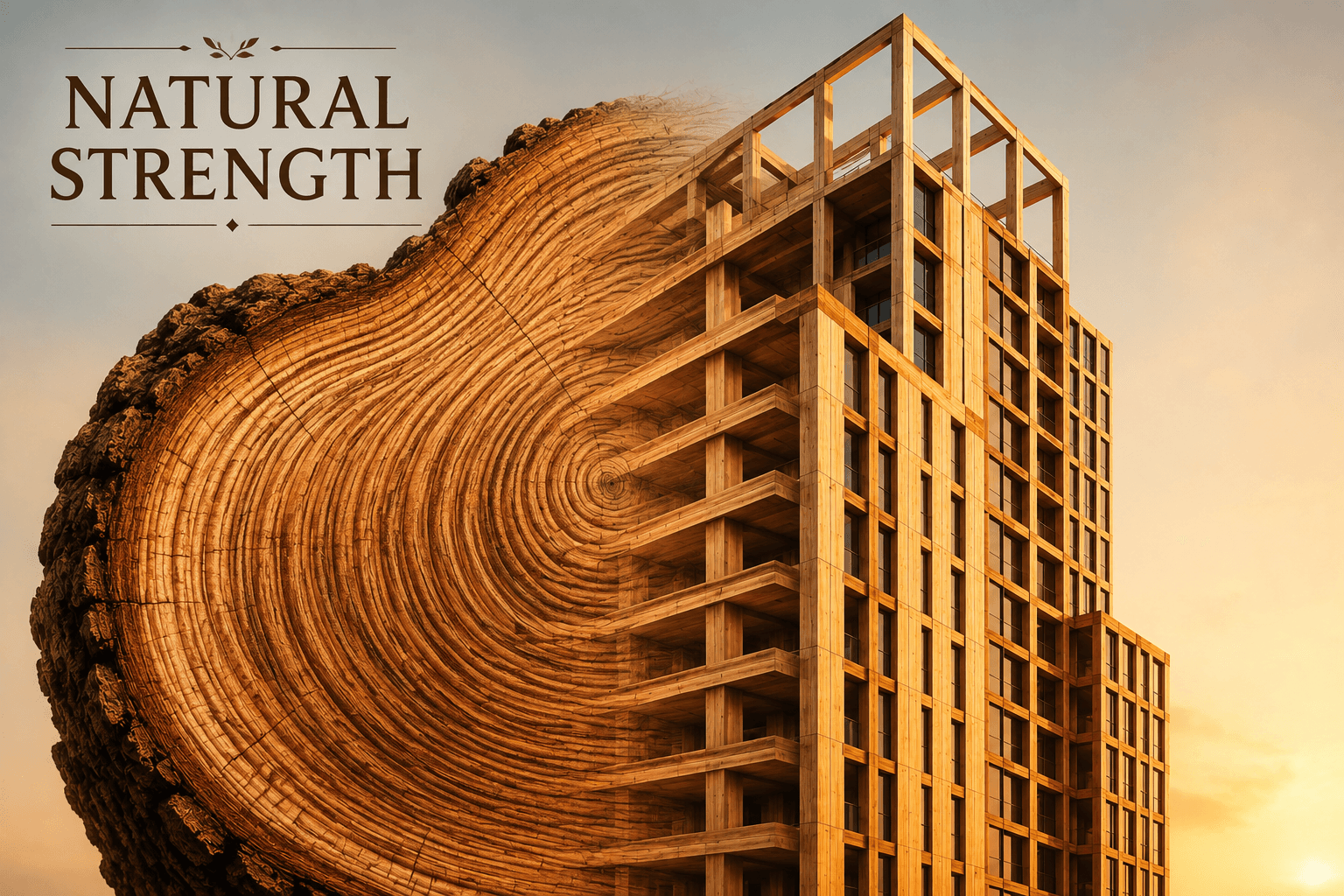
Tonight, roughly 2.3 billion people will cook dinner over a fire built from wood, the same material now being engineered into skyscrapers more than 18 stories tall.
Nobody built a factory to make that possible.
A tree did it using sunlight, water, and air.
Wood never stopped being one of the most valuable materials on Earth. We simply became so accustomed to it that we forgot how remarkable it really is.
This is the story of wood's strange, continuous reign from the thousands of oak trees that went into a single 18th-century warship to the timber towers rising in cities today and what "renewable" really means when a resource this useful is also finite.
A Machine That Builds Itself Out of Sunlight
Almost every structural material humans rely on has to be dug up, melted, or chemically transformed.
Steel needs a blast furnace.
Concrete needs a kiln hot enough to process its raw materials.
Wood needs a tree standing in a field, quietly pulling carbon dioxide from the atmosphere and turning it into cellulose and lignin.
Those compounds give wood its remarkable combination of strength and lightness.
The result is a material with an unusual set of trade-offs.
Pound for pound, wood can hold significant loads while weighing far less than steel.
And there's something almost absurd about that:
It's a structural material you can set on fire.
Did You Know?
Wood's strength doesn't simply come from being dense.
It comes from its structure.
Long cellulose fibers running through the grain provide much of its tensile strength, while lignin helps bind and stiffen the structure.
A tree is, in a very literal sense, pre-reinforced.
The Navy That Ran on Forests
For most of recorded history, wood wasn't one building material among many.
It was close to the only one available at scale.
Nowhere is that more obvious than during the age of sail.
HMS Victory, Lord Nelson's flagship at Trafalgar, is estimated to have required around 6,000 mature oak trees during its construction roughly the equivalent of 100 acres of forest.
And that was one ship.
Historians estimate that the Royal Navy's fleet around 1800 required roughly 1.2 million oak trees to build and maintain.
The ships that carried exploration, trade, and naval warfare across the world were, quite literally, forests first.
It Still Feeds Billions of Fires Every Night
It's tempting to file that story under history a relic from before coal and oil took over.
It isn't.
Roughly 2.3 billion people still cook with wood, charcoal, or other forms of biomass.
That's a population larger than China, relying on forms of fuel humans have used for thousands of years.
But that reliance comes with a serious cost.
The World Health Organization links household air pollution from polluting cooking fuels and technologies to millions of premature deaths each year, particularly in poorly ventilated homes.
Wood's oldest job feeding the household fire is still one of its biggest.
For better and for worse.
Spread evenly across the global population, the world's forests amount to roughly half a hectare per person.
It sounds like a lot.
Until you remember that much of that forest is already supporting ecosystems, communities, biodiversity, agriculture, and other human needs.
The Paper Trail Nobody Thinks About
Cooking fires and warships are easy to picture.
The paper trail is easier to miss mostly because it is designed to disappear the moment you're done with it.
Every cardboard box delivered to a doorstep, every grocery bag, and every sheet in a printer tray began as wood pulp: trees mechanically or chemically broken down into fibers and then pressed into new forms.
The world produces roughly 400 million tonnes of paper and paperboard each year.
The number is difficult to visualize.
And almost none of that material looks, sitting on a shelf or inside a shopping bag, like the tree it came from.
That's the quiet trick of wood.
It does enormous amounts of invisible work precisely because it's so good at not looking like wood anymore.
The Skyscraper Made of Trees
At the same time wood is still feeding cooking fires in some parts of the world, it is being engineered into some of the most advanced buildings on Earth.
Mass timber uses thick layers of wood engineered into structural panels, beams, and slabs. One widely used form is cross-laminated timber, in which layers of wood are arranged in alternating directions and bonded together.
The result can support buildings that would once have been constructed primarily from steel and concrete.
Mjøstårnet, an 18-story tower in Brumunddal, Norway, is one of the world's most prominent examples of large-scale timber construction. Read more here
The attraction isn't simply aesthetic.
Steel and cement production are energy-intensive, while growing trees removes carbon dioxide from the atmosphere as they accumulate biomass.
Life-cycle studies suggest that some mass-timber buildings can have substantially lower embodied emissions than comparable conventional structures, depending on how the wood is sourced, processed, transported, and eventually managed.
So the equation isn't simply:
Wood = good.
It's:
Well-managed forests + responsibly sourced timber + appropriate construction = potential climate advantage.
Renewable Doesn't Mean Infinite
None of this works if the forests disappear.
For a long stretch of the 20th century, that looked like a serious possibility.
According to the UN Food and Agriculture Organization, global net forest loss averaged roughly 10 million hectares per year during the 1990s.
The more recent numbers are better.
FAO's latest assessments show that the rate of net forest loss has fallen substantially as forest regeneration and expansion have offset more of the world's forest loss.
That's genuine progress.
But it also reveals something important about the word "renewable."
Renewable doesn't mean unlimited.
It means a resource can regenerate, if humans allow it to regenerate faster than they consume it.
Knowlegic Perspective
It's easy to mistake familiarity for unimportance.
Wood is everywhere, in furniture, buildings, fences, packaging, paper, and fuel.
Things that are everywhere rarely feel precious.
But nothing about a tree's ability to grow a load-bearing material from sunlight, water, and air is ordinary.
We've simply lived with it for so long that the strangeness wore off.
The return of wood to serious architecture isn't just nostalgia.
It's a recognition that one of humanity's oldest building materials may also remain one of its smartest, provided the forests supplying it are treated as a resource rather than an inexhaustible backdrop.
Wood never stopped being one of the most useful materials on Earth.
We just became so accustomed to it that we stopped noticing.
Now, as timber towers rise into city skylines and the carbon costs of conventional construction receive greater scrutiny, we're beginning to look at the material differently again.
The same substance that built wooden fleets and fed cooking fires for thousands of years is now being engineered into the buildings of the future.
It just took us a while to notice what a remarkable material it always was.
Sources & References
Britannica, "Wood - Strength, Structure, Uses"
PMC (NIH), "Wood-Based Materials in Building"
RuralHistoria, "A Victory and 1.2 Million Oak Trees"
Royal Museums Greenwich, "HMS Victory"
FAO, "Global Forest Resources Assessment 2025: Key findings"
Statista, "Global paper and paperboard production"
Enjoyed this?
Get notified when a new Knowlegic story worth knowing is published.


