

The Telescope Made of Antarctic Ice
This year's Nobel Prize in Physics honours IceCube, a detector built from a cubic kilometre of South Pole ice that catches the "ghost particles" that other telescopes miss.
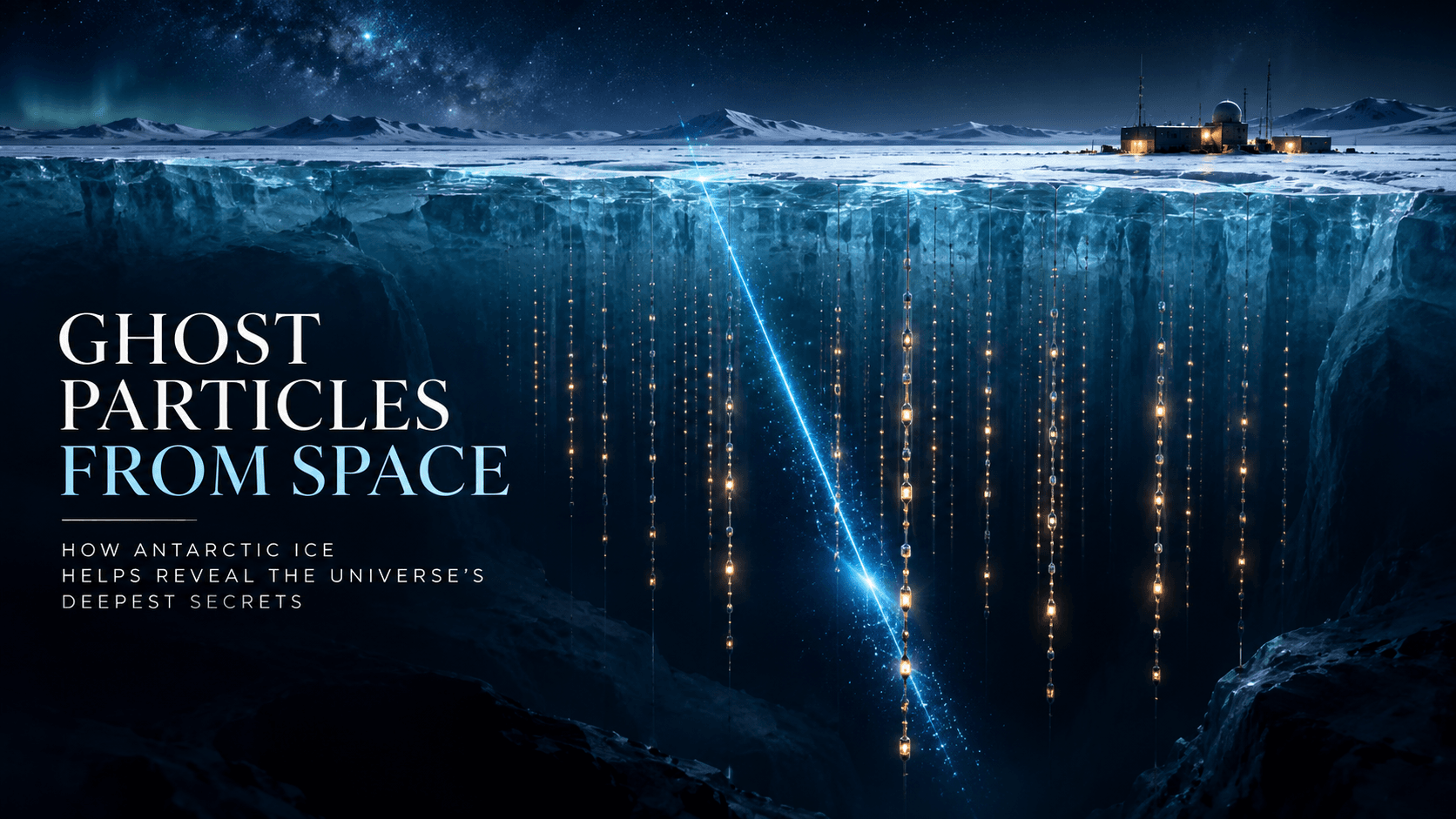
Hold out your hand. This year's physics Nobel, roughly 100 trillion neutrinos from the Sun and from space pass through our bodies every second.
You feel none of it, and neither does the ground beneath you. These particles can cross planets, stars and people without being altered.
That is why a team went to the bottom of the world: neutrinos ignore almost everything, so a cubic kilometre of Antarctic ice had to be built to catch even a few.
The Particle That Ignores Everything
A neutrino is almost massless and electrically neutral. The report calls them the so-called "ghost particles" from space.
Think of a ball thrown through a fog of widely scattered dust motes. Almost every throw passes straight through. Only once in a long while does the ball clip a mote, and that rare clip is the only chance to know it was ever there.
A neutrino detector is built to watch for that clip. The catch is that you need an enormous amount of material for a rare clip to become likely.
Turning Ice Into a Detector
Francis Halzen, a Belgian physicist, first proposed in 1988 that the transparent ice under the South Pole could serve as a detector, Al Jazeera reports. When a neutrino hits an atomic nucleus, it sets off a burst of light, and sensors buried in the ice can register it.
So what is IceCube? It is the result of that idea. The IceCube collaboration describes it as "a cubic-kilometer particle detector made of Antarctic ice."
The numbers are large. The in-ice part of the detector consists of 5,160 digital optical modules, the light sensors, spread along strings that reach from 1,450 to 2,450 metres below the surface. The last of its 86 strings was lowered into the ice, and the project says it was completed in December 2010.
The detector does not see a neutrino itself. The IceCube page explains that neutrinos are not observed directly. When one interacts with the ice, it produces electrically charged secondary particles, and those emit Cherenkov light, a faint glow produced because the particles move through the ice at a speed greater than light's speed in ice.
The IceCube team writes that neutrinos can travel to Earth "with essentially no attenuation." That means they cross vast distances of space with almost no loss, which is what makes them useful as messengers from far away.
The First Messengers From Outside
For a detector built to catch the rare event, the proof of success is a catch. In November 2013 the collaboration reported 28 very high-energy events, found in data collected from May 2010 to May 2012, each above 50 teraelectronvolts.
Halzen called it "the first indication of very high-energy neutrinos coming from outside our solar system." He was blunter in the same release: "This is the dawn of a new age of astronomy."
The 2013 result was a first indication, and the collaboration's spokesperson said the team was still working on "understanding what this signal means and where it comes from." Tracing a neutrino to a source came later.
Following One Neutrino Home
On 22 September 2017, IceCube sent out a neutrino alert. According to Michigan State University, the observatory broadcast the coordinates to telescopes worldwide for follow-up observations.
The trail led to a blazar designated TXS 0506+056, about 4 billion light years from Earth. Michigan State describes a blazar as "a giant elliptical galaxy with a massive, rapidly spinning black hole at its core."
Archival data pointed the same way. Michigan State's release says a later look at archived data turned up a burst of over a dozen astrophysical neutrinos, from late 2014 into early 2015, tied to that same blazar.
Why does that matter? Michigan State's release describes the long-standing puzzle of what creates and launches cosmic rays across such vast distances as an enduring mystery, and a neutrino traced to a single source is a clue to it.
A Picture of Our Own Galaxy
In June 2023 the collaboration produced something that sounds like a trick: an image of the Milky Way made without ordinary light. It was the first neutrino-based image of our galaxy, reports Interesting Engineering.
According to the University of Wisconsin-Madison release, the study drew on 60,000 neutrinos collected over a decade. The galaxy turned out to be quiet: the release puts the Milky Way at between a tenth and a hundredth of the neutrino brightness of the average distant galaxy.
What the image adds is a second, independent view of the same sky, drawn by a different kind of messenger.
The easy way to tell this story is as a triumph of engineering: sensors lowered into a polar ice sheet, a prize at the end. The more interesting reading is about patience. Halzen proposed the idea in 1988, the detector was finished in December 2010, and the first indication of neutrinos from outside the solar system arrived in 2013.
There is a second lesson in what the detector had to do. The new views of the sky came not from staring harder at light but from building something that could catch a particle that ignores almost everything.
Neutrinos have nearly no mass and no charge, which is why almost nothing stops them, and why a cubic kilometre of ice at the bottom of the world had to be built to catch even a few.
Knowlegic Perspective
The easy way to tell this story is as a triumph of engineering: sensors lowered into a polar ice sheet, a prize at the end. The more interesting reading is about patience. Halzen proposed the idea in 1988, the detector was finished in December 2010, and the first indication of neutrinos from outside the solar system arrived in 2013.
There is a second lesson in what the detector had to do. The new views of the sky came not from staring harder at light but from building something that could catch a particle that ignores almost everything.
Neutrinos have nearly no mass and no charge, which is why almost nothing stops them, and why a cubic kilometre of ice at the bottom of the world had to be built to catch even a few.
Sources & References
- Francis Halzen wins Nobel Prize in Physics for work on 'ghost particles', Al Jazeera (2026)
- World's largest neutrino telescope wins its creator the 2026 Nobel Prize in Physics, Interesting Engineering (2026)
- IceCube, IceCube Neutrino Observatory, University of Wisconsin, Madison
- IceCube pushes neutrinos to the forefront of astronomy, IceCube Neutrino Observatory (2013)
- IceCube neutrinos point toward long-sought cosmic ray accelerator, Michigan State University (2018)
- IceCube shows Milky Way galaxy is a neutrino desert, ScienceDaily / University of Wisconsin-Madison (2023)
Enjoyed this?
Get notified when a new Knowlegic story worth knowing is published.


