

Artemis Mission-Why NASA Is Going Back to the Moon and Why It Could Change Humanity Forever
More than 50 years after the last human left the Moon, NASA is preparing to return. But this time, the mission isn't about winning a race, it's about building the future of humanity in space.
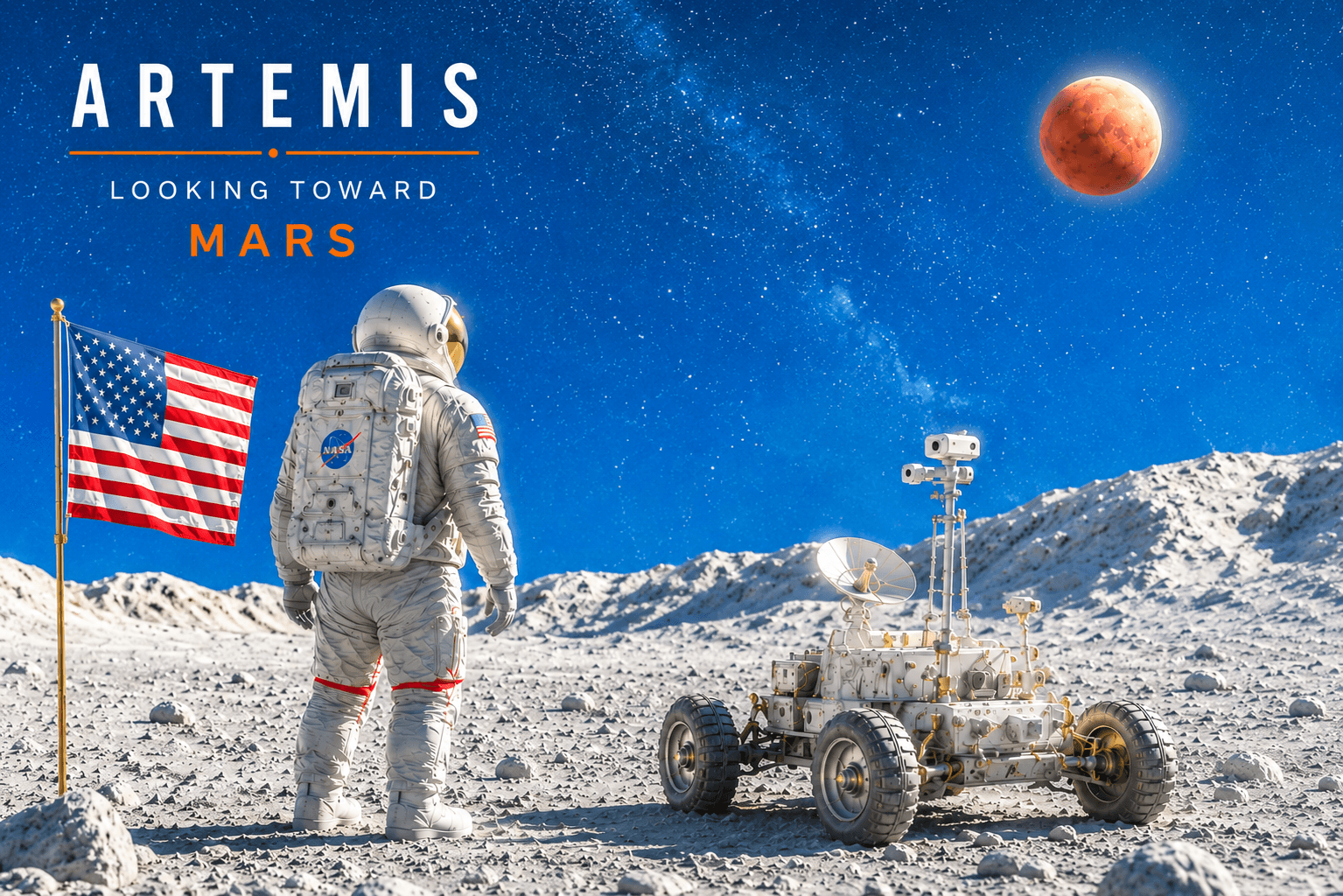
Close your eyes for a moment and imagine standing on the Moon.
There is no wind brushing past your face. No birds singing. No clouds drifting across the sky. Even your own footsteps make no sound.
The only thing stretching endlessly before you is a grey, silent landscape that has remained almost unchanged for billions of years.
Now imagine leaving and not coming back for over half a century.
That is exactly what humanity did.
On 14 December 1972, Apollo 17 astronaut Eugene Cernan stepped back into the lunar module after becoming the last person to walk on the Moon. Before climbing aboard, he looked across the barren surface and said:
"We leave as we came and, God willing, as we shall return."
Those words became one of history's longest unfulfilled promises.
For more than 50 years, no human has set foot on the Moon.
So why, after all this time, is NASA preparing to go back?
The answer has surprisingly little to do with the Moon itself.
The Moon Isn't the Destination Anymore
If someone asked you where humanity should go after mastering space travel, chances are you'd answer Mars. It's the planet that has inspired books, films and decades of scientific ambition. So why spend billions of dollars returning to a place we've already visited?
Think about learning to climb Mount Everest. You wouldn't start by attempting the summit.
You'd first train on smaller mountains, test your equipment, learn how your body reacts and discover problems while help is still relatively close.
That's exactly what the Moon has become. NASA no longer sees it as the finish line. It sees it as the world's most ambitious training ground.
The Artemis program is designed to answer a much bigger question:
Can humans learn to live beyond Earth?
If the answer is yes, then Mars becomes far more realistic.
Meet Artemis- Apollo's New Beginning
If the name sounds familiar, that's no coincidence.
In Greek mythology, Artemis is the twin sister of Apollo.
NASA intentionally chose the name to connect its next chapter of lunar exploration with the missions that first carried humans to the Moon in the late 1960s and early 1970s.
But Artemis has a very different mission. Apollo proved that humans could reach another world. Artemis aims to discover whether humans can stay there.
NASA has also announced that Artemis will land the first woman and the first person of color on the lunar surface, reflecting a broader and more inclusive era of space exploration.
It's a reminder that this journey belongs to all of humanity and not just one generation or one nation.
Why Not Skip Straight to Mars?
At first glance, the Moon might seem like a detour. After all, Mars is where scientists believe humanity may one day establish its first settlement beyond Earth.
But space has a way of turning simple ideas into incredibly difficult engineering problems.
Mars lies, on average, about 225 million kilometers from Earth.
Even with today's technology, astronauts would spend roughly six to nine months travelling there.
If something goes wrong, there is no quick rescue mission. The Moon, by comparison, is only about 384,400 kilometers away.
Astronauts can reach it in approximately three days. That's close enough to test new spacecraft, life-support systems, habitats, power generation, communication networks and even space farming before committing to much longer journeys.
The Moon isn't replacing Mars. It's helping make Mars possible.
There's Something Hidden at the Moon's South Pole
For decades, scientists believed the Moon was almost completely dry. That assumption changed dramatically in the 21st century.
Several missions, including NASA's Lunar Reconnaissance Orbiter and India's Chandrayaan-1, found strong evidence that permanently shadowed craters near the Moon's south pole contain water ice.
At first, that might not sound particularly exciting. Until you realize that water is one of the most valuable resources in space. It can be used for drinking. It can be split into hydrogen and oxygen to produce rocket fuel. It can provide breathable oxygen for astronauts.
Imagine planning a camping trip. Would you rather carry every bottle of water you'll need for weeks, or camp beside a freshwater lake?
That's the difference water ice could make. Instead of transporting every kilogram from Earth—a process that costs thousands of dollars per kilogram—future astronauts may be able to use resources already waiting on the Moon.
Scientists even have a name for this idea: In-Situ Resource Utilization (ISRU).
It's a complicated phrase for a surprisingly simple concept: Use what you find instead of bringing everything with you.
The Most Powerful Rocket NASA Has Ever Built
To make Artemis possible, NASA had to build a new generation of spacecraft. At its center is the Space Launch System (SLS), the most powerful rocket NASA has ever developed.
Standing over 98 meters (322 feet) tall, it generates more thrust than the legendary Saturn V rocket during launch.
Sitting on top is Orion, a spacecraft designed to carry astronauts farther from Earth than any human-rated spacecraft since Apollo.
Unlike the cramped command modules of the 1960s, Orion incorporates modern computing, improved life-support systems and enhanced safety features for deep-space missions.
Together, SLS and Orion represent decades of engineering built upon everything NASA learned from Apollo, the Space Shuttle and the International Space Station.
Artemis I Was More Than a Test Flight
Before astronauts could climb aboard Orion, NASA had to prove the spacecraft could survive the journey. In November 2022, Artemis I launched without a crew. During its 25-day mission, Orion travelled more than 2 million kilometers, flew farther beyond the Moon than any spacecraft designed to carry humans had ever travelled, and safely returned to Earth.
It wasn't simply a rehearsal.
It tested navigation systems, communication, heat shields and deep-space operations under real conditions. Every successful test reduced uncertainty for the astronauts who will eventually follow.
A Space Station Around the Moon
Imagine flying to another country.
Most long-distance journeys involve airports where passengers transfer between flights. NASA is planning something similar, but in space.
Known as Gateway, this small lunar-orbiting space station will act as a staging point for future missions. Astronauts won't necessarily fly directly from Earth to the Moon every time.
Instead, they may travel through Gateway, transfer supplies, conduct scientific experiments and prepare for missions to the lunar surface.
Gateway is also expected to help scientists understand how humans can live in deep space for months at a time—knowledge that will be essential for Mars.
The Moon Is a Tough Place to Live
If you've ever complained about Earth's weather, the Moon offers a useful reminder of how comfortable our planet really is. During the lunar day, temperatures can climb above 120°C.
During the lunar night, they can fall below –170°C.
There is virtually no atmosphere.
No breathable air.
No rain.
No rivers.
No magnetic field to shield astronauts from cosmic radiation.
Even the dust creates problems.
Lunar dust is incredibly fine, sharp and abrasive.
During the Apollo missions, astronauts found that it clung to spacesuits, scratched equipment and even irritated their eyes and lungs after being carried inside the spacecraft.
Living on the Moon isn't simply difficult. It's one of the harshest environments humans have ever attempted to survive.
This Time, the World Is Going Together
One of the biggest differences between Apollo and Artemis isn't technological. It's political.
Apollo was born during the Cold War, when the United States and the Soviet Union competed for dominance in space.
Artemis looks very different.
More than 50 countries have joined the Artemis Accords, a set of principles promoting peaceful exploration, scientific cooperation and responsible behavior in space.
Agencies such as the European Space Agency (ESA), JAXA (Japan) and the Canadian Space Agency (CSA) are contributing major technologies and expertise.
Commercial companies are playing a larger role too.
For example, NASA selected SpaceX's Starship as the first human landing system for Artemis III, while other companies are developing lunar habitats, rovers and cargo systems.
The next chapter of space exploration is no longer a race between nations.
It's becoming one of humanity's largest collaborative engineering projects.
Why Should Any of This Matter to You?
It's a fair question.
After all, most of us will never travel to the Moon.
But history tells an interesting story.
The Apollo program accelerated advances in computing, telecommunications, materials science and medical technologies that eventually found their way into everyday life.
The Artemis program is expected to drive innovations in robotics, autonomous systems, renewable energy, water recycling and advanced manufacturing technologies with applications far beyond space exploration.
Just as importantly, ambitious scientific missions often inspire the next generation of engineers, researchers and entrepreneurs.
Today's child watching an Artemis launch could become tomorrow's scientist solving challenges we haven't even imagined yet.
The Bigger Picture
When people hear about Artemis, it's easy to focus on rockets, astronauts and moon landings.
But the program represents something much larger.
For thousands of years, humans have explored new continents, crossed vast oceans and built civilizations by venturing into the unknown.
Space may be the next chapter in that story.
No one knows whether humans will eventually establish permanent communities on the Moon or Mars. But every long journey begins with a first step.
Artemis isn't just about returning to a place we've already visited.
It's about discovering whether humanity is ready for the places we've never reached.
One Small Step- Again
More than fifty years ago, Apollo astronauts left footprints on the Moon.
Those footprints are still there today because there is no wind to erase them.
Soon, new footprints may join them.
Not as symbols of a race won.
Not as proof that reaching the Moon is possible.
But as the beginning of something entirely different.
The Artemis program asks a bold question: What if the Moon isn't the end of our journey, but the place where humanity finally learns how to leave home?
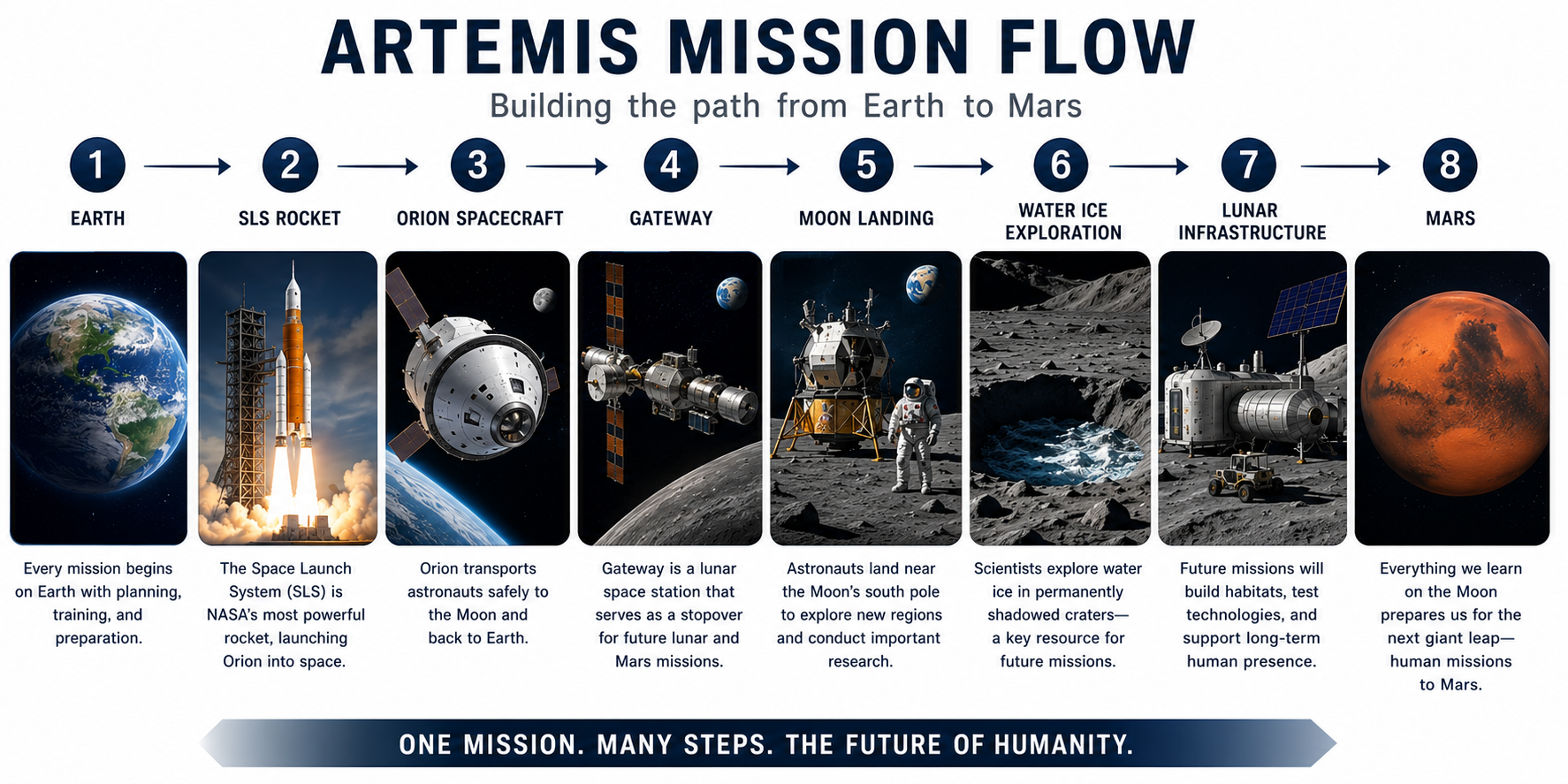 If Apollo taught us that we could reach another world, Artemis may teach us how to make the universe feel a little less distant.
And perhaps, decades from now, future generations will look back on these missions not as a return to the Moon—but as the moment humanity truly became a spacefaring civilization.
Enjoyed this?
Get notified when a new Knowlegic story worth knowing is published.


