

Who's in Charge Once You Leave Earth?
No single authority governs outer space anymore. Here's who actually makes the rules once you're off the planet, and why that's becoming a problem.
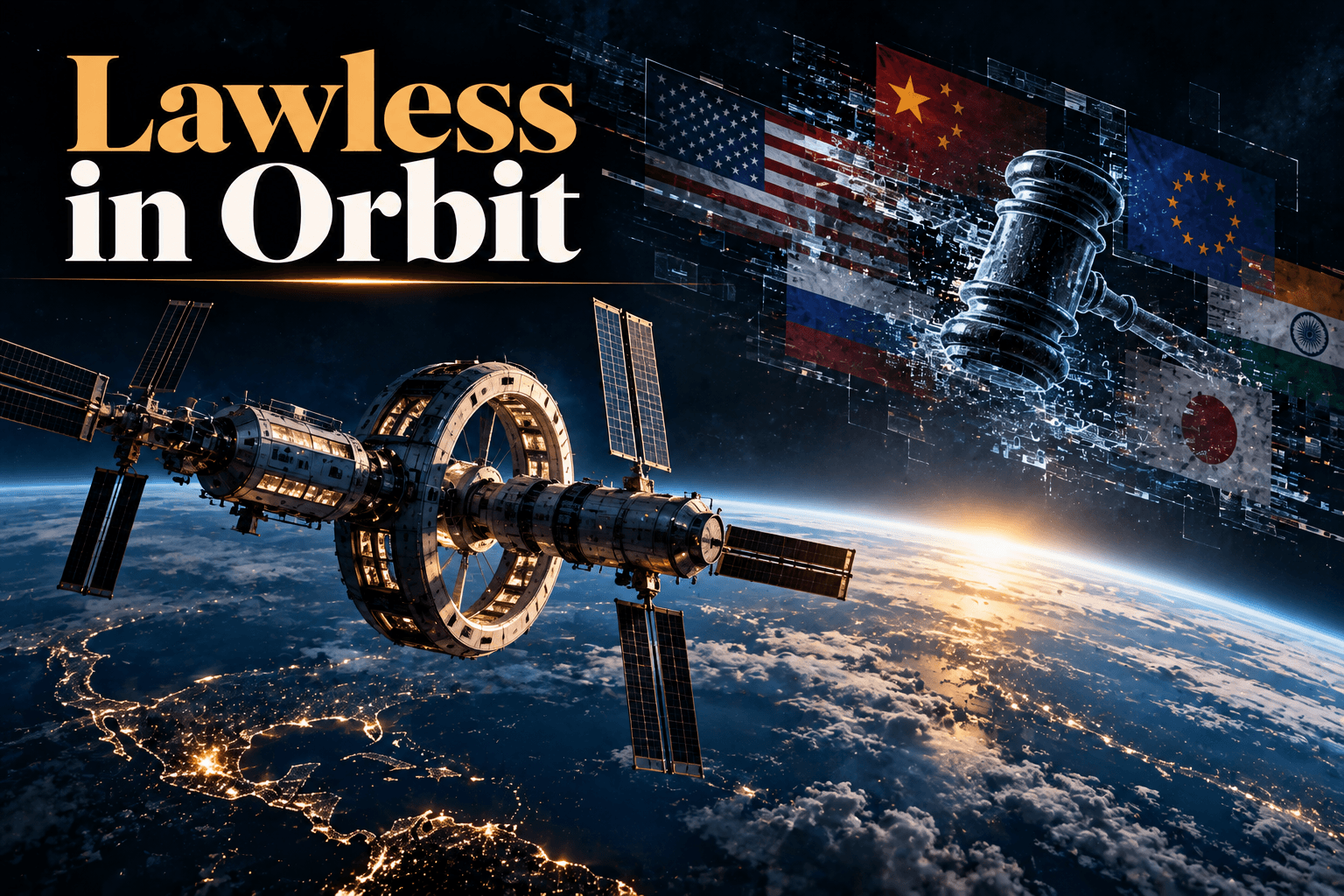
Picture a private space station a few years from now. The crew didn't fly up on a government mission. One works for an American company, one for a tourism outfit, one is a paying guest who wrote a very large check. Then something goes wrong: an injury, a theft, a death. Someone asks the obvious question, and there's a long pause before anyone answers.
We tend to assume this was solved decades ago, the way a ship's flag decides whose courts handle a dispute at sea. Space has a version of that idea too, but it was built for a world where only governments could get there, and it's already straining under traffic it was never designed for.
Space never built its own government. It inherited whichever country wrote the loosest rules first, and that is now quietly deciding who answers for what happens off the planet.
A Treaty Built for a World With Only a Few Players
In 1967, reaching orbit required the budget of a superpower. So when countries agreed the Outer Space Treaty at the United Nations that year, they said very little about private companies. They simply made each government responsible for anything launched under its flag.
The rule is almost identical to the one governing ships at sea: a spacecraft, and everyone inside it, stays under the authority of whichever country it's registered to, no matter where it travels. Jurisdiction follows the flag, not the location. For most of the Space Age, that was enough, because almost everything in orbit was a government mission anyway.
Did You Know?
The treaty calls astronauts "envoys of mankind." It requires every signing country to help astronauts in distress, whatever their nationality, so the rule that settles who's in charge also asks governments to look after each other's crews.
When the Astronauts Don't Work for a Government Anymore
That flag-based rule wobbles the moment the people in orbit aren't there on a government's behalf. Private space stations are no longer hypothetical: companies are building modules meant to operate independently once the International Space Station retires, and tourism flights already carry passengers on no government mission at all.
Legal scholars keep landing on the same point: the treaty only touches private operators in passing, by making their home government answerable for them. It doesn't say how. Nobody has had to test whether a country can force a commercial station to investigate a crime once it's a business, not a government partnership, running the show.
It's a strange echo of a question Knowlegic has looked at from another angle: when you ask whether the first human born on Mars would ever consider Earth home, you hit the same unresolved blank. Nobody has decided which country's law, if any, that child would be born under.
The Race to Write the Loosest Rules
Because the treaty leaves the details to each government, a handful of countries have started competing to look like the most welcoming place to register a space company. Luxembourg led the way in 2017, passing a law that lets companies based there own whatever resources they extract from an asteroid or the Moon. The United Arab Emirates followed with its own space laws, widely read as a bid to draw private investment. It's the same instinct that led Dubai to eliminate income tax and court global business; orbit is just the newest asset class getting the treatment.
The same split shows up on the Moon itself. The US built the Artemis Accords, signed by more than 60 countries, which lets a company fence off a lunar "safety zone." Russia and China refused to sign, arguing that amounts to a disguised land claim, something the original treaty bans, and are building a rival framework around their own lunar station program. Two rulebooks, one Moon, and no referee standing above either one.
Fly at Your Own Risk, For Now
Even today's paying space tourists get thinner protection than they'd guess. US law has long barred air safety regulators from writing binding safety rules for commercial spaceflight, a deliberate "learning period" meant to let the industry mature first; it's been extended repeatedly since 2004 and is due to run to 2028. In its place, passengers largely rely on informed consent and insurance. For the person strapped into the seat, the honest answer to who's in charge is: a contract they signed, and a policy they'll likely never read.
Knowlegic Perspective
None of this is really a story about rockets. It's the older story of what happens when capability outruns law: whoever moves first gets to write the rules everyone else lives inside of, at least until something forces a renegotiation.
The 1967 treaty assumed space would stay slow and government-controlled for a long time. That assumption broke faster than its drafters could have guessed, and the law never got a formal update to match. What's filled the vacuum isn't a single global authority, but something closer to a bidding war: countries competing to offer the most permissive paperwork, companies picking whichever flag lets them move fastest, and insurance policies quietly doing the work regulation used to do.
Space never built its own government. It inherited whichever country wrote the loosest rules first, and for now, that's as close to an answer as "who's in charge" gets.
Sources & References
- Treaty on Principles Governing the Activities of States in the Exploration and Use of Outer Space (full text), United Nations Treaty Collection (1967)
- Artemis Accords, NASA (2026)
- Law of July 20th 2017 on the Exploration and Use of Space Resources, Luxembourg Space Agency (2017)
- Regulation of Commercial Human Spaceflight Safety: Overview and Issues for Congress, Congressional Research Service (2025)
- Keeping Pace With Crimes in Space / jurisdiction aboard the ISS, Congressional Research Service (2022)
Enjoyed this?
Get notified when a new Knowlegic story worth knowing is published.


