

How Far Apart Are the Planets, Really?
The solar system looks compact in every diagram. In reality, the planets are separated by distances so enormous that even our best spacecraft are still barely out the front door.
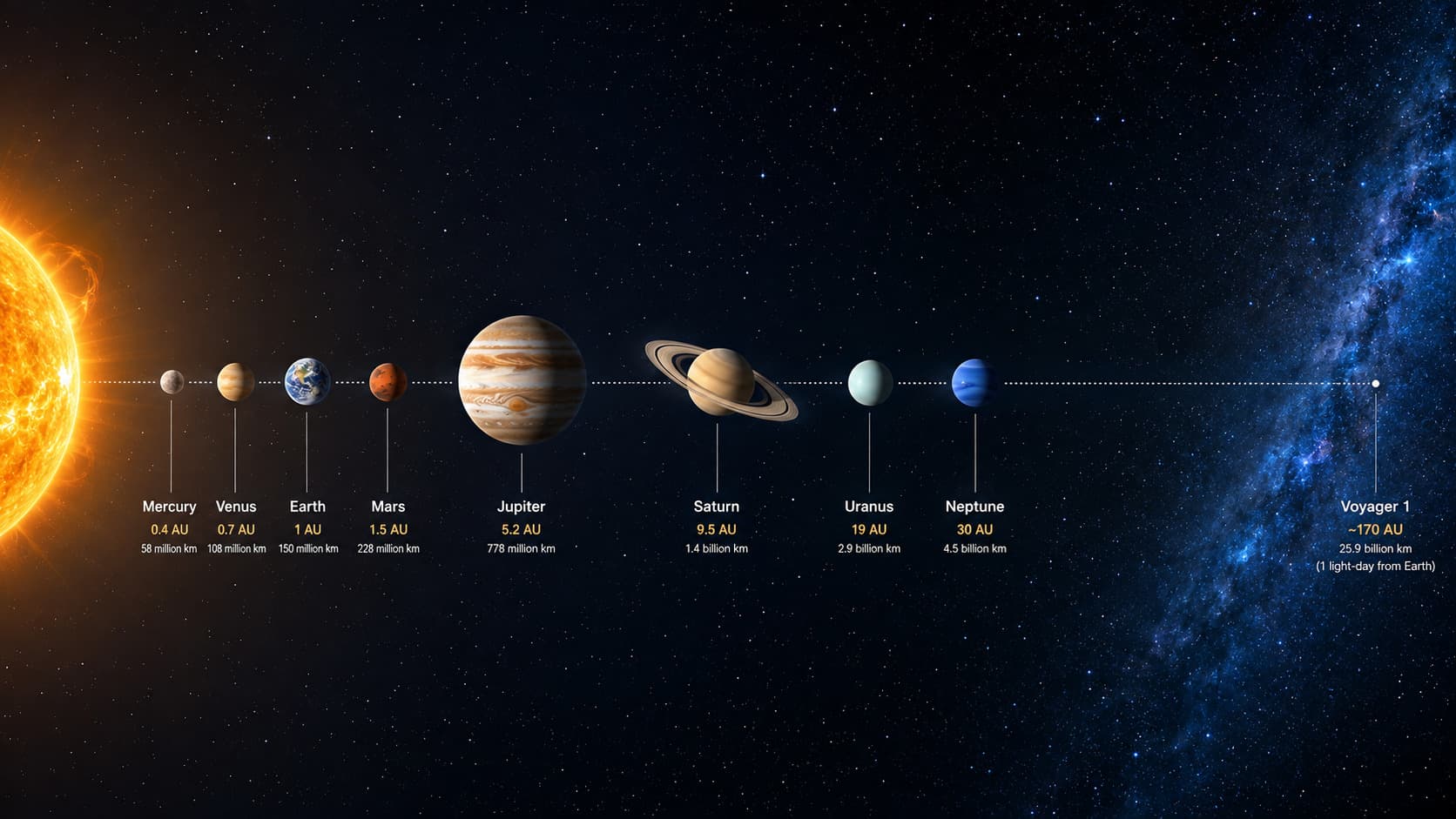
On November 18, 2026, NASA's Voyager 1 is expected to become the first human-made object to reach a full light-day from Earth about 25.9 billion kilometers away.
That sounds impossibly distant.
But here's the strange part: even then, Voyager 1 will be only about 170 times farther from the Sun than Earth is.
That's because our mental picture of the solar system is badly distorted.
Almost every classroom poster shows the planets neatly lined up, just a few centimeters apart. The real solar system looks nothing like that.
The planets aren't packed together. They're separated by enormous volumes of empty space.
And once you see the actual scale, even familiar distances start to feel extraordinary.
No Poster Has Ever Shown the Solar System Honestly
Look at almost any solar system diagram.
Mercury, Venus, Earth, Mars, Jupiter, Saturn, Uranus and Neptune appear comfortably spaced across a page.
It's useful for learning their order.
It's terrible for understanding distance.
If you tried to draw the solar system at true relative distances while keeping Earth visible, Neptune would quickly disappear off the page.
So let's shrink the Sun instead.
Imagine the Sun as a 60-centimeter beach ball.
On that scale:
- Earth would be a tiny peppercorn about 64 meters away roughly the length of a soccer pitch.
- Jupiter would be about 330 meters away.
- Neptune would be nearly 2 kilometers away.
- Voyager 1 would be a tiny speck roughly 11 kilometers away, and still moving outward.
Suddenly, the solar system looks less like a collection of neighboring planets and more like what it really is:
Mostly empty space, with occasional worlds scattered through it.
And this isn't merely a thought experiment.
In 2001, the Smithsonian Institution, NASA and the Challenger Center created a walkable scale model of the solar system along Washington, D.C.'s National Mall.
The lesson was simple:
Numbers tell you how far something is. Scale helps you feel it.
The Distance Between Planets are Always Changing
There's another problem with asking how far apart planets are.
There isn't always one answer.
Earth and Mars, for example, don't maintain a fixed distance. As both planets travel around the Sun, their separation can range from roughly 56 million to 400 million kilometers.
At their closest recorded approach, on August 27, 2003, Mars and Earth came within about 55.8 million kilometers of each other.
That helps explain why Mars missions aren't launched whenever engineers feel like it.
Mission planners take advantage of recurring orbital windows, when the geometry between Earth and Mars makes the journey more efficient.
So when we talk about planetary distance, we're really talking about a constantly moving relationship.
Astronomers Use a Different Ruler
Kilometers become awkward very quickly when you're measuring the solar system.
So astronomers use the astronomical unit, or AU.
One AU is Earth's average distance from the Sun: about 150 million kilometers.
Using AU gives us a much clearer picture of the solar system:
 Look at what happens after Mars.
Jupiter is already 5.2 AU from the Sun.
Neptune is around 30 AU away.
Sunlight takes more than four hours to reach Neptune.
The outer solar system isn't simply farther away.
It's operating on an entirely different scale.
Wait-Mercury Is Earth's Closest Neighbor?
Here's where things get surprisingly counterintuitive.
Ask someone which planet is closest to Earth, and the likely answer is Venus.
At its closest approach, Venus can indeed come within roughly 38 million kilometers of Earth.
But there's a difference between asking:
Which planet can come closest to Earth?
and:
Which planet is closest to Earth on average?
Those aren't the same question.
A 2019 analysis tracked planetary positions continuously across a 10,000-year simulation.
The result?
Mercury not Venus is Earth's closest planetary neighbor on average.
Mercury's average distance from Earth worked out to about 1.04 AU, compared with roughly 1.14 AU for Venus.
Why?
Because Venus may come extremely close to Earth, but it also spends long periods on the opposite side of the Sun.
Mercury stays much closer to the Sun, orbiting at roughly 0.4 AU.
That means it never gets quite as far away from Earth or, remarkably, from the other planets as you might expect.
Run the planetary dance over thousands of years, and Mercury emerges as the statistically closest planetary neighbor to all seven other planets.
Did You Know?
Sunlight takes about 4 hours and 10 minutes to reach Neptune.
For Voyager 1, the communication delay is even more striking.
A signal sent from Earth can take roughly 23 hours to reach the spacecraft.
By the time NASA receives a response, nearly another day has passed.
And Voyager 1 is still moving outward.
When it reaches the one-light-day mark in November 2026, it will be around 170 AU from the Sun—more than four times Neptune's average distance.
Yet even that isn't the edge of the solar system.
The Oort Cloud may begin somewhere around 2,000 to 5,000 AU from the Sun and potentially extend to around 100,000 AU.
Voyager 1 could take roughly 30,000 years to cross the outer region.
So the eight planets are not the whole neighborhood.
They're closer to the inner district.
Knowlegic Perspective
Distance is one of those things we think we understand because we experience it constantly.
A kilometer feels familiar.
A thousand kilometers feels far.
A million kilometers becomes difficult to picture.
A billion kilometers becomes almost meaningless to our intuition.
That's why the solar system is such a powerful lesson in scientific thinking.
We can calculate planetary positions with extraordinary precision. NASA can predict when Voyager 1 will cross a particular distance.
But precision isn't the same as intuition.
Sometimes you need a beach ball, a peppercorn and a two-kilometer walk before your brain can begin to understand what the numbers actually mean.
The planets aren't arranged like a neat row on a classroom poster.
They're moving continuously through an enormous volume of space, separated by distances that are difficult for the human mind to visualize.
And perhaps that's the most surprising fact about our solar system:
Space isn't empty because there's nothing in it.
It's empty because everything in it is unimaginably far apart.
Enjoyed this?
Get notified when a new Knowlegic story worth knowing is published.


