

Will the First Human Born on Mars Consider Earth Home?
A child born on Mars would be the first human to grow up under a different gravity, sky, and environment. But the more interesting question may be: where would they actually feel they belong?
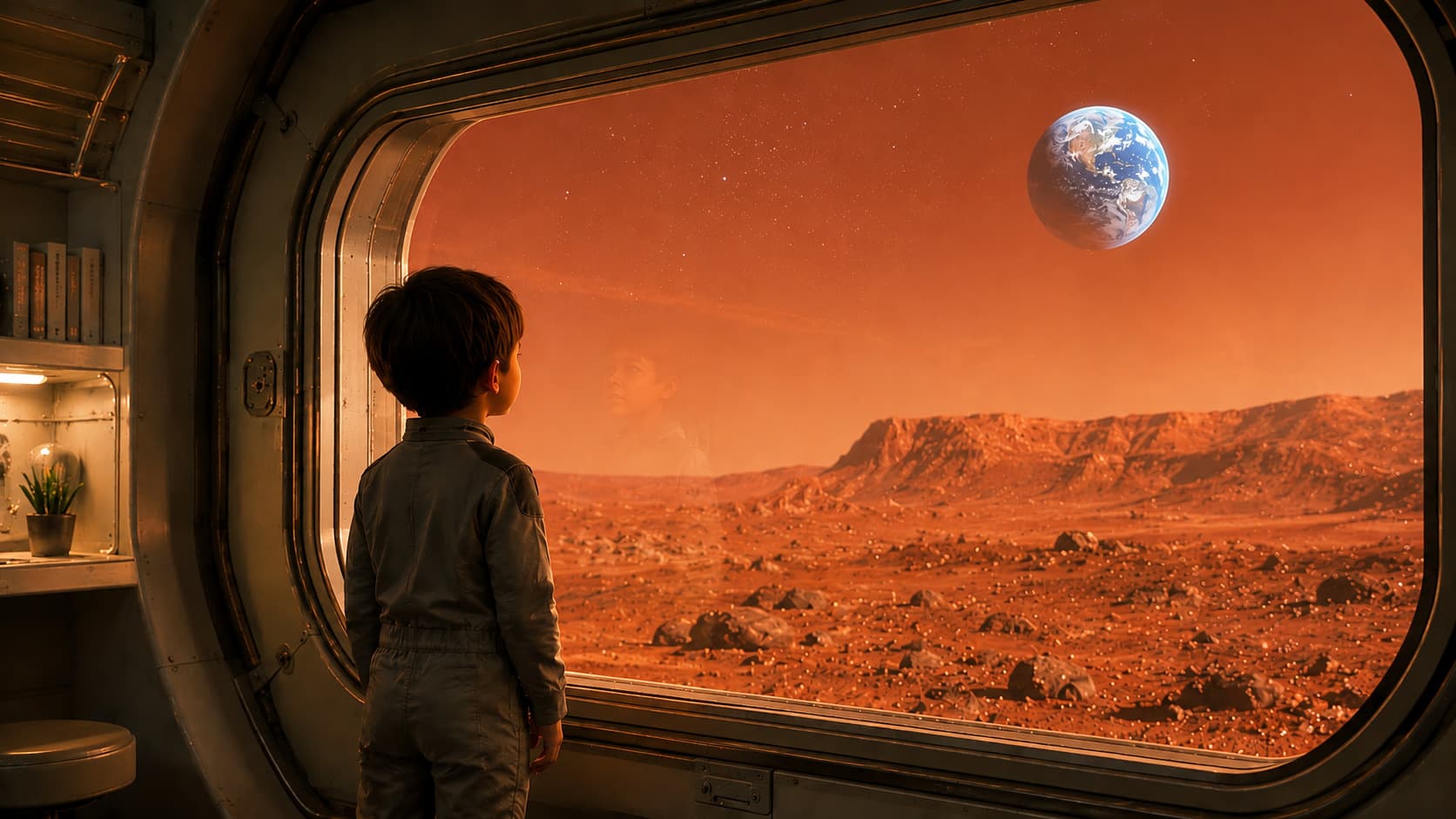
Nobody has ever been conceived, carried through pregnancy, or born anywhere except Earth.
That makes the idea of a first human born on Mars almost entirely speculative.
But the question it raises is surprisingly grounded in research.
Would someone born on Mars consider Earth their home?
The answer may depend on more than where they were born. Their body would develop under Martian gravity. Their childhood would unfold inside a radically different environment. And their cultural identity might be shaped by people who have never experienced Earth in the way their parents did.
We don't have a Mars-born person to study.
But decades of research on children raised between cultures on Earth offer an intriguing clue:
Home may be less about geography than about belonging.
Nobody Has Actually Done This
Let's start with the obvious problem.
There is no Mars-born human.
And we're probably much farther from that milestone than science fiction timelines suggest.
Researchers examining the technical, biological, and legal challenges of establishing a permanent human settlement on Mars have argued that realistic space settlement could be centuries away rather than decades away.
The biology alone explains why.
Mars has significantly higher radiation exposure than Earth. Researchers studying the possibility of human reproduction during a Mars mission have raised concerns about reproductive health, including potential effects on ovarian reserve.
Then there's gravity.
Mars has only about 38% of Earth's gravity.
We have no human data showing what that environment would do to a developing fetus over an entire pregnancy, let alone what it would mean for a person who spent their entire childhood there.
A Body That Never Knew Earth's Gravity
Astronauts who spend months in microgravity return to Earth with weakened bones and muscles and need time to recover.
But imagine something fundamentally different.
A child born and raised on Mars wouldn't be recovering from Earth's gravity.
Their body would develop for Mars from the beginning.
Their bones, muscles, and cardiovascular system would grow under a gravitational pull less than half as strong as Earth's.
We don't yet know exactly what that would mean for a Mars-born adult.
But one thing is clear: returning to Earth wouldn't simply be a matter of stepping off a spacecraft and walking around.
Earth's gravity is more than two and a half times stronger than Mars's.
For someone whose body had developed entirely in 0.38g, Earth could feel physically overwhelming.
In other words, Mars wouldn't just be the place they lived.
It could become the environment their body was built around.
Did You Know?
Researchers only recently developed reliable ways to study the effects of partial gravity on living organisms.
Experiments involving mice and rats have helped scientists investigate what happens when organisms experience something between Earth's gravity and weightlessness.
That's important because Mars is neither Earth nor zero gravity.
It's a completely different biological environment.
Then There's the Legal Problem
Even before asking where a Mars-born child would feel at home, there's a more basic question:
What country would they belong to?
The international treaty governing activities in space, the Outer Space Treaty of 1967-establishes that nations cannot claim sovereignty over Mars or other celestial bodies.
But it doesn't clearly explain what happens when a human being is actually born there.
International law has mechanisms for births aboard ships and aircraft, where nationality can be connected to a vessel or its registration.
But a permanent settlement on another planet doesn't fit neatly into those existing categories.
A Mars-born child could therefore arrive into the world with something surprisingly basic still unresolved:
What does their citizenship actually mean?
We've Already Seen a Version of This on Earth
This is where the question gets much more interesting.
Psychologists and sociologists have spent decades studying third culture kids, children who grow up in cultures different from those of their parents.
They include children of diplomats, missionaries, military families, and international workers who spend significant parts of childhood moving between countries.
And researchers have noticed something fascinating.
These children may not feel completely at home in their parents' country because they didn't grow up there.
But they may not feel completely at home in the country where they were raised either, because they don't share its cultural history.
So where is home?
Often, it becomes something less geographical.
Relationships become more important.
Third culture kids can develop a strong sense of belonging with people who share their unusual experience of moving between cultures and never fitting entirely into one place.
Home becomes something they carry with them.
But Mars Changes Everything
It would be tempting to call a Mars-born child a kind of extreme third culture kid.
But that comparison has a major limitation.
A child raised in another country on Earth is still biologically adapted to Earth.
Their body doesn't care whether they grew up in Mumbai, London, Tokyo, or Buenos Aires.
A Mars-born human would be different.
Their body itself would have developed in another gravitational environment.
Their relationship with Earth's atmosphere, gravity, landscape, and perhaps even movement would be fundamentally different.
That means their displacement wouldn't just be cultural.
It could also be biological.
And that's something psychology has never had a real human subject to study.
Visual Thinking: Two Kinds of Displacement
Imagine two children.
One grows up between several countries on Earth.
The other grows up on Mars.
The first may struggle with questions such as:
Where is my culture?
Which place is really home?
The second might eventually face those questions too, but with another layer:
Which planet is home?
For a Mars-born generation, Earth might become the ancestral homeland described in stories, photographs, videos, and family memories.
Mars, meanwhile, would be the place where they learned to walk.
Where they made friends.
Where they went to school.
Where they experienced their first sunrise.
Where their memories began.
That could make the emotional meaning of "home" surprisingly complicated.
Knowlegic Perspective
The honest answer is that we don't know whether a Mars-born human would consider Earth home.
There is no evidence yet because the situation doesn't exist.
But research on identity and displacement gives us an important clue.
For people who grow up between worlds, home often becomes less about a particular location and more about the people who understand their experience of belonging.
That could be even more powerful on Mars.
A Mars-born child might not think of Earth as "home" simply because their ancestors came from there.
They might think of Earth as somewhere their family came from.
Mars could be home because that's where their life began.
And perhaps their strongest sense of belonging would come from the people who grew up there alongside them.
So, Would Earth Feel Like Home?
Maybe.
But perhaps not in the way we imagine.
To an Earth-born person, Mars is another planet.
To a Mars-born person, Mars could simply be home.
Earth might instead become something closer to an ancestral homeland—a place they know intimately through stories but have never personally experienced.
And if they eventually visit Earth, they might discover something even stranger:
The planet humanity evolved on could feel unfamiliar.
Its gravity could feel heavy.
Its atmosphere could feel different.
Its landscapes could seem enormous and strange.
The planet we call home might feel, to them, like somewhere else.
A child born on Mars might never call Earth home.
Not because Earth wouldn't matter.
But because home may never have been about the planet to begin with.
The strongest evidence for that doesn't come from Mars.
It comes from decades of research on people who grew up between cultures here on Earth.
They show us that belonging can be built through relationships, shared experiences, and a community that understands where you come from—even when no single place completely does.
So perhaps the first generation born on Mars won't have to choose between Earth and Mars.
They may create a new definition of home altogether.
Not where humanity began.
Not even where they were born.
But where they found their people.
Enjoyed this?
Get notified when a new Knowlegic story worth knowing is published.


