

China Has a Word for Working Yourself to a Standstill-Involution
In 2025, China's top economic planners did something unusual: they told companies to stop competing so hard. The word for the problem they were trying to fix has been circulating among exhausted students and workers for years.
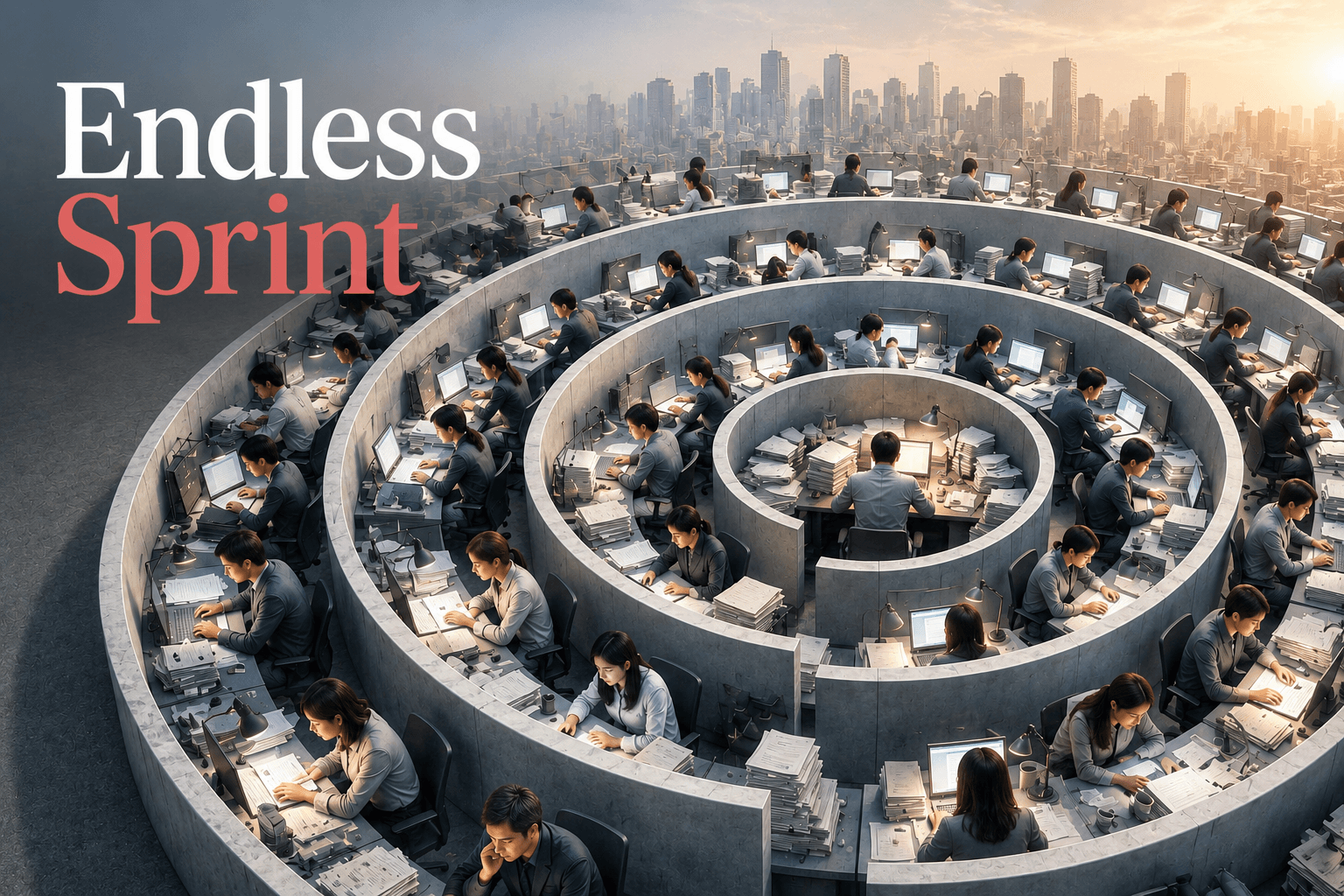
In July 2025, China's most powerful economic body sat down for a meeting with an unusual agenda item: convincing the country's companies to stop competing so aggressively.
That's not typically the kind of thing a government has to ask for. Competition is supposed to be self-correcting companies that cut prices too far go out of business, and the survivors settle into a sustainable market. But that isn't what was happening. Automakers, solar panel manufacturers, and steel producers were locked into price wars so relentless that almost nobody involved was actually winning, and profit margins across entire industries were quietly collapsing.
There's a word Chinese students, workers, and now economists use for this exact pattern, effort escalating endlessly while the payoff stays flat, or shrinks. It's called involution, and once you understand what it actually means, it's hard to unsee it.
A Word Borrowed From Anthropology, Repurposed by Exhausted Twenty-Somethings
Involution- nèijuǎn in Mandarin, literally something close to "inward rolling", didn't start as slang. The English term first appeared with roughly this meaning in a 1963 study by American anthropologist Clifford Geertz, describing agricultural societies where each generation crammed more labor into the same fixed plot of land without ever actually increasing what it produced. Economic historian Philip Huang later used it to explain why capitalism never fully took root in parts of China's agrarian economy for similar reasons.
Around 2020, the term jumped from academic papers into everyday Chinese internet slang, and the meaning sharpened into something more personal: pouring in more hours, more money, more effort, into a competition where the total prize never grows, so all that extra effort does is raise the bar for everyone else competing for the same fixed reward.
Did You Know?
The word's path is almost as strange as its meaning: it began as a term for 20th-century Indonesian rice farming under Dutch colonial rule, got picked up by scholars studying Chinese peasant agriculture decades later, and only became a mass-market word for burnout after Chinese students and office workers started using it to describe their own lives on social media.
The Exam That Made the Pattern Visible
China's national college entrance exam, the gaokao, is where most people encounter involution first, even if they don't use the word for it. Elite universities admit a fixed number of students each year. If every student studies a little harder, nobody's odds actually improve , the ranking just shifts, and the bar for "competitive" rises for everyone at once.
A widely cited 2023 survey attributed to Peking University found that 68% of urban Chinese youth aged 18 to 35 said they felt trapped in competitive cycles they couldn't escape chasing top exam scores, elite jobs, or simply keeping pace with peers online; that figure has been repeated across multiple outlets covering China's youth-pressure crisis without an independently published version of the underlying survey, so it's worth treating as a widely reported estimate rather than a precisely verified one. Parents have responded by pushing tutoring earlier and earlier, and students preparing for major exams increasingly describe study days stretching well past what was typical a decade ago. Nobody in that system is choosing to work less, because doing so only means falling further behind everyone else who isn't.
Nine to Nine, Six Days a Week
The same mechanism shows up in the workplace, most visibly in what became known as "996"- a work schedule running 9 a.m. to 9 p.m., six days a week, that spread across China's tech and startup sectors as an unofficial badge of commitment. China's Supreme People's Court and its labor ministry jointly ruled in August 2021 that the practice violates the country's labor law, but the underlying pressure that produced it, that visibly outworking your colleagues is often the only lever available for standing out has proven much harder to legislate away.
The frustrating part is that working longer hours doesn't reliably translate into producing more. It's the same gap that shows up whenever longer hours crowd out the kind of focused, uninterrupted work that actually moves a project forward , except at national scale, and with an entire generation absorbing the cost.
When an Entire Industry Starts Cannibalizing Itself
Involution isn't only a story about individual exhaustion, it became a major corporate problem, too. In 2024, 227 car models in China had their prices cut, more than the 148 the year before and nearly two and a half times 2022's total, according to China Passenger Car Association data. The average cut was around 8.3%. By 2023, the average profit margin across China's entire auto industry had slid to about 5%, its lowest point in at least a decade, per the China Association of Automobile Manufacturers.
Nobody forced any single automaker to cut prices that far. Each one did it because a competitor already had, and standing still meant losing market share the exact same zero-sum math as the gaokao, just with cars and factories instead of exam scores.
The Government Steps In
That's the backdrop for the July 2025 meeting Xi Jinping chaired, where China's Central Financial and Economic Affairs Commission explicitly called for cracking down on "disorderly low-price competition", official language for involution's business-world cousin. Beijing has since rolled out more than 50 measures across industries including EVs, solar panels, steel, and cement, and has floated updating a decades-old pricing law to formally restrict price wars.
The stakes go beyond any one industry. Persistent, involution-driven price-cutting has become one contributor to a broader deflation risk in China's economy when companies across an entire sector are simultaneously cutting margins toward the bone just to stay competitive, that pressure shows up in falling prices economy-wide, not just in the sector where it started.
Interesting Fact: Involution has a well-known cultural opposite: "lying flat," or tangping- a term that spread across Chinese social media starting in 2021, describing a deliberate choice to opt out of the competition entirely rather than keep running in place. It's less a solution to involution than a quiet refusal to keep playing a game its participants increasingly suspect nobody can actually win.
Knowlegic Perspective
What makes involution worth understanding isn't that it's uniquely Chinese, it's that it names something most competitive systems eventually run into and rarely have a word for. Any contest with a fixed prize and an unlimited number of people willing to try harder for it will eventually reach a point where more effort stops producing more winners and starts just raising the cost of staying in the game. China's experience is unusually visible because the pattern showed up in exam halls, tech offices, and car factories all within the same few years, forcing even the government to name it and respond.
Most places experiencing something similar don't have that word yet, which doesn't mean they aren't already living inside it.
Sources & References
• Feeling burned out? 'Involution' is the word for that — NPR (2025)
• "996" is Ruled Illegal: Understanding China's Changing Labor System — China Briefing (2021)
• China's discount war rolls on after 227 EV models slashed prices in 2024 — South China Morning Post (2025)
• China's Deflationary Spiral Hurts Economy Harder Than Official Numbers Suggest — Bloomberg (2025)
• 'Lying Flat' Is the New Resistance Movement to Materialism — Caixin Global (2021)
Enjoyed this?
Get notified when a new Knowlegic story worth knowing is published.


