

Why Mars Has Two Faces, and the Buried Heat That May Explain It
Mars's southern half stands higher, older, and more battered than its north. A 2026 study reading the planet's gravity found the rock beneath the south is hundreds of degrees hotter, and still partly molten.
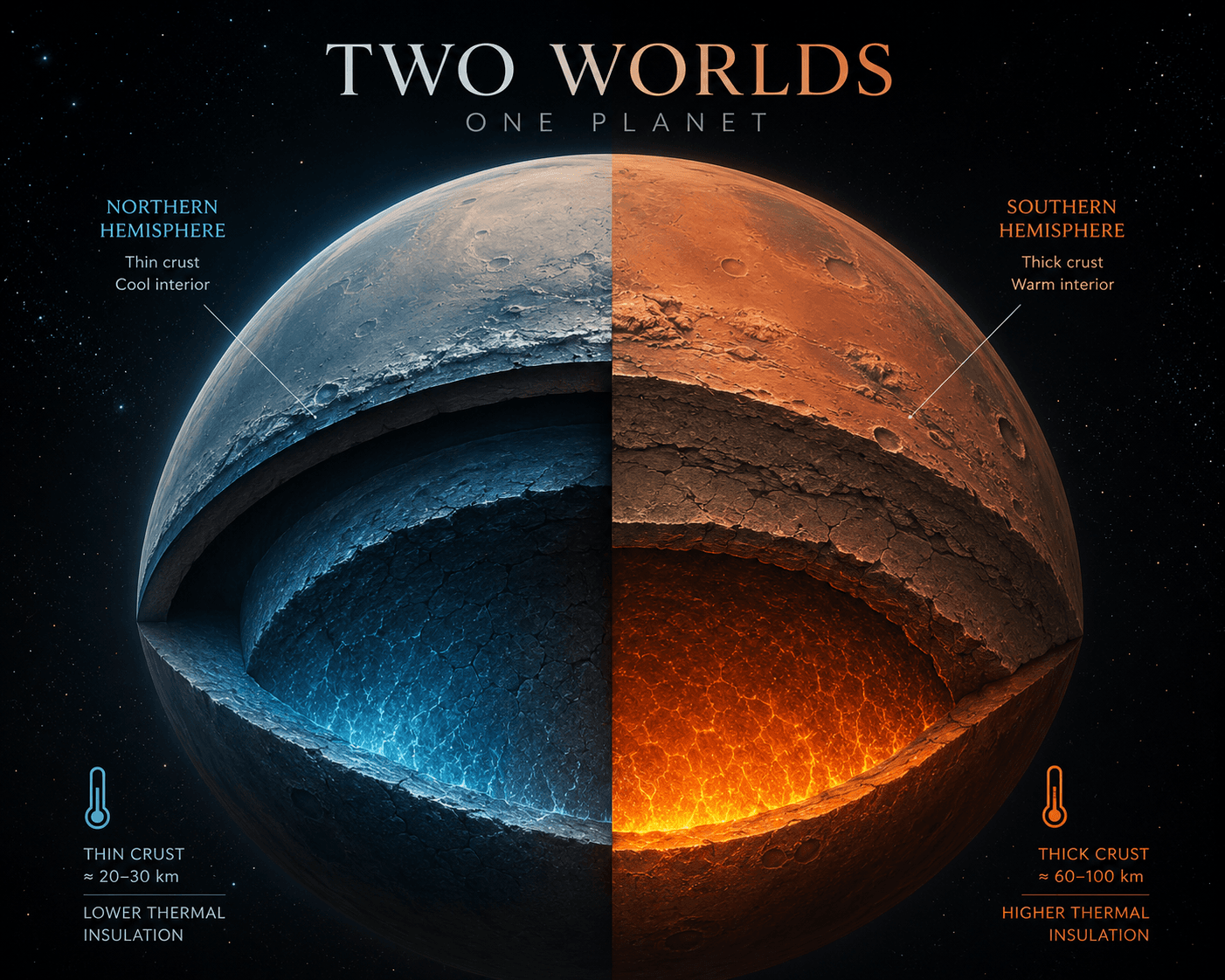
Picture standing on the border. Behind you, to the north, the ground runs flat and smooth for thousands of kilometers, the kind of terrain you could land a plane on. Ahead, to the south, it climbs into rough highlands several kilometers higher, ground so old and so pounded by craters that little on Earth comes close to its age.
The two halves are so different they look like pieces of two separate planets welded together. Roughly a third of Mars is that low northern plain. The other two thirds is the cratered south, sitting on crust nearly twice as thick. For four decades the explanations have split into two camps: a colossal early impact scooped out the north, or something slow and deep inside Mars piled extra material under one side.
In August 2026, a team reading the tiny flex in Mars's gravity found the boundary is not skin deep. The rock beneath the southern highlands is hundreds of degrees hotter than the rock beneath the north, and still partly molten today. Mars's two faces go all the way down.
The Line That Splits the Planet in Half
Planetary scientists call it the Martian dichotomy, and it is one of the oldest unsolved puzzles about our neighbor. The northern lowlands are flat, smooth, and relatively young looking, with few large craters. The southern highlands stand about five kilometers higher on average, carry roughly twice the crustal thickness, and are saturated with impact scars dating back to the solar system's violent youth.
It is as if one hemisphere of a baseball were smooth leather and the other were rough concrete. Any complete story of Mars has to explain how a single planet ended up built so unevenly, and that story connects to almost everything else about the place, including how far apart the planets really are and why Mars, closer to the Sun's warmth than the gas giants, still froze into the dry world we see now.
Two ideas have competed for years. One says a giant object struck the northern hemisphere early on, blasting out a basin so large it covers a third of the planet. The other says the split came from within, as sluggish currents in Mars's mantle carried heat and material toward one side over hundreds of millions of years. Neither has been able to close the case.
Reading a Planet by Its Wobble
You can learn a lot about a sealed box without opening it, just by pressing on it. A box packed with dense wood barely gives. A box of warm clay dents under your thumb. How much something yields to a push tells you what it is made of and how warm it is.
Mars gets pushed the same way, by the Sun. Its orbit is an oval and its axis is tilted, so the Sun's gravitational pull on the planet strengthens and weakens over the Martian year of 687 days. That changing pull raises tides in the solid body of Mars, squeezing and relaxing the whole planet by a small amount on a yearly cycle. How much Mars flexes depends on how stiff its insides are, and warm rock flexes more than cold rock.
To measure that flex, a team led by Alexander Berne, then a graduate student at Caltech and now at the University of Arizona, turned to three NASA spacecraft already circling Mars: Mars Global Surveyor, Mars Odyssey, and Mars Reconnaissance Orbiter. Across about sixteen years, tiny changes in each probe's speed, some no larger than a fraction of a millimeter per second, revealed how Mars's gravity field shifts shape through its year. The technique is called tidal tomography, and the results were published in the journal Nature. "If Mars has a weird structure in the mantle, this signal will be different" than it would be for an evenly built planet, Berne explained.
Did You Know?
Mars has no global magnetic field today, but long stretches of its southern crust are strongly magnetized, frozen records of a magnetic dynamo that shut down roughly four billion years ago. That leftover magnetism is oddly one sided, concentrated in the south, and a hotter southern interior may help explain why the two hemispheres recorded such different magnetic histories.
A 400-Degree Divide, Still Warm After Billions of Years
The gravity signal came back lopsided. Parts of it deviated from what an evenly built planet would produce by as much as a few times over, and the cleanest explanation was that the stiffness of Mars's mantle changes by more than a fifth along a roughly north-south line, one that traces the surface boundary almost exactly.
Translated into temperature, the mantle under the southern highlands runs 200 to 400 degrees Celsius hotter than the mantle under the north, and in places it is warm enough to be partially molten. The northern rock behaves as rigid; the southern rock behaves as soft.
That the heat is still there is the striking part. Mars is a small planet, and small planets cool fast. It has had four and a half billion years to shed its warmth into space. Finding a region that stayed hundreds of degrees hotter than its surroundings across all that time is like finding a mug of coffee still steaming days after it was poured. Something has been holding the heat in.
NASA's InSight lander listened to Mars from 2018 to 2022 and detected more than a thousand marsquakes. Seismic waves that traveled under the southern hemisphere lost their energy faster than waves that passed under the north, an independent hint that the rock down south is hotter and softer, and it matches what the gravity map now shows.
What the Buried Heat Is Trying to Tell Us
The cause is still open. The warmth could be a leftover from the same giant impact that may have carved the northern basin. It could be that the thick southern crust works like a blanket, trapping heat given off by radioactive elements such as thorium, potassium, and uranium that are more concentrated there. Writing in Scientific American, researchers noted that more than one of these could be true at once, an ancient blow to the north and a heat-trapping crust in the south working together.
Whatever the origin, the payoff is a single interior story that ties together loose threads. It offers a reason the southern crust is so magnetized. It fits the way marsquakes fade in the south. And it speaks to the question that keeps drawing spacecraft to Mars: water. The same internal lopsidedness shaped how basins formed and where water could have pooled, and how long the planet stayed warm enough for it. The dichotomy "gives information about processes that may have influenced the hydrology of Mars, including the formation of basins that may have held water," the team noted.
Testing which origin story is right will take more than one method. A giant impact and slow internal churning predict slightly different shapes for the buried temperature map, so a denser gravity survey, or a network of seismometers spread across both hemispheres rather than the single InSight station, could tell them apart. Mission planners have floated both. For now the result narrows the field: any explanation for Mars's split has to leave the southern mantle measurably hotter billions of years later, which is a harder test than matching the surface alone.
That is the same family of reasoning planetary scientists use elsewhere in the solar system, from the moons an ancient collision carved out around Neptune to the long argument over whether early Mars stayed wet long enough to matter, a question that still shadows the more distant one of whether the first human born on Mars would ever call Earth home.
Knowlegic Perspective
For most of the space age, the Martian dichotomy was a surface story. It was a map with a smooth top and a rough bottom, and an argument about which early catastrophe drew the line between them. This result moves the line inward. Whatever happened to Mars was not a coat of paint applied to one hemisphere; it reached into the mantle and is still radiating there, faintly, today.
The work is also a reminder of how much sits unread in data we already have. No new mission flew. The answer was waiting inside sixteen years of routine radio tracking from spacecraft sent to study Mars's weather, its minerals, its surface, until someone thought to model the way the whole planet bends under the Sun.
The smooth northern plains and the battered southern highlands are not two finishes on the same ball. Mars's two faces go all the way down, and the hotter half is still warm enough, billions of years on, to bend the planet's own gravity.
Sources & References
- Thermal Anomaly Discovered Below Mars's South Pole, Caltech (2026)
- Tidal tomography reveals a thermal anomaly beneath Mars's crustal dichotomy, Nature (2026)
- Mars' Southern Half Is Weirdly Warm Underground, Smithsonian Magazine (2026)
- NASA's InSight Study Provides Clearest Look Ever at Martian Core, NASA (2023)
Enjoyed this?
Get notified when a new Knowlegic story worth knowing is published.


