

How Big Is the Solar System, Really? A Trip at the Speed of Light
Distances in kilometers stop meaning anything past a certain point. Measured in travel time and the speed of light, the solar system turns out to be almost entirely empty.
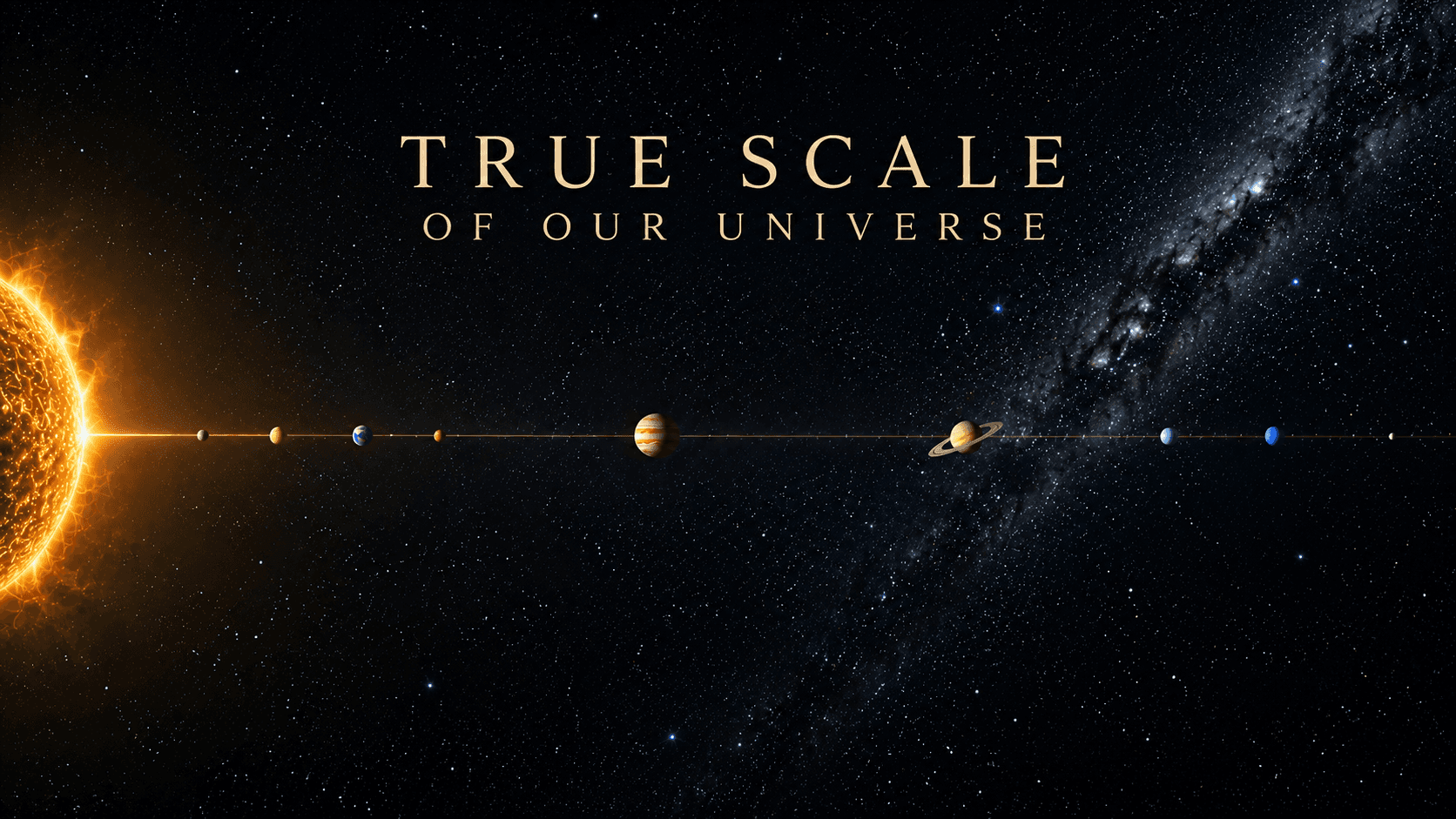
Step outside on a clear afternoon and hold your hand up to the Sun. The warmth you feel is real, but it is not current. That light left the Sun's surface about eight minutes and twenty seconds ago, crossed roughly 93 million miles of nothing, and only just arrived. If the Sun had somehow switched off while you were reading this paragraph, you would have no way to know for another eight minutes.
Now keep going. Send that same beam of light past Mars, where it arrives about thirteen minutes old. Past Jupiter, where it is more than forty minutes old. Out to Neptune, the last major planet, where sunlight shows up more than four hours after it left home, so faint that local noon would look to us like deep dusk.
The solar system is almost entirely empty space, and the only honest way to feel its size is to stop counting miles and start counting time.
The Sun You See Is Always in the Past
Light is the fastest thing there is, moving at about 186,000 miles per second, and on Earth that speed feels like no delay at all. Flip a switch and the room is lit. The Sun breaks that intuition. It is far enough away that its light takes a noticeable amount of time to reach us, which is why astronomers often describe the Earth-Sun gap not as a distance but as a duration: about eight light-minutes, per NASA.
That reframing is the whole trick. Once you measure space in how long light takes to cross it, the numbers become things a person can actually hold in mind. Mars sits around thirteen light-minutes from the Sun. Jupiter is roughly forty-three. Each of those gaps is millions of miles, but "forty-three minutes" is a lunch break, and that makes the scale suddenly graspable.
It also means every image of the sky is a snapshot of different moments. When Jupiter and Saturn appear near each other, you are seeing Jupiter as it was about three-quarters of an hour ago and Saturn as it was well over an hour ago, stitched into one picture that never actually existed.
Did You Know?
Sunlight is even older than its eight-minute trip suggests. The energy in a single ray was generated by fusion deep in the Sun's core and then spent somewhere between tens of thousands and a few hundred thousand years ricocheting through the Sun's dense interior before it finally reached the surface and made the quick eight-minute hop to Earth.
Four Hours to the Edge of the Planets
Push out to Neptune and the friendly minute-scale numbers give way to hours. NASA puts sunlight's travel time to Neptune at about four hours, and one NASA reference measured from Earth lists Neptune as four light-hours and ten light-minutes away. Because Neptune sits about 30 times farther from the Sun than Earth does, and light thins out with the square of distance, sunlight there is roughly 900 times dimmer than it is here, which is why NASA describes high noon on Neptune as looking like dim twilight.
To make that spacing visible, NASA offers a model: shrink the Sun to the size of a dime and lay the solar system out on a football field. Earth ends up on the 2-yard line. Jupiter reaches about the 10-yard line. Neptune is 60 yards downfield, and tiny Pluto is near the far end zone at 79 yards. Almost the entire field is bare grass. That is the point that flat diagrams hide by squeezing the planets into a tidy row, and it is why the picture changes completely once you see how far apart the planets really are.
The emptiness is not a rounding detail. Add up every planet, moon, asteroid, and comet, and it is a vanishingly small fraction of the space the Sun's gravity governs. The solar system is less a set of worlds with space between them than an emptiness with a few worlds scattered through it.
The Probe That Has Been Falling Away for Fifty Years
The clearest way to feel this scale is to follow something that has actually made the trip. Voyager 1 launched on September 5, 1977, swung past Jupiter and Saturn, and then kept going. It is now the most distant human-made object in existence, moving away from the Sun at about 38,000 miles per hour, which sounds enormous and is still a crawl next to light.
On August 25, 2012, after 35 years of travel, Voyager 1 crossed the heliopause, the boundary where the Sun's outward wind of particles finally gives way to the gas between the stars. That crossing is the usual marker for leaving the Sun's bubble. Even so, a radio signal from Voyager 1 now takes more than 22 hours to reach Earth, and on November 18, 2026, the spacecraft will pass a milestone NASA has been counting toward: one full light-day from Earth, a distance of about 16 billion miles. Nearly fifty years of continuous flight to put a single day of light-travel between us and the probe.
Did You Know?
Voyager 2 left the Sun's bubble in November 2018, about six years after its twin, and it crossed at almost the same distance from the Sun, roughly 120 times the Earth-Sun gap. The two probes took different routes and departed six years apart, yet the edge of the heliosphere sat at nearly the same distance for both, a closeness that surprised the mission's scientists, who had expected it to shift as the Sun's activity rose and fell.
Past the Planets, the Solar System Barely Begins
Here is the part that undoes most people's mental map. Crossing the heliopause is not the same as reaching the edge of the solar system. Far beyond it lies the Oort Cloud, a vast shell of icy bodies loosely bound to the Sun that is thought to begin around 1,000 times the Earth-Sun distance and stretch out perhaps a hundred times farther than that.
Voyager 1, for all its speed and all its decades, will take roughly 300 years just to reach the inner edge of that cloud, and something like 30,000 years to pass through it. Only then is it truly clear of the Sun's gravity.

And the nearest star after our own, Alpha Centauri, is about 4.3 light-years away, a gap so large that Voyager would need tens of thousands of years to cross it, if it were even headed that way. The space between stars makes the space between planets look crowded. It is a useful thing to remember whenever a headline makes the galaxy sound busy, or describes what falling into a distant black hole would actually do to you as though such a place were nearby. Even the violent, crowded-sounding corners of the universe are mostly separated by distances light itself struggles to cross in a human lifetime.
What the Time Measurement Actually Buys You
Measuring the solar system in light-time does not shrink it. It does the opposite: it forces the scale into a unit small enough to reason about, then shows how many of those units pile up. Eight minutes to Earth. Four hours to Neptune. A full day, after fifty years of flight, to Voyager 1. Centuries to the Oort Cloud. Years of pure light-travel to the next star. The planets we obsess over, including the strange ones like Neptune with its moons shaped by an ancient collision, are rare islands in a system that is overwhelmingly, almost perfectly, empty.
Knowlegic Perspective
There is a reason almost every diagram of the solar system is wrong. The planets are easy to draw; the emptiness is not. Fit Neptune's true distance on the page and the inner planets collapse into a single dot. So we get the tidy row of evenly spaced worlds, and we quietly absorb the idea that the solar system is a place with things in it.
Switching to light-time is a small correction with a large payoff. It keeps the distances in a unit the mind can carry, minutes and hours and days, while making it impossible to ignore how many of them separate one object from the next. The solar system stops being a diagram and becomes what it actually is: a handful of specks, a long way apart, drifting through a great deal of nothing.
The sunlight on your hand is eight minutes old; Neptune's is more than four hours old. The solar system is almost entirely empty space, and the only honest way to feel its size is to stop counting miles and start counting time.
Sources & References
- How Big Is the Solar System?, NASA Science (2024)
- Cosmic Distances, NASA Science (2024)
- Neptune: Facts, NASA Science (2024)
- Voyager 1: What Is a Light-Day, NASA Science (2025)
- Voyager - Frequently Asked Questions, NASA Jet Propulsion Laboratory (2026)
- The Voyage to Interstellar Space, NASA (2022)
- Oort Cloud and Scale of the Solar System (Infographic), NASA Science (2013)
Enjoyed this?
Get notified when a new Knowlegic story worth knowing is published.


