

Neptune's Moons and the Ancient Collision That Made Them
Two tiny moons around Neptune are carrying minerals that appear to have formed deep inside much larger worlds. The clue may be evidence of a cosmic collision billions of years ago.
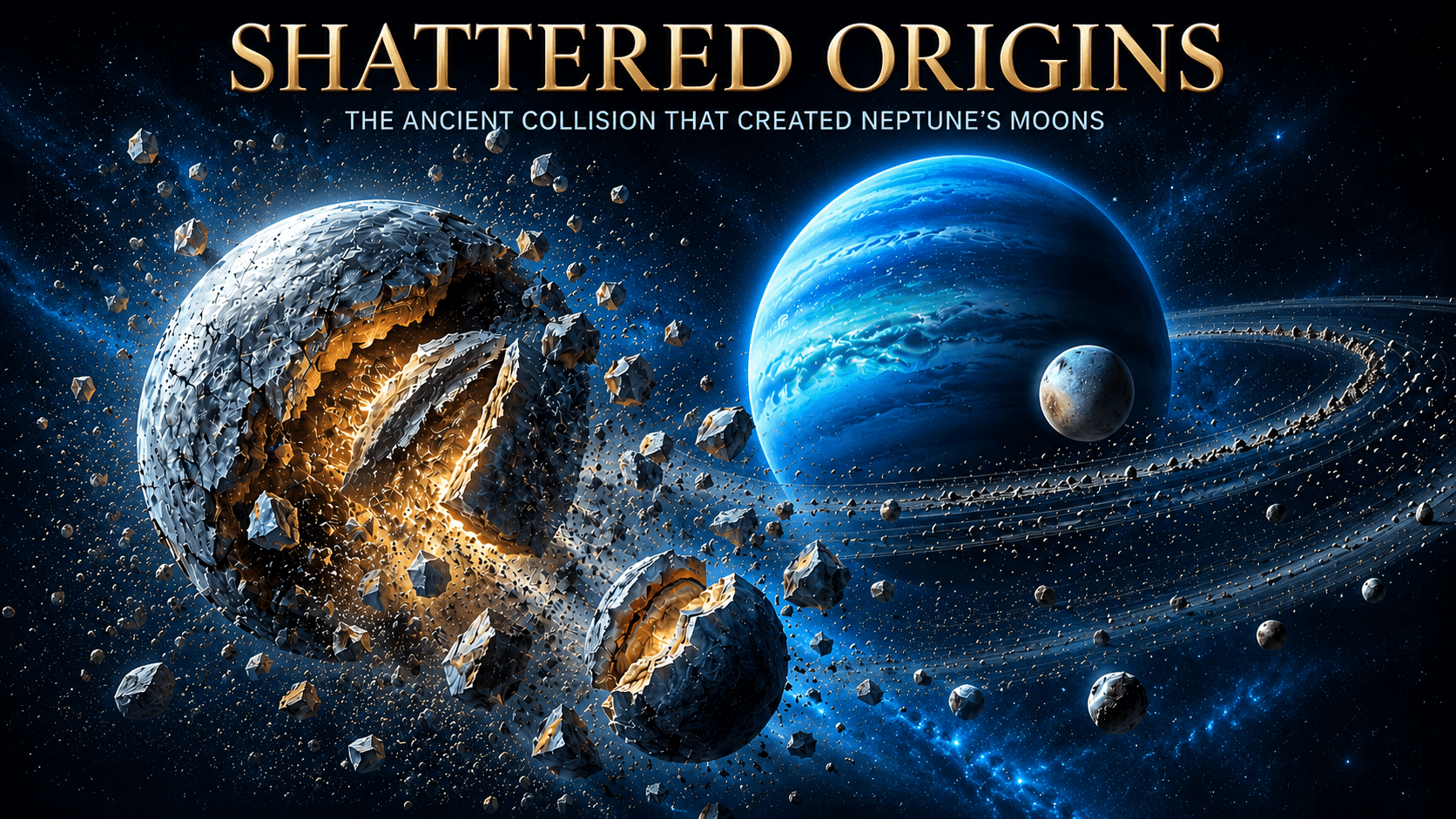
Three of Neptune's small inner moons have just given scientists an extraordinary glimpse into worlds that may no longer exist.
Using the James Webb Space Telescope, researchers observed Larissa, Galatea, and Proteus, along with Neptune's rings. They found an unexpected chemical signature: magnesium-rich phyllosilicates, a family of clay minerals associated with prolonged interaction between rock and liquid water.
There's a problem.
These moons are far too small to have generated the conditions needed to form those minerals deep inside themselves.
So where did the material come from?
The leading explanation reaches back billions of years, to a time when Neptune may have captured its enormous moon Triton.
That event could have destroyed an earlier generation of Neptune's moons.
And today's small moons and rings may be the surviving debris.
In other words, Webb may have found chemical fingerprints from worlds that were destroyed billions of years ago.
A Chemical Signature That Shouldn't Be There
Clay sounds ordinary.
On Earth, we encounter it everywhere.
But finding certain clay minerals around Neptune is anything but ordinary.
The JWST observations revealed a 2.72-micron absorption feature associated with magnesium-rich phyllosilicates. These minerals are evidence of aqueous alteration, chemical reactions between rock and liquid water.
That matters because the environment around Neptune is extraordinarily cold.
The small moons studied by Webb show no evidence of surface water ice, yet they carry signatures indicating that their material was once exposed to conditions involving liquid water.
So scientists are left with a puzzle:
How did material formed deep inside a warm, water-rich body end up on tiny, cold moons orbiting Neptune?
The answer may be violent.
Webb Became the Detective
The discovery was possible because JWST doesn't simply take pretty pictures.
Its instruments can split incoming light into different wavelengths.
That spectrum acts like a chemical fingerprint.
Different materials absorb and reflect specific wavelengths of light. By studying those patterns, researchers can work backward to determine what a distant surface contains.
For Neptune's faint inner moons, that was especially important.
Their tiny size and proximity to the much brighter Neptune made them extremely difficult targets.
The 2026 study provided the first near-infrared spectroscopic observations of these three moons, allowing researchers to investigate their composition in a way that hadn't previously been possible.
And the result was unexpected.
The researchers weren't simply finding more ice.
They were seeing evidence of material that appears to have come from inside a much larger body.
Did You Know?
The minerals found by Webb had not previously been detected in this way on small outer-solar-system bodies beyond Jupiter.
That's part of what made the observation so surprising.
The researchers weren't looking at the remains of a normal icy surface.
They may have been looking at exposed interior material, the kind normally buried beneath kilometers of rock and ice
Enter Triton
To understand the mystery, we need to look at Neptune's largest moon.
Triton is strange.
Unlike most large moons in the solar system, it orbits Neptune in the opposite direction to Neptune's rotation.
Astronomers call this a retrograde orbit.
That unusual orbit is one of the strongest clues that Triton didn't form alongside Neptune.
Instead, scientists think Triton was probably a Kuiper Belt object captured by Neptune's gravity.
NASA describes Triton as sharing several characteristics with Pluto, supporting the idea that the moon may have originated much farther from Neptune before being captured.
But capturing a world as large as Triton wouldn't have been a quiet event.
Its arrival could have dramatically disturbed Neptune's existing satellite system.
The Moon That Wrecked the Neighborhood
Imagine Neptune billions of years ago.
Instead of the strange collection of moons we see today, it may once have had a more conventional system of larger satellites.
Then Triton arrived.
Its gravitational interaction with Neptune could have destabilized those original moons.
Some may have collided.
Some may have been thrown out.
Others may have been broken apart.
NASA has previously described the idea that Triton's capture tore up Neptune's original satellite system, with debris later re-forming into a new generation of smaller moons.
The 2026 JWST findings add something new to that story:
chemical evidence that may actually come from inside those destroyed worlds.
From Wreckage to New Moons
Here's the key idea.
Suppose Neptune once had several large icy moons.
Those worlds could have become warm enough internally for liquid water to interact with rock.
Over long periods, that chemistry could have produced hydrated minerals such as phyllosilicates.
Then Triton's capture destabilized the system.
The moons were shattered.
Their interiors were exposed.
Fragments spread throughout the region around Neptune.
Eventually, some of that debris came back together.
And from that wreckage emerged the smaller moons and rings we see today.
It's a little like finding pieces of an old building inside a pile of rubble.
The rubble didn't construct the original building.
It remembers what the building used to be.
But There's an Important Caveat
This isn't a solved mystery.
The researchers favor the idea that Neptune once had a larger original moon system that was destroyed during Triton's capture.
But they also identify another possibility:
A large Kuiper Belt object, perhaps comparable in scale to Pluto, could have passed close enough to Neptune to be tidally torn apart.
Either scenario would explain the same fundamental observation:
The clay-bearing material appears to have come from somewhere much larger.
So the JWST observation doesn't prove exactly which catastrophe happened.
It gives scientists a powerful clue about the material's origin and narrows the possible histories of Neptune's moons.
Why Proteus Matters
One of the most interesting parts of the observation is what Webb didn't find.
Proteus- the largest of the three moons studied, did not show the same magnesium-rich phyllosilicate signature.
That difference matters because it suggests that Neptune's small moons may not all have formed from exactly the same material or in exactly the same way.
Caltech researchers suggest Proteus may have reaccreted from a different part of the debris field or experienced later processing that altered or removed the mineral signature.
So even the wreckage has a history.
Not every fragment ended up carrying the same evidence.
The Solar System Keeps Its Evidence
There's something beautifully strange about planetary science.
A violent event can happen billions of years ago, then disappear from view.
The worlds involved may be destroyed.
Their fragments may scatter.
And yet a chemical signature can survive.
Waiting for an instrument sensitive enough to notice it.
That is what makes Webb so valuable.
It isn't only allowing us to see farther.
It's allowing scientists to read evidence that has been sitting in plain sight or rather, in plain darkness for billions of years.
Neptune's small moons may have looked like debris.
Instead, they could be pieces of a much larger story.
Knowlegic Perspective
This discovery is fascinating because the moons themselves aren't necessarily the main story.
The evidence they're carrying is.
For billions of years, Neptune's inner moons looked like relatively insignificant pieces of rock.
But JWST's spectroscopic instruments effectively asked a different question:
What are these objects actually made of?
The answer revealed something much bigger.
Their chemistry may be giving us access to the interiors of ancient icy worlds that were destroyed long before humans existed.
Normally, the interior of a differentiated moon is inaccessible. Its deepest materials remain buried beneath layers of rock and ice.
A cosmic collision changes that.
Break the world apart, and its interior can become its surface.
That is what makes this discovery so powerful.
We're not simply observing the aftermath of an ancient collision.
We may be looking directly at material that the collision exposed.
Two tiny moons around Neptune contain evidence that appears to have originated inside much larger, water-altered worlds.
Those worlds may have been destroyed when Triton was captured by Neptune.
Their fragments may have collided, scattered, and eventually reassembled into the small moons and rings we see today.
We don't yet know every detail of that ancient catastrophe.
But the chemistry gives scientists something remarkable:
a physical clue from inside a world that no longer exists.
And sometimes, that's all science needs to reopen a billion-year-old mystery.
Sources & References
https://www.science.org/doi/10.1126/sciadv.aeb1437
https://www.sciencedaily.com/releases/2026/08/260813045545.htm
https://phys.org/news/2026-07-neptune-moons-shattered-ancient-icy.html
https://phys.org/news/2026-07-neptune-tiny-moons-story-triton.html
Enjoyed this?
Get notified when a new Knowlegic story worth knowing is published.


