

What Actually Happens If You Fall Into a Black Hole?
What happens if you fall into a black hole? Discover spaghettification, event horizons, NASA's black hole simulation, and the physics still left unexplained.
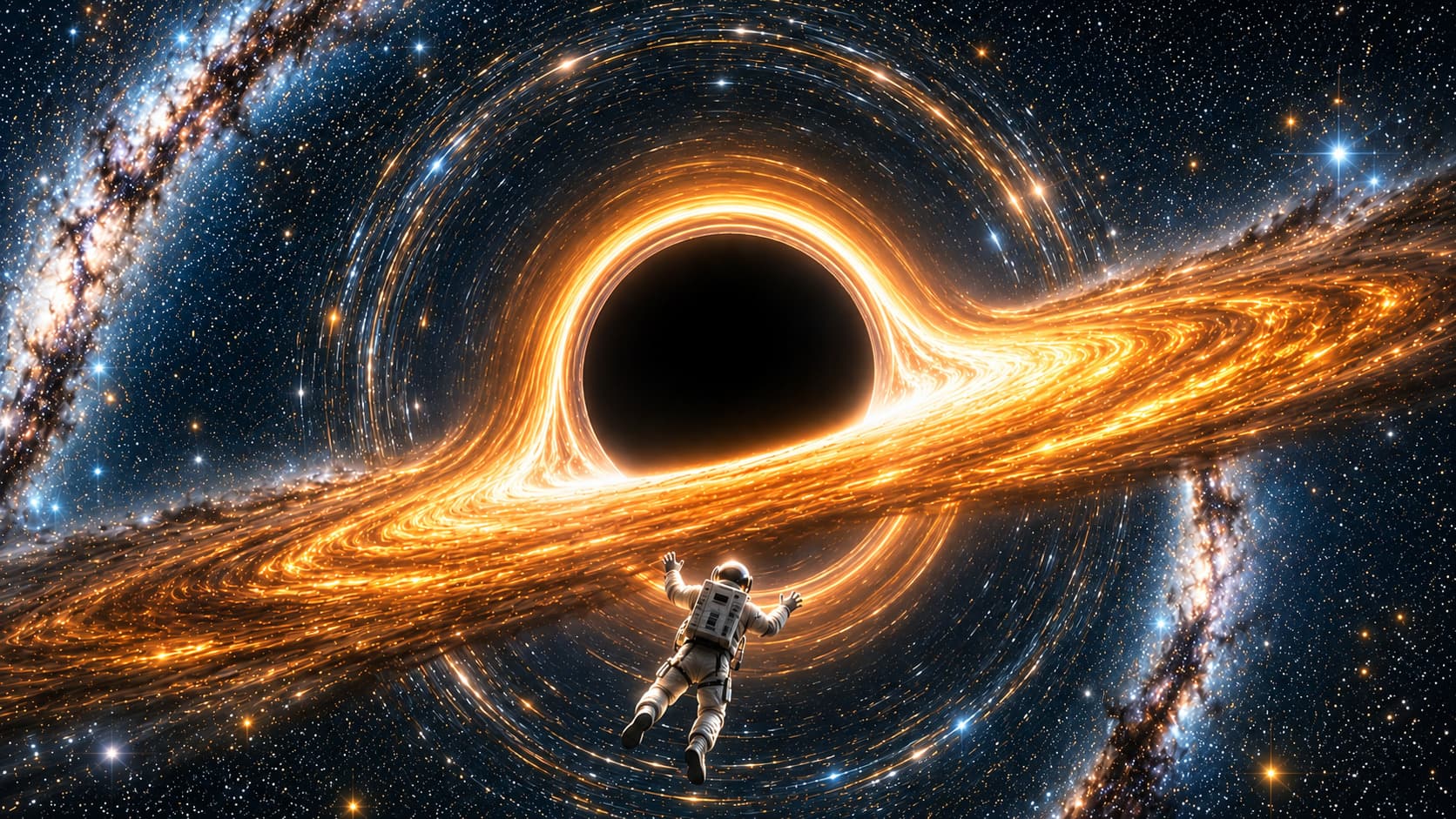
Imagine falling toward a black hole.
You might expect the same terrifying fate described in movies: crossing an invisible boundary and being instantly destroyed.
But physics gives a much stranger answer.
Fall toward a small, stellar-mass black hole, and tidal forces could stretch you apart before you even reach the event horizon.
Fall toward a supermassive black hole, and you could cross that same boundary without noticing anything unusual at all.
NASA has even simulated what the journey would look like near the supermassive black hole at the center of our galaxy.
And beneath this surprisingly well-understood picture lies one of physics' deepest unresolved problems:
what really happens at the event horizon when Einstein's theory of gravity meets quantum mechanics?
The Size of the Black Hole Decides Your Fate
The force responsible for stretching objects near a black hole is called spaghettification.
The name sounds almost playful.
The physics isn't.
Gravity becomes stronger the closer you get to a black hole. But it doesn't pull equally on every part of your body. Your feet, for example, would experience stronger gravity than your head.
That difference creates an enormous tidal force.
You are stretched lengthwise while being compressed from the sides much like Earth's oceans experience tides from the Moon, except under vastly more extreme conditions.
Here's the surprising part:
The smaller the black hole, the sooner this happens.
Around a stellar-mass black hole, the gravitational gradient near the event horizon can be so extreme that you'd be torn apart before crossing it.
Around a supermassive black hole, the event horizon is much farther from the central singularity. The tidal forces at the horizon can therefore be surprisingly gentle.
You could cross it intact.
The destruction would come later.

What Would Someone Watching You See?
Now things get weird.
Imagine someone watching your fall from a safe distance.
They would never actually see you cross the event horizon.
As you approach the horizon, extreme gravity causes time to pass differently relative to the distant observer. Your signals become increasingly delayed, your light shifts toward redder wavelengths, and your image becomes progressively dimmer.
From their perspective, you appear to slow down and fade near the edge.
It can look as though you are frozen just outside the horizon.
But that's not what you experience.
What You Would Actually Experience
From your own perspective, things are very different.
You don't suddenly feel time slowing down.
You don't see yourself freeze.
And, if you're falling into a sufficiently massive black hole, crossing the event horizon may not produce any dramatic local sensation at all.
You simply continue falling.
Eventually, however, tidal forces become overwhelming.
And unlike the distant observer's perspective, your own journey to the black hole's center takes a finite amount of your own time.
Both descriptions are correct.
That's one of the strangest consequences of relativity: two observers can describe the same event in radically different ways without either being wrong.
NASA Simulated the Fall
This isn't only a thought experiment.
In 2024, NASA astrophysicist Jeremy Schnittman and colleagues used the agency's Discover supercomputer to simulate a camera falling toward a black hole roughly comparable to Sagittarius A*, the supermassive black hole at the center of our galaxy.
Sagittarius A* has a mass of about 4.3 million Suns, with an event horizon spanning roughly 16 million miles.
In the simulation, the camera crosses the event horizon and survives for another 12.8 seconds before being destroyed by tidal forces.
During that brief interval, it travels roughly another 79,500 miles toward the singularity.
The computational effort was extraordinary.
The simulation tracked more than 500 billion individual light rays bending through warped spacetime. It produced around 10 terabytes of visual data and took roughly five days to render using a fraction of the supercomputer's more than 129,000 processors.
The result gives us something remarkable:
A visual journey through an environment humans could never safely experience themselves.
NASA simulation: A virtual camera plunges into a supermassive black hole, showing how light and spacetime appear to behave near and beyond the event horizon.
Video Link:https://svs.gsfc.nasa.gov/14576
And Then Physics Hits a Wall
The classical picture seems remarkably clear.
But there's a problem.
Black holes sit at the intersection of two enormously successful theories:
General relativity, which describes gravity and spacetime.
Quantum mechanics, which describes the behavior of matter and information at microscopic scales.
And when physicists try to make both theories work together around an evaporating black hole, they encounter a deep contradiction.
One proposed solution is particularly dramatic.
It's called the firewall hypothesis.
Instead of the event horizon being a locally uneventful boundary, perhaps an enormous wall of high-energy radiation exists there—destroying anything that crosses it.
That would contradict the smooth horizon predicted by classical general relativity.
There is no universally accepted resolution.
Physicists have proposed multiple competing explanations, but the fundamental disagreement remains.
So when we say a person could cross a supermassive black hole's event horizon without noticing anything unusual, there's an important qualifier:
That's what classical general relativity predicts.
The deeper quantum description remains an open question.
Two Black Holes. Two Very Different Fates
So, what actually happens if you fall into a black hole?
It depends.
Stellar-Mass Black Hole
Tidal forces can become extreme before you reach the event horizon.
You could be spaghettified before crossing the boundary.
Supermassive Black Hole
The event horizon can be comparatively gentle.
You could cross it intact and continue falling.
Eventually, tidal forces win.
But the deeper mystery isn't how you die.
It's what the event horizon really means when our two greatest physical theories are forced to describe the same place.
Knowlegic Perspective
This is what makes black holes so fascinating.
The science isn't simply a story of things we don't understand.
In many respects, we understand the classical physics extraordinarily well.
We can calculate the forces.
We can model the distorted spacetime.
We can simulate the journey.
We can even render the bending of individual light rays.
And yet, right at the boundary between gravity and quantum mechanics, our best theories stop agreeing.
The black hole is not just a place where matter disappears. It's a place where our understanding of reality is tested.
The strangest thing about falling into a black hole isn't that you'd eventually be destroyed.
It's that the moment of crossing the point of no return may feel completely ordinary.
To someone watching from far away, you'd appear to slow and fade.
To you, you'd simply keep falling.
And somewhere beyond that apparently quiet boundary lies a problem that physics still hasn't solved:
Can general relativity and quantum mechanics both be right?
Perhaps that's the real reason black holes fascinate us.
They don't merely show us where matter, light, and time behave strangely.
They show us where our understanding of the universe begins to break.
Enjoyed this?
Get notified when a new Knowlegic story worth knowing is published.


